EN
EN
 Stunning views
 Off-mountain activities
 Classic mountain charm
 Best amenitiesStunning viewsOff-mountain activitiesClassic mountain charmBest amenitiesStunning viewsOff-mountain activitiesClassic mountain charmBest amenitiesStunning viewsOff-mountain activitiesClassic mountain charmBest amenities
Alpe di Siusi, also known as Seiser Alm, is the largest high-altitude alpine meadow in Europe, a vast, gently rolling plateau sitting at around 1,850m in the heart of the South Tyrolean Dolomites in Italy. The scale is extraordinary: 56 square kilometres of open grassland, scattered mountain huts, and cross-country trails, framed by two of the most recognisable mountain groups in the Alps, the Sassolungo and the Sciliar, both part of a UNESCO World Heritage site. In winter the meadow becomes one of the most striking ski landscapes anywhere, set against the rock faces of the Dolomites, where the skiing is relaxed and unhurried and the whole area is almost entirely car-free.
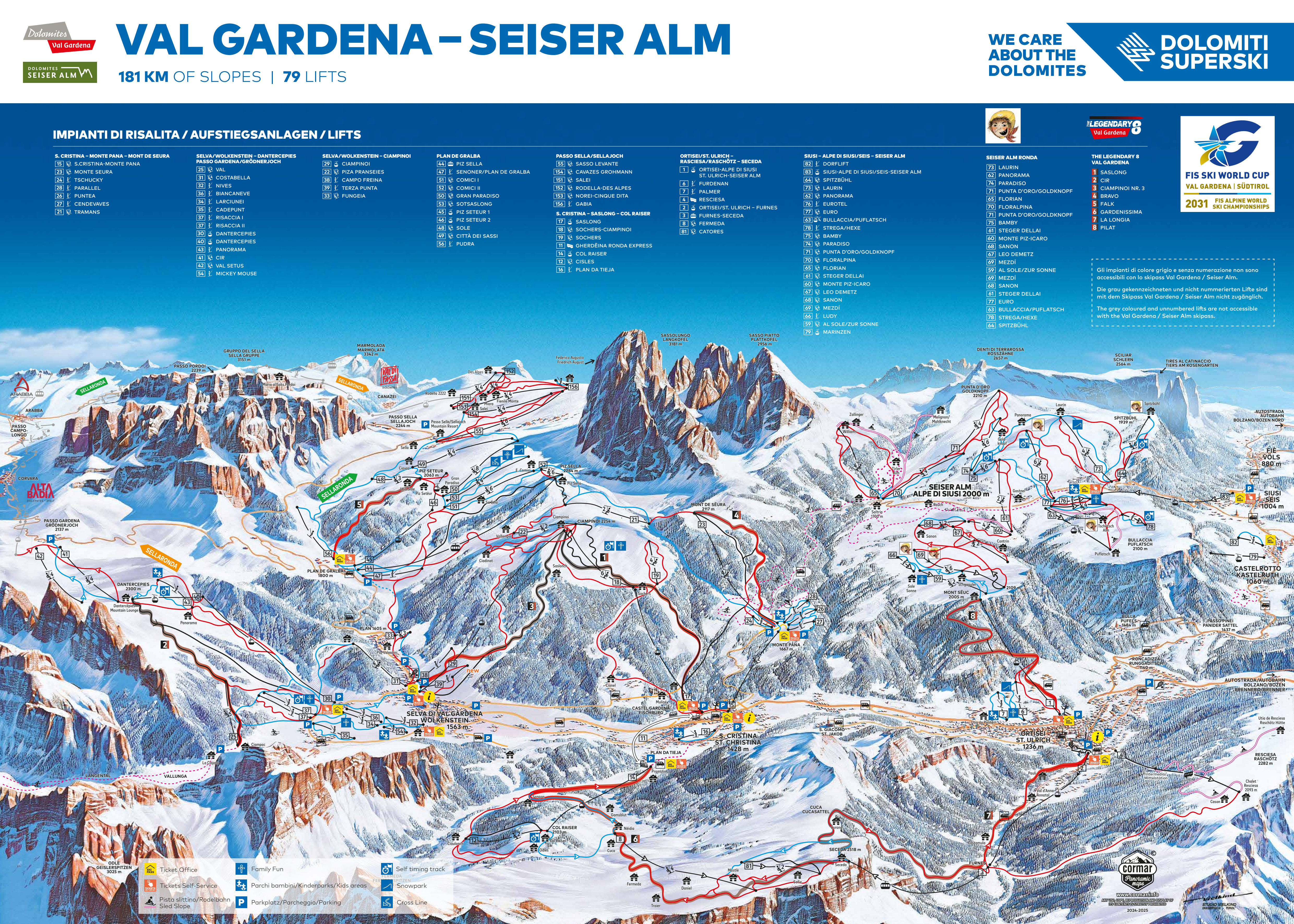
The Alpe di Siusi ski area forms part of the broader Val Gardena-Alpe di Siusi domain, which together covers around 181km of pistes across 188 runs, reaching a summit of 2,500m. Alpe di Siusi itself has around 60km of mostly gentle, sunny pistes spread across the plateau and its surrounding slopes, with wide blues and easy red runs for some of the most enjoyable cruising in the Dolomites. For more challenging terrain, the lifts drop down into Val Gardena's longer, steep pistes, including the famous Saslong World Cup downhill course at Santa Cristina. The Dolomiti Superski pass extends access even further, to over 1,200km of pistes across the wider Dolomite. Thanks to the altitude and extensive snowmaking, the season runs reliably from early December through early April.
Down below the plateau sits the pretty village of Castelrotto, with painted house fronts, a landmark church bell tower, and traditional family-run inns. The plateau above is largely car-free, reached by cable car from Siusi or the Val Gardena side, and protected as a nature park. There’s a bilingual Italian-German culture that runs through this corner of South Tyrol, and food and culture is half the appeal: the plateau is dotted with dozens of welcoming mountain huts serving traditional cooking where a long lunch with a Dolomites view is as much a part of the day as the skiing. Add in winter walking and snowshoeing across the meadow, sledging runs, and one of Europe's biggest cross-country networks, and there's plenty here beyond the downhill.
Check out Alpe di Siusi ski deals to start planning your trip.
Alpe di Siusi, also known as Seiser Alm, is the largest high-altitude alpine meadow in Europe, a vast, gently rolling plateau sitting at around 1,850m in the heart of the South Tyrolean Dolomites in Italy. The scale is extraordinary: 56 square kilometres of open grassland, scattered mountain huts, and cross-country trails, framed by two of the most recognisable mountain groups in the Alps, the Sassolungo and the Sciliar, both part of a UNESCO World Heritage site. In winter the meadow becomes one of the most striking ski landscapes anywhere, set against the rock faces of the Dolomites, where the skiing is relaxed and unhurried and the whole area is almost entirely car-free.
The Alpe di Siusi ski area forms part of the broader Val Gardena-Alpe di Siusi domain, which together covers around 181km of pistes across 188 runs, reaching a summit of 2,500m. Alpe di Siusi itself has around 60km of mostly gentle, sunny pistes spread across the plateau and its surrounding slopes, with wide blues and easy red runs for some of the most enjoyable cruising in the Dolomites. For more challenging terrain, the lifts drop down into Val Gardena's longer, steep pistes, including the famous Saslong World Cup downhill course at Santa Cristina. The Dolomiti Superski pass extends access even further, to over 1,200km of pistes across the wider Dolomite. Thanks to the altitude and extensive snowmaking, the season runs reliably from early December through early April.
Down below the plateau sits the pretty village of Castelrotto, with painted house fronts, a landmark church bell tower, and traditional family-run inns. The plateau above is largely car-free, reached by cable car from Siusi or the Val Gardena side, and protected as a nature park. There’s a bilingual Italian-German culture that runs through this corner of South Tyrol, and food and culture is half the appeal: the plateau is dotted with dozens of welcoming mountain huts serving traditional cooking where a long lunch with a Dolomites view is as much a part of the day as the skiing. Add in winter walking and snowshoeing across the meadow, sledging runs, and one of Europe's biggest cross-country networks, and there's plenty here beyond the downhill.
Check out Alpe di Siusi ski deals to start planning your trip.
Skiing and snowboarding on the Alpe di Siusi means wide, sunny pistes rolling across an open plateau, with traditional mountain huts dotted between the runs and the sheer rock walls of the Sassolungo and Sciliar rising on either side. The runs are broad and well-groomed, and because the plateau sits slightly apart from Val Gardena's main network, the slopes here stay noticeably quieter, so there's room to find your rhythm without dodging the crowds, even on a busy week. At an average altitude of 1,850m, the snow stays reliable through the season, and the largely south-facing slopes get plenty of sun. Getting around is quick and comfortable: big gondolas carry you up from Siusi and Ortisei, and the plateau's lifts are modern, many of them heated bubble chairs, so cold, slow rides are rare.
The local 60km suits beginners and intermediates particularly well, with gentle blues across the plateau and wide, rolling reds on the surrounding slopes, plus a small number of steeper pitches for stronger skiers to open up. Beyond that, the combined Val Gardena-Alpe di Siusi domain gives 181km on a single pass, a full week's skiing for any level. From the plateau's eastern edge, lifts link across into Val Gardena, where the terrain turns longer and steeper, including the famous Saslong World Cup downhill course and the entry point to the Sellaronda, the classic full-day circuit of the Sella massif. For even more, the Dolomiti Superski pass opens up over 1,200km of pistes across the wider Dolomites, enough varied terrain to ski somewhere different every day for a fortnight.
Alpe di Siusi is one of the finest places in the Dolomites to learn to ski. The plateau's wide, gently graded runs are made for building confidence, with forgiving gradients, plenty of space, and scenery so good that even your first tentative turns feel like an occasion. The open layout helps as much as the gradients do: there are no sudden steep pitches or narrow bottlenecks to catch you out, and with very few trees on the plateau, beginners have room to make mistakes safely. The largely car-free setting keeps everything calm and unhurried, which takes a lot of the pressure out of the early days.
Most people start at the Spitzbühl beginner area, with its gentle slopes and magic-carpet lifts, or at the practice area by the Ludy tow lift, both served by the resort's two well-regarded ski schools. From there, the step up to longer blues comes quickly and naturally. Within a few days, many beginners are cruising gentle runs like the Panorama, which winds right through the heart of the plateau between the mountain huts, with plenty of sunny terraces to stop at for lunch and the Sassolungo filling the skyline.
WeSki insider tip: Once you've found your feet, make the Bullaccia (Puflatsch) sector your next goal. The blue runs up here are some of the gentlest on the plateau, the area catches the sun, and a couple of the best-loved mountain huts sit right by the pistes, so you can reward a morning's progress with a proper South Tyrolean lunch and one of the finest views in the Dolomites.
Intermediates are arguably the biggest winners at Alpe di Siusi. The plateau's flowing blue runs are wide, well-groomed, and made for long, sweeping turns, building speed and confidence with the Dolomite towers as a constant backdrop. When you're ready to push on, the runs dropping from the Punta d'Oro and Bullaccia areas carry a bit more pitch and make a natural next step, and the connection into Val Gardena opens up plenty more besides.
The link into Val Gardena is what gives an intermediate week here real variety. Crossing over to the Selva and Santa Cristina side brings longer red runs with proper gradient, and the entry point to the Sellaronda, the classic tour right around the Sella massif and one of the great intermediate days out in the Alps. Across the combined 181km domain, there's more than enough to fill a full week without skiing the same run twice.
WeSki insider tip: Set aside a day to ski the Sellaronda. The full loop around the Sella massif is a proper adventure, four valleys, a string of villages, and constantly changing Dolomite scenery, all linked by lifts and pistes and very doable for a steady intermediate. Pick the clockwise (orange) or anti-clockwise (green) direction, start reasonably early so you're not chasing the last lifts, and build in a long lunch at a mountain rifugio along the way.
The plateau itself is gentle by nature, so there's only a little properly steep terrain up here, a short black run on the Bullaccia and a few sharper pitches, but the wide, fast pistes are still good fun to open up if you like carving at speed. For a real test, the best advice is to head over to the Val Gardena side, where the terrain gets genuinely steep. The Ciampinoi sector above Selva has well-pitched reds and blacks, and the Saslong, the famous World Cup downhill, is a serious run with sustained gradient and real racing pedigree.
The Dolomiti Superski pass widens the field a long way further. From the Val Gardena lift system you can reach the steeper runs at Arabba and Corvara, the itinerary routes around the Sella massif, and the Marmolada glacier, the highest point in the Dolomites at 3,343m, with a top-to-bottom descent of well over 1,000m vertical. For off-piste, the terrain around the Sassolungo and the Sella towers, and the Val Duron behind the plateau, holds some excellent steep, powdery lines, best explored with a guide who knows where the snow is sitting. In short, strong skiers will find their challenge across the wider Dolomites, with the plateau itself making a relaxed home base to return to.
WeSki insider tip: Alpe di Siusi has something most resorts don't, free public speed-check and race runs dotted around the plateau. Test yourself on the auto-timed speed track at Goldknopf (Punta d'Oro), where strong skiers regularly clock over 100km/h, or race the clock on the parallel course by the Hexe lift.
Alpe di Siusi is a rewarding mountain for snowboarders, and the open plateau plays to a board's strengths. The wide, gently rolling pistes give you space to lay out long, clean carves, there are natural rollers and banks scattered across the terrain to pop off and play with, and the gondola-and-chairlift setup means very few draglifts to break up your run. Gentle gradients also make it one of the more forgiving places to learn on a board, with room to find your edges without fighting steep or crowded slopes.
What really puts Alpe di Siusi on the map for riders is the Snowpark Seiser Alm (King Laurin). Stretching 1.5km across the plateau with around 70 features, the layout runs from an Easy and Family line for first-timers, through a Medium line, up to a Pro line with big kickers for serious freestylers. When you fancy a change, the Val Gardena connection adds steeper runs and the freeride terrain around the Sella and Sassolungo for riders wanting to venture further.
Off-piste isn't the main event on the Alpe di Siusi itself. The plateau's gentle, rolling shape means there's little steep terrain to drop into, and its protected nature-park status limits where you can ski off the marked runs. For proper freeride, the Val Gardena connection is where you should head, opening up the couloirs and itinerary routes around the Sella group, the steeper lines above the treeline, and the terrain beneath the Sassolungo.
With a Dolomiti Superski pass, the options widen further still, out to the Marmolada glacier and beyond. The Dolomites are serious, glaciated mountains, so take a local guide for any off-piste day: they'll find the best snow and keep you safely on the right side of the terrain.
Several ski schools operate on the plateau and in the base villages, running group and private lessons for all ages and abilities. English-speaking instructors are readily available, so booking lessons is straightforward whatever your level, and the schools cater to everyone from first-timers to skiers polishing their technique.
Beyond standard ski lessons, the choice of specialist tuition is unusually broad. The long-established Seiser Alm Ski School, with over 80 instructors, runs snowboarding, telemark, and freestyle coaching, guided freeride and ski-touring days into the wider Dolomites, cross-country lessons in both classic and skating styles, and even snow-kiting and adaptive lessons for skiers with disabilities.
Freestyle is one of Alpe di Siusi's real strengths, thanks to the Snowpark Seiser Alm (also known as King Laurin), one of the best and biggest terrain parks in the Dolomites. Stretching 1.5km across the plateau with around 70 features, it has been voted Italy's best park several times over and has ranked among the world's top freestyle resorts. The layout is fully progressive: an Easy and Family line for first-timers and children, a Medium line to build on, and a Pro line with big kickers for advanced riders, plus a distinctive Wood line with obstacles built entirely from timber.
For a change of scene, the wider Val Gardena and Dolomiti Superski network adds further parks, including the Snowpark Piz Sella, all reachable on the linked lift system. But with one of the Dolomites' finest parks right on the plateau, most riders won't need to go looking.
Alpe di Siusi is a natural fit for a family ski holiday. The plateau is wide, gentle, and almost entirely car-free, and parents can relax knowing the whole area is calm and contained. The combination is irresistible: a safe ski environment for children during the day, and the South Tyrolean base villages for evening atmosphere, with excellent restaurants, wellness hotels, and the warm charm that makes South Tyrol so appealing. Accommodation quality is typically high and the region's family-friendliness is deeply embedded in the culture.
Younger children can thrive here, with well-equipped nursery areas, a children's fun park, and ski schools that take little ones from around age three, including the Yeti Club kids' area at Saltria. As they progress, gentle blue runs across the plateau give them room to build confidence, and the wide, forgiving terrain means mixed-ability families can happily ski together and meet at a hut for lunch. Older children and teenagers have plenty to grow into, from the King Laurin snowpark for budding freestylers to the steeper runs and the Sellaronda circuit over on the Val Gardena side once they're skiing confidently.
Off the slopes, there's lots to fill the non-skiing hours, from toboggan runs and horse-drawn sleigh rides to snow play areas and winter walks into the nature park. Down in the base village of Castelrotto, the family-run hotels are a hit, many with pools and spas to unwind in after a day out. With mountain huts dotted across the plateau for easy lunch stops and the Dolomites filling every view, it's an easy place to spend a family week on the snow. Restaurants are warm and welcoming to children, serving hearty South Tyrolean cooking that kids dig into happily after a day in the cold.
Between the vast plateau, the Dolomite nature park, and the South Tyrolean villages below, there's plenty to do here beyond the downhill skiing. The plateau and its surroundings offer an exceptional range of winter activities, while the villages and the wider Bolzano area bring real cultural and culinary depth to a rest day.
Eating well is a big part of any day at Alpe di Siusi, and the experience splits between the Almhütten (mountain huts) scattered across the plateau and the restaurants down in the base villages. Having a long lunch at one of the huts will be a holiday highlight, with hearty South Tyrolean cooking and the Sassolungo or Sciliar filling the view from sun terraces while you eat.
In the evening, the base villages are where to head for dinner, and Castelrotto in particular has several impressive restaurants to enjoy. The food throughout is a distinctive South Tyrolean blend of Italian and Tyrolean traditions, where canederli (bread dumplings), spätzle, speck, and strudel sit happily on the menu alongside fresh pasta and a glass of local wine.
WeSki insider tip: Make time for a proper hut lunch and order Kaiserschmarrn, the South Tyrolean classic of fluffy shredded pancake dusted with icing sugar and served with fruit compote. The huts here take real pride in their version, and a few are famous for it.
Après-ski at Alpe di Siusi is relaxed and low-key. As the lifts wind down, the sun terraces of the mountain huts are the natural place to gather, with a Glühwein or a beer in hand and the Dolomite peaks turning rosy in the late light. It's a sociable, unhurried scene, more about settling in for a drink and the view than a loud bar crowd.
Down in the base villages, the evening offers a relaxed mix of options: a drink at a Gasthof bar, a long dinner at a traditional restaurant, or a nightcap in a wood-panelled Stube. Castelrotto has the livelier evening scene of the two villages, with bars and cafés around its handsome main square. For a bigger night out, Ortisei in Val Gardena (about 20 minutes by car) has a wider choice of bars and restaurants and a buzzy pedestrian centre.
Après-ski spots to know:
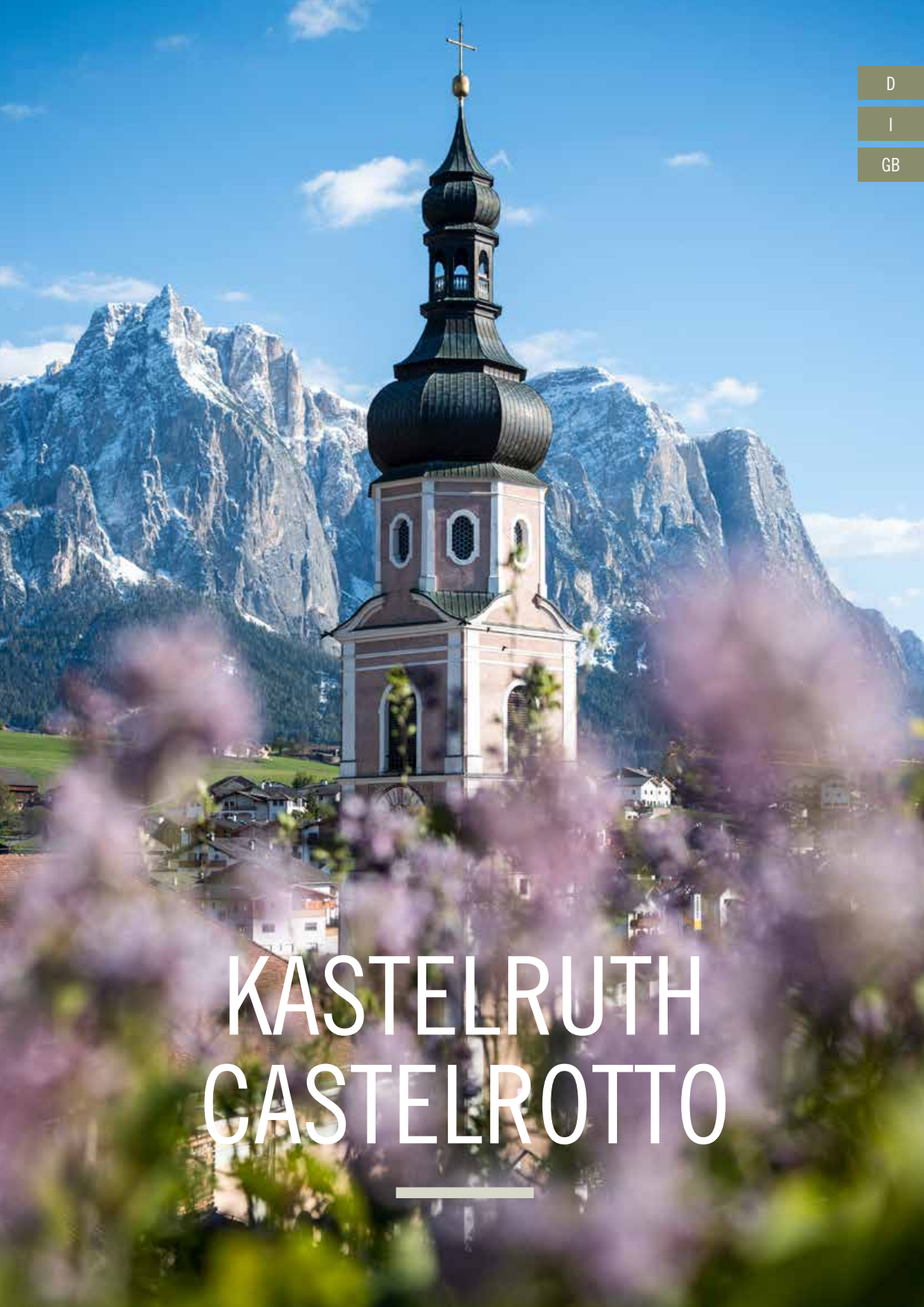
Most accommodation sits in the two valley villages below the plateau, Castelrotto and Siusi, with a handful of properties up on the plateau itself. Staying on the plateau is the most atmospheric option, with snow on the doorstep, direct ski access, and the calm of the car-free setting, though evening options are limited to your hotel and the nearby huts. The villages, by contrast, give you the wider choice of places to stay and easy access to restaurants and bars, with the plateau a short gondola ride away. Of the two, Castelrotto has the livelier evening scene and a broader range of restaurants, while Siusi is quieter and sits right by the gondola up to the slopes.
Wherever you base yourself, the standard of accommodation is high. The choice runs from wellness hotels to family-run Gasthöfe and self-catering apartments, and even modest three-star properties tend to have a sauna, steam room, and sometimes a pool. Half-board is widely available and worth taking, with multi-course dinners that show off South Tyrol's distinctive cooking, and the warm, polished hospitality the region is known for runs right through.
The Val Gardena-Alpe di Siusi pass covers the combined 181km domain across both areas, with all the connecting lifts included, so you can roam freely between the plateau and the longer, steeper terrain over in Val Gardena on a single pass. For the wider Dolomites, the Dolomiti Superski pass opens up over 1,200km across 12 linked areas, taking in the Sellaronda circuit, the Marmolada glacier, Cortina, Alta Badia, and more, enough variety to ski somewhere different every day.
Check for family and multi-day pass options when booking your Alpe di Siusi ski holiday package through WeSki to find the best fit for your trip.
Rental shops in Castelrotto, Siusi, and up on the plateau carry a full range of downhill, cross-country, and snowboard equipment for all abilities. The staff know the local terrain and take the time to match you to the right setup, whether you're after piste skis, a snowboard, or Nordic gear for the cross-country trails, which are a real strength here. It's worth booking ahead during the busier weeks to be sure of getting the setup you want.
The base villages of Castelrotto and Siusi are small and walkable, with shops, restaurants, and cafés clustered around their main squares and easy to reach on foot once you're settled in. To get up to the slopes, the plateau is car-free, reached by the modern Seiser Alm cable car from Siusi, which climbs to Compaccio in around 15 minutes, or by cable car from the Val Gardena side. Once you're up there, you get around on skis during the day, with the lift system carrying you across to Val Gardena and back.
Linking the villages is straightforward. A network of ski buses and shuttle services connects Castelrotto, Siusi, and the cable car base through the season, so you can leave the car behind for the everyday journeys, and local taxi firms are easy to book through your accommodation for anything off the timetable. A car is handy for day trips further afield, to Bolzano, Ortisei, or the other Dolomiti Superski areas, and there's a large free car park at the cable car base in Siusi. The roads in from the A22 Brenner motorway are well-maintained and easy to drive, though winter tyres are essential in snow.
Alpe di Siusi sits in South Tyrol, on the plateau above the valley villages of Castelrotto and Siusi, and is well served by several airports included in WeSki's flight options. Innsbruck, just over the Brenner pass in Austria, is the closest at around 120km (roughly 1h 30m by road). Milan Bergamo (around 255km) and Venice (around 295km) are further south, while Munich (around 300km) lies over the border in Germany, all comfortably manageable with a transfer or hire car. The A22 Brenner motorway runs through the valley below, with the Bolzano Nord and Chiusa exits both serving the resort.
WeSki can sort your travel from the airport, with private transfers and car rental available as part of your booking. Add one to your Alpe di Siusi ski holiday package for door-to-door travel arranged before you arrive.
It's Europe's largest high-altitude alpine meadow, 56 square kilometres of gently rolling terrain at 1,850m, framed by the Sassolungo and Sciliar massifs of the UNESCO Dolomites. The plateau is almost entirely car-free, the cross-country network is one of the finest in the Alps, and the wide, sunny pistes set beneath the Dolomite rock faces make for skiing with a setting few places can rival.
It's one of the best places to learn in the Dolomites. The wide, gentle plateau runs, the calm car-free setting, and well-regarded ski schools give beginners space and confidence, and there are no sudden steep pitches or bottlenecks to catch you out. The step up from nursery slopes to longer blue runs comes quickly and naturally.
Lifts on the eastern edge of the plateau link across into Val Gardena, opening up longer, steeper terrain and bringing the combined domain to 181km on a single pass. From the Val Gardena side, you can join the Sellaronda circuit and reach the wider Dolomiti Superski network. The connection is straightforward for intermediates and above.
What is the cross-country skiing like near Alpe di Siusi?
Outstanding. The groomed Nordic trails across the plateau are among the finest in the Alps, winding over the open meadow with the Sassolungo and Sciliar in constant view. They cover everything from gentle recreational loops to demanding race-grade tracks, in both classic and skating styles. For Nordic skiers, the cross-country here is reason enough to make the trip.
The plateau's altitude of around 1,850m gives reliable snow from early December through early April, backed up by extensive snowmaking on the main runs. The largely south-facing slopes get plenty of sun, which can soften the snow on warm afternoons, while the runs on the Val Gardena side hold firmer in the shade. January to March is the most consistent period.
The plateau is the most immersive option, waking up in the car-free landscape with the Dolomites outside your window, though evening options are limited to the mountain huts and a few hotel restaurants. The base villages of Castelrotto and Siusi have more restaurants, shops, and evening atmosphere, plus excellent wellness hotels, with the plateau a short, scenic gondola ride away each morning. Both work well; it comes down to whether you want ski-in seclusion or village life in the evenings.
The plateau itself is mostly gentle, so for steeper skiing the best advice is to head over to the Val Gardena side, where the Ciampinoi sector, the Saslong World Cup run, and the Sella group's itinerary routes deliver real challenge. The Dolomiti Superski pass opens up far more across the wider Dolomites. Strong skiers get the best of both: a beautiful, scenic base on the plateau and serious terrain a short hop away.
Yes, English is widely spoken in hotels, restaurants, ski schools, and shops, so day-to-day communication is easy for English-speaking visitors. You'll hear both German and Italian spoken locally, with German the more common of the two around Castelrotto and Siusi.
 4.9/5
4.9/5I usually book flights, ground transportation, hotel, ski rental and lift tickets myself but this year used WeSki for a trip to Morzine. It was so much easier. Everything worked perfectly - ground transportation arrived on time and there was plenty of feedback throughout the whole process giving you confidence the vacation would go smoothly.

A really useful service that is so much easier to use than other 'all-inclusive' sites. It nicely bridges the gap between a travel agent and booking the trip yourself online. I'll use WeSki every time I go skiing from now on.
We booked a late minute skiing trip to Morzine through we ski. We looked at booking the trip ourselves but could get anywhere near the price quoted by we ski. The company was excellent and we had no problems at all from start to finish. I would definitely use them to book another weekend skiing trip.
Seamless experience from start to finish. I was spending ages trying to sort out a weekend break and managed to do it with we ski in minutes and for the same price as booking it all up yourself. Flight, transfers and accommodation was all as expected and faultless.