EN
EN
 Classic mountain charm
 Stunning views
 Off-mountain activitiesClassic mountain charmStunning viewsOff-mountain activitiesClassic mountain charmStunning viewsOff-mountain activitiesClassic mountain charmStunning viewsOff-mountain activities
Sesto (Sexten in German) is a traditional South Tyrolean village at the head of the Sesto Valley, directly beneath the most famous skyline in the Dolomites. The Sesto Sundial - a chain of peaks named after the hours of the day because the sun passes over each in sequence - rises directly above the village, and the Tre Cime di Lavaredo, the three rock towers that are the defining image of the Italian Dolomites and a UNESCO World Heritage Site, stand at the valley's end. The village itself is a quiet, year-round farming community with traditional timber-and-stone houses, a parish church, working dairy farms, and the kind of deep-rooted South Tyrolean character that larger resort towns have long since diluted. It's a place where the mountains, not the tourism, still set the agenda.
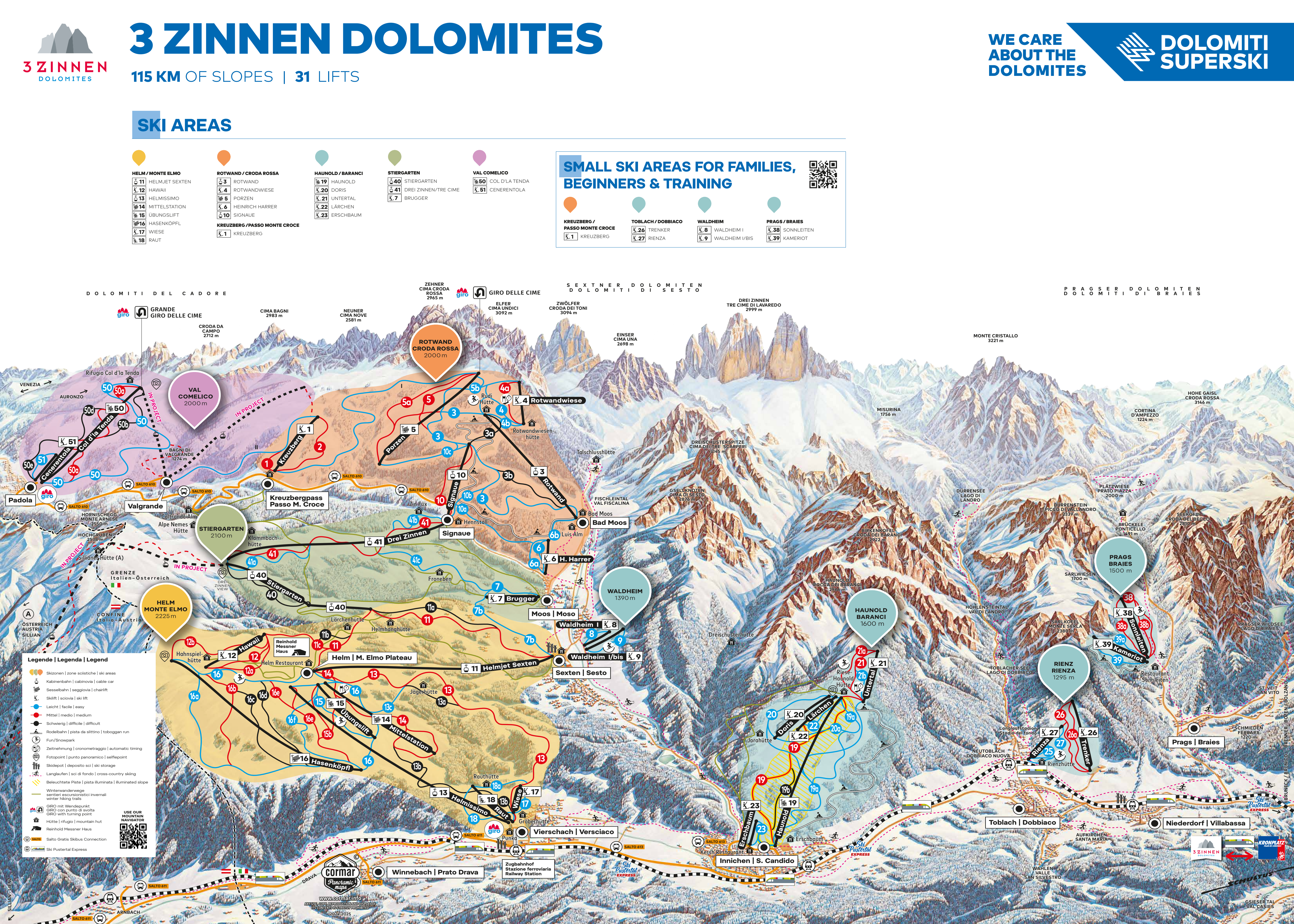
Sesto is one of the base villages for the 3 Peaks Dolomites (Drei Zinnen) ski area, which covers 115km of pistes across 82 runs served by 31 lifts - including six gondolas. The Helm (Elmo) sector, accessed directly from Sesto via gondola, is the sunniest and most panoramic part of the ski area, with south-facing slopes that look out across the Puster Valley towards the Rieserferner group and into Austria. The summit reaches 2,300m with a 1,170m vertical drop. The terrain is predominantly beginner and intermediate, making it one of the most accessible ski areas in the Dolomites. The Dolomiti Superski pass opens access to over 1,200km of pistes across the wider region.
What makes Sesto special is the combination of the most spectacular mountain scenery in the Alps with a village that's remained genuinely authentic. The Tre Cime are visible from the slopes, the Sesto Dolomites provide a jaw-dropping backdrop to every run, and the village below has the kind of quiet Tyrolean soul - wood-panelled Stuben, home-baked strudel, cattle bells in the distance - that you can't fabricate. The area also has 255km of cross-country skiing trails, making the Puster Valley one of Europe's premier Nordic destinations. Check out Sesto ski deals to start planning your trip.
Sesto (Sexten in German) is a traditional South Tyrolean village at the head of the Sesto Valley, directly beneath the most famous skyline in the Dolomites. The Sesto Sundial - a chain of peaks named after the hours of the day because the sun passes over each in sequence - rises directly above the village, and the Tre Cime di Lavaredo, the three rock towers that are the defining image of the Italian Dolomites and a UNESCO World Heritage Site, stand at the valley's end. The village itself is a quiet, year-round farming community with traditional timber-and-stone houses, a parish church, working dairy farms, and the kind of deep-rooted South Tyrolean character that larger resort towns have long since diluted. It's a place where the mountains, not the tourism, still set the agenda.
Sesto is one of the base villages for the 3 Peaks Dolomites (Drei Zinnen) ski area, which covers 115km of pistes across 82 runs served by 31 lifts - including six gondolas. The Helm (Elmo) sector, accessed directly from Sesto via gondola, is the sunniest and most panoramic part of the ski area, with south-facing slopes that look out across the Puster Valley towards the Rieserferner group and into Austria. The summit reaches 2,300m with a 1,170m vertical drop. The terrain is predominantly beginner and intermediate, making it one of the most accessible ski areas in the Dolomites. The Dolomiti Superski pass opens access to over 1,200km of pistes across the wider region.
What makes Sesto special is the combination of the most spectacular mountain scenery in the Alps with a village that's remained genuinely authentic. The Tre Cime are visible from the slopes, the Sesto Dolomites provide a jaw-dropping backdrop to every run, and the village below has the kind of quiet Tyrolean soul - wood-panelled Stuben, home-baked strudel, cattle bells in the distance - that you can't fabricate. The area also has 255km of cross-country skiing trails, making the Puster Valley one of Europe's premier Nordic destinations. Check out Sesto ski deals to start planning your trip.
From Sesto, the Helm gondola rises to the Helm/Elmo sector - a broad, south-facing mountain that provides the 3 Peaks area's sunniest and most panoramic skiing. The slopes fan out across wide, open meadows with uninterrupted views of the Sesto Dolomites' pale rock towers, the Carnic Alps along the Austrian border, and on clear days, the peaks of the Hohe Tauern far to the north. It's the kind of setting where you repeatedly stop skiing just to look.
The full 3 Peaks Dolomites domain connects Sesto's Helm sector with the Rotwand and Stiergarten areas above San Candido and Versciaco via a network of lifts and pistes. With 115km across 82 runs, the linked area has enough for a full week's skiing. The terrain is predominantly gentle to intermediate, with wide, beautifully groomed runs that suit cruisers, families, and anyone who values scenery over steepness. A free ski bus connects the base villages, making it easy to access different sectors each day.
The Helm sector is excellent for beginners. The south-facing aspect means warm, sunny conditions, and the wide, gently graded slopes provide spacious, unpressured terrain for building confidence. The nursery area at the Helm mid-station has conveyor carpets and easy lifts, and the progression to longer blue runs is smooth - the mountain's rounded profile means gradients stay forgiving even as you venture further.
Nearly half the runs across the full 3 Peaks domain are beginner-graded, giving new skiers an exceptional amount of gentle terrain. The ski school is experienced with children and first-timers, English-speaking instructors are available, and the overall atmosphere is relaxed and family-oriented. The sunshine on the Helm makes learning pleasant even on cold days, and the Dolomite views provide a reward from the very first runs.
WeSki insider tip: The Helm sector's south-facing slopes catch the sun from early morning, softening the snow to a forgiving consistency ideal for learners. By mid-morning the conditions are perfect - warm, grippy, and with that golden Dolomite light that makes every photograph look extraordinary.
Intermediates have a strong selection across the connected domain. The Helm sector's red runs provide flowing, panoramic descents with proper pitch, and the linking runs across to the Rotwand and Stiergarten sectors add variety and a sense of journey. The 4.7km longest run gives a satisfying sustained descent, and the efficient lift system means you can cover the full domain in a day's skiing.
The Dolomiti Superski pass dramatically expands the intermediate experience. Day trips to Cortina d'Ampezzo, Alta Badia, Val Gardena, and the Sellaronda circuit - the famous ski tour around the Sella massif - are all possible from Sesto. The Sellaronda in particular is one of the great intermediate skiing experiences in the world: a full-day circuit crossing four Dolomite passes with constantly changing scenery. It's about an hour's drive to the starting point but well worth the journey.
WeSki insider tip: The long red runs dropping from the Helm ridge towards the Puster Valley are the Sesto sector's highlight for intermediates - sustained gradient, excellent grooming, and a panorama that includes Austria, the Carnic Alps, and the Sesto Dolomites all at once. Ski them in the morning for the best snow and light.
The Helm sector's terrain is predominantly gentle, with the advanced skiing concentrated in the Rotwand and Stiergarten areas accessible via the linked lift system. The 13 advanced-graded runs across the 3 Peaks domain provide genuine challenge, particularly when moguled or left ungroomed. The steeper north-facing slopes hold firm, cold snow and have enough pitch to demand committed technique.
For a full week of steep skiing from a Sesto base, the Dolomiti Superski pass is essential. Cortina's Olimpia delle Tofane, Val Gardena's Saslong World Cup run, and the challenging itinerary routes around the Sella group provide genuinely demanding terrain. Sesto's value for advanced skiers is as a peaceful, affordable, and beautiful base from which to explore the wider Dolomites - returning each evening to a quiet village rather than a busy resort.
WeSki insider tip: Use Sesto as your base camp and treat the Dolomiti Superski pass as your playground. Drive to a different area each day - Cortina one day, Alta Badia the next, the Sellaronda the day after - and come back to Sesto's quiet, beautiful valley each evening. It's the smartest way to ski the Dolomites.
The wide, sunny Helm slopes suit beginner and intermediate snowboarding well. The gondola access eliminates surface-lift issues on the main vertical, and the natural terrain has gentle rollers and features suited to a relaxed riding style. The views from the board are spectacular. Advanced freeriders will find the gentle terrain limiting locally, though the steeper sectors elsewhere in the 3 Peaks domain and the wider Dolomiti Superski network add options.
Off-piste in the Helm sector is limited by the gentle topography, though the terrain above the treeline has some skiable side-country when conditions allow. The wider 3 Peaks domain has steeper off-piste options around the Rotwand sector. For serious off-piste, the Dolomites' itinerary routes - particularly around the Sella group and the Marmolada glacier - provide more challenging terrain. Sesto's surrounding peaks also have established ski touring routes for equipped skiers. A guide is recommended.
The Sesto ski school runs group and private lessons for all ages from the Helm gondola base. English-speaking instructors are readily available in this trilingual (German, Italian, English) region. Children's programmes start from around age three, and the sunny, gentle Helm terrain makes Sesto a particularly effective and pleasant place for lessons. The ski school has a strong reputation for patience and quality instruction.
The 3 Peaks domain has a terrain park with features for beginner and intermediate freestyle riders. It's not Sesto's main draw, but provides a fun diversion. For more advanced park facilities, the wider Dolomiti Superski network has parks at several larger resorts accessible on the same pass.
Sesto is one of the most enchanting places in the Dolomites for a family ski holiday. The gentle Helm terrain, the warm sunshine, the spectacular Dolomite backdrop, and the village's authentic Tyrolean character create an environment that children respond to instinctively. This isn't a resort - it's a real mountain village where farming families live alongside skiers, cattle graze in summer meadows that become pistes in winter, and the pace of life is set by the seasons rather than by tourism.
Younger children have excellent nursery terrain and ski school on the sunny Helm slopes, with the gondola making access simple. The toboggan runs, ice skating, and horse-drawn sleigh rides provide non-skiing entertainment that's as memorable as the skiing itself. Older children and teenagers can explore the full 3 Peaks domain, and the Dolomiti Superski pass opens up genuinely ambitious day trips. The Tre Cime di Lavaredo, accessible on snowshoe excursions, add a sense of adventure that resonates with children.
For parents, Sesto's appeal is its authenticity and tranquillity. The family-run hotels serve outstanding South Tyrolean half-board cooking, the village has a bakery, a small supermarket, and a handful of warm restaurants - everything you need and nothing you don't. The absence of resort-style nightlife, crowds, and commercial pressure creates a holiday where the family actually spends time together rather than being pulled in different directions. The views from the breakfast table alone are worth the journey.
Sesto's position at the head of a Dolomite valley, with the Tre Cime nearby and the Austrian border close, gives rest days and non-skiers a depth of experience that goes well beyond the ski area.
The Sesto Valley and surrounding Dolomite landscape provide an outstanding range of winter activities:
The Sesto Valley's natural beauty, cultural heritage, and border proximity provide genuine depth for rest days.
Dining in Sesto is South Tyrolean at its most authentic. The village is small, so the restaurant choice is intimate, but the quality is high and the atmosphere is warm. The cuisine blends Italian and Tyrolean traditions: canederli (bread dumplings), speck (cured ham), Käsespätzle (cheese noodles), and strudel sit alongside Italian pasta, pizza, and espresso. On-mountain Hütten add altitude dining with some of the finest panoramic views in the Dolomites.
WeSki insider tip: Ask for Tirtlan at a traditional Gasthof or Hütte - deep-fried rye dough pockets filled with spinach, ricotta, or sauerkraut, served with a fresh salad. They're a Sesto Valley speciality that you won't find on many menus outside this corner of South Tyrol. Pair with a glass of Lagrein, the indigenous red from the nearby Bolzano vineyards.
Après-ski in Sesto is as quiet and authentic as the village itself. The end of the ski day means a Glühwein on the Helm terrace as the sun drops behind the Sesto Sundial peaks, followed by a walk back to the village through snow-covered meadows. The atmosphere is contemplative rather than celebratory - you're here for the mountains, and the evening is about absorbing the experience rather than drowning it out.
The evening scene is centred entirely on food. The hotel restaurants and the village Gaststätten fill for dinner, candles are lit, and the conversation is warm and unhurried. There are no nightclubs, no DJ bars, and no late nights. If you want evening entertainment, San Candido is 10 minutes away and marginally livelier, but most visitors to Sesto have chosen it specifically for the quietness. The sauna at your hotel, a five-course half-board dinner, and the stars above the Dolomites are the evening programme.
Après-ski spots to know:
Accommodation in Sesto is predominantly family-run hotels and Gasthofe in the South Tyrolean tradition - properties that combine genuine warmth with impressive facilities. Even modest three-star hotels typically have spa areas with saunas, steam rooms, and relaxation spaces, and half-board rates include multi-course South Tyrolean dinners that are a genuine highlight of the stay. A few self-catering apartments and holiday homes are also available.
The village is small and quiet, with the Helm gondola a short walk or ski bus ride from most properties. The South Tyrolean hotel model represents outstanding value - the combination of accommodation, half-board cooking, spa access, and the village's setting is difficult to match at comparable prices anywhere in the Dolomites. Booking ahead for Christmas, New Year, and Italian school holidays is important given the village's limited bed count.
The 3 Peaks Dolomites pass covers all 31 lifts and the full 115km ski area shared with San Candido. For the wider Dolomites, the Dolomiti Superski pass covers over 1,200km across 12 areas. Free beginner lifts at the base areas reduce costs for families with new skiers. Check for family and multi-day pass options when booking your Sesto ski holiday package through WeSki to find the best fit for your trip.
Rental shops in the village and at the Helm gondola base carry a full range of downhill, cross-country, and snowboard equipment. The South Tyrolean shops provide attentive, multilingual service. Nordic equipment rental is a strength given the exceptional 255km trail network. Booking ahead during peak holiday weeks is wise.
The village is small and walkable. The Helm gondola base is a short walk or ski bus ride from the centre. A free ski bus connects Sesto with San Candido and Versciaco for accessing the other 3 Peaks sectors. The bus runs regularly through the season and is included with the lift pass.
A car is useful for day trips to Cortina, Lienz, and other Dolomiti Superski resorts. Sesto is close to San Candido's train station (about 10 minutes by car or bus), which provides rail connections along the Puster Valley and into Austria. Parking is available in the village and at the gondola base.
Sesto is at the head of the Sesto Valley, a side valley of the Puster Valley in South Tyrol, near the Austrian border. The nearest airports are Innsbruck (around 140km, roughly two hours by car), Venice Marco Polo (around 210km), and Bolzano (about 120km by road). The Brenner motorway from Innsbruck connects to the Puster Valley road, which leads to the Sesto turn-off. San Candido's train station, about 10 minutes away, has connections from Fortezza (Brenner line) and Lienz (Austria).
WeSki has car rentals from the airport. Add one to your Sesto ski holiday package for flexibility on the ground.
Both share the 3 Peaks Dolomites ski area. San Candido is a larger, medieval town with more shops, restaurants, a swimming pool, and evening facilities. Sesto is a smaller, quieter farming village with more traditional character and the closest proximity to the Tre Cime di Lavaredo. San Candido suits families wanting more town infrastructure; Sesto suits visitors who prioritise tranquillity, authenticity, and the most dramatic Dolomite views. They're about 10 minutes apart by car or bus.
The Sesto Sundial (Meridiana di Sesto) is a chain of peaks visible directly above the village, each named after an hour of the day because the sun passes over them in sequence throughout the daylight hours. The peaks include the Neunerkofel (9 o'clock), Zehnerkofel (10 o'clock), Elferkofel (11 o'clock), and Zwölferkofel (12 o'clock). It's a striking geological feature unique to this valley and provides one of the most distinctive mountain panoramas in the Alps.
Excellent. The Helm sector's sunny, wide, gently graded slopes are ideal for learning. Nearly half the runs across the 3 Peaks domain are beginner-graded, and the ski school is well-regarded with English-speaking instructors. The warm, sunny conditions and spectacular views make learning here a pleasure rather than an ordeal.
The summit at 2,300m and extensive snowmaking across the domain provide good reliability from late November through mid-April. The Helm sector's south-facing aspect means the snow can soften on warm days, but the grooming is excellent and snowmaking keeps conditions consistent. North-facing slopes elsewhere in the 3 Peaks domain hold firmer snow. January to March is the most reliable window.
Very much so. The 255km of cross-country trails, snowshoe excursions to the Tre Cime, winter hiking, horse-drawn sleigh rides, and the village's atmospheric charm give non-skiers and rest days genuine depth. The hotel spas are another highlight. For non-skiers who enjoy mountain scenery and outdoor activities, Sesto is one of the most rewarding destinations in the Dolomites.
Yes. South Tyrol is trilingual (German, Italian, English), and English is widely spoken in hotels, restaurants, ski schools, and shops. Sesto's primary language is German (South Tyrolean dialect), but communication in English is effortless. It's one of the easiest Italian destinations for English-speaking visitors.
For a week's stay, yes - particularly for intermediates and advanced skiers who want to explore the wider Dolomites. Day trips to Cortina, Alta Badia, Val Gardena, and the Sellaronda circuit are all feasible. For shorter stays or families focused on the local gentle terrain, the 3 Peaks Dolomites pass is sufficient and more affordable.
 4.9/5
4.9/5I usually book flights, ground transportation, hotel, ski rental and lift tickets myself but this year used WeSki for a trip to Morzine. It was so much easier. Everything worked perfectly - ground transportation arrived on time and there was plenty of feedback throughout the whole process giving you confidence the vacation would go smoothly.

A really useful service that is so much easier to use than other 'all-inclusive' sites. It nicely bridges the gap between a travel agent and booking the trip yourself online. I'll use WeSki every time I go skiing from now on.
We booked a late minute skiing trip to Morzine through we ski. We looked at booking the trip ourselves but could get anywhere near the price quoted by we ski. The company was excellent and we had no problems at all from start to finish. I would definitely use them to book another weekend skiing trip.
Seamless experience from start to finish. I was spending ages trying to sort out a weekend break and managed to do it with we ski in minutes and for the same price as booking it all up yourself. Flight, transfers and accommodation was all as expected and faultless.