EN
EN
 Backcountry (off-trail) skiing
 Reliable snow resort
 Stunning viewsBackcountry (off-trail) skiingReliable snow resortStunning viewsBackcountry (off-trail) skiingReliable snow resortStunning viewsBackcountry (off-trail) skiingReliable snow resortStunning views
Kirkwood sits high on the edge of the United States' California Sierra Nevada, just south of Lake Tahoe. Founded in 1972, it's always been a skier's mountain, wild and high, set in a broad alpine bowl ringed by granite peaks. The base keeps things low-key and friendly, with a small cluster of timber lodges and condos around a village plaza and everything within a short walk. Starting the day at 2,377 metres rewards you with far-reaching mountain views, though it's worth taking your first day gently, as most people need a day or two to adjust to the altitude.
Kirkwood's skiing spans 2,300 acres and five separate peaks, and for all its big-mountain reputation, it has terrain for everyone. Beginners get real room to progress on wide, gently graded slopes backed by a well-regarded ski school, while intermediates can stretch out on the long, tree-lined runs lower down. Higher up you'll find Kirkwood's serious side, where a wind-sculpted expanse of open bowls, exposed ridges, cornices and chutes makes for strong, adventurous skiing, with around 610 metres of vertical from the 2,987-metre summit. Its exposed, ridge-top position works in your favour, pulling in storm after storm and holding the snow well into spring, with a season that usually runs from late November to mid-April.
Kirkwood is a mountain to enjoy off the pistes as well as on them. Across the highway, the Cross Country and Snowshoe Centre opens up trails for cross-country skiing, snowshoeing and fat biking through a quiet alpine meadow. For something more adventurous, Kirkwood's guides run backcountry tours and avalanche-skills clinics for heading beyond the boundary. Evenings are relaxed, with casual bars and grills around the Village for an après beer and dinner (the historic log-cabin Kirkwood Inn along the highway is a local favourite for its chilli). For a change of scene, South Lake Tahoe and its restaurants, bars and lakeside days out are around 45 minutes away. Check out Kirkwood ski deals to start planning your trip.
Check out Kirkwood ski deals to start planning your trip.
Kirkwood sits high on the edge of the United States' California Sierra Nevada, just south of Lake Tahoe. Founded in 1972, it's always been a skier's mountain, wild and high, set in a broad alpine bowl ringed by granite peaks. The base keeps things low-key and friendly, with a small cluster of timber lodges and condos around a village plaza and everything within a short walk. Starting the day at 2,377 metres rewards you with far-reaching mountain views, though it's worth taking your first day gently, as most people need a day or two to adjust to the altitude.
Kirkwood's skiing spans 2,300 acres and five separate peaks, and for all its big-mountain reputation, it has terrain for everyone. Beginners get real room to progress on wide, gently graded slopes backed by a well-regarded ski school, while intermediates can stretch out on the long, tree-lined runs lower down. Higher up you'll find Kirkwood's serious side, where a wind-sculpted expanse of open bowls, exposed ridges, cornices and chutes makes for strong, adventurous skiing, with around 610 metres of vertical from the 2,987-metre summit. Its exposed, ridge-top position works in your favour, pulling in storm after storm and holding the snow well into spring, with a season that usually runs from late November to mid-April.
Kirkwood is a mountain to enjoy off the pistes as well as on them. Across the highway, the Cross Country and Snowshoe Centre opens up trails for cross-country skiing, snowshoeing and fat biking through a quiet alpine meadow. For something more adventurous, Kirkwood's guides run backcountry tours and avalanche-skills clinics for heading beyond the boundary. Evenings are relaxed, with casual bars and grills around the Village for an après beer and dinner (the historic log-cabin Kirkwood Inn along the highway is a local favourite for its chilli). For a change of scene, South Lake Tahoe and its restaurants, bars and lakeside days out are around 45 minutes away. Check out Kirkwood ski deals to start planning your trip.
Check out Kirkwood ski deals to start planning your trip.
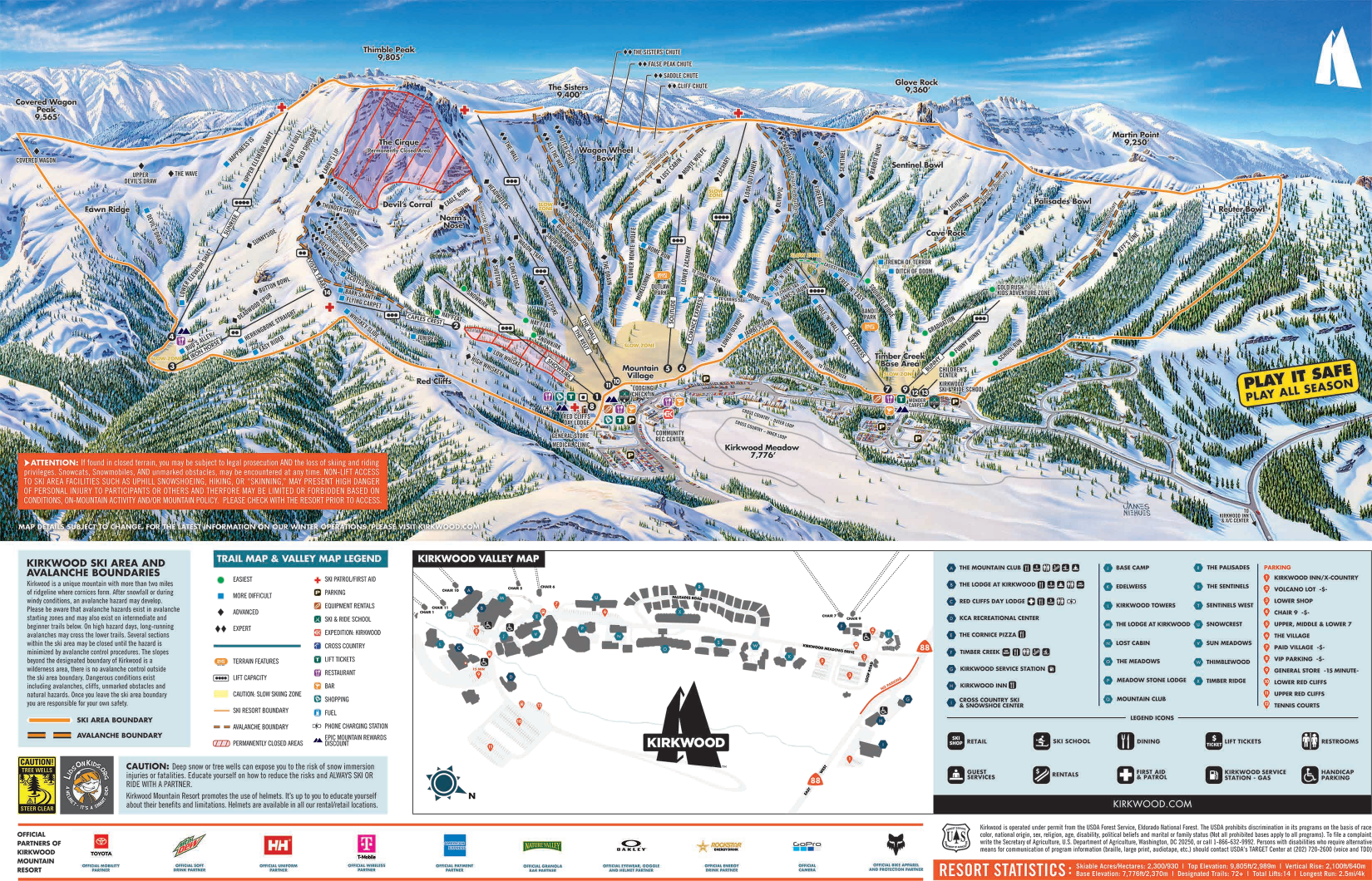
Kirkwood's skiing wraps around a broad alpine bowl, with runs dropping from a rocky, cornice-topped ridgeline into the forest below. It has a big-mountain feel to it, with wide-open faces above the treeline, sustained steeps through trees, and plenty of tucked-away corners to keep you exploring for days. Most of the terrain rises straight from the base on the front side, with everything from gentle groomers to steep lines higher on the ridge. A quieter bowl on the backside offers mellow cruising and long views over the wilderness. Kirkwood's calling card is The Wall, which is a row of steep chutes you can see right from the base and a magnet for strong skiers keen to test themselves.
Getting around Kirkwood is straightforward. Two high-speed quads, Cornice Express on the front side and Timber Creek Express by the beginner area, do most of the heavy lifting, while the rest of the network is slower fixed-grip chairs (in keeping with the mountain's no-frills character). The backside is reached by a long, slow ride on Sunrise chair, so it's a bit of a commitment, and worth checking it's open before you head across. The main thing to plan around is the wind. Sitting high and exposed, Kirkwood's upper and backside lifts can go on hold in strong gusts, particularly during storms, so it's worth checking the daily lift status. You'll also hear locals calling the lifts by number rather than name, Chair 6 for Cornice, Chair 10 for The Wall.
Important for international visitors: It's worth knowing that North American resorts grade their runs differently from Europe. Green circles are the easiest beginner runs, and blue squares are intermediate, though they span a wider range than European blues, from gentle cruisers to noticeably steeper pitches. Black diamonds are advanced, and double black diamonds are expert-only, taking in the steepest, most technical terrain. There's no direct equivalent to the European red, so if you're an intermediate used to reds, expect some blues to feel a step up, and given how much steep terrain Kirkwood has, treat its blacks and double blacks with respect.
Kirkwood may be best known for its steep terrain, but the cliffs and chutes aren't the whole story. It goes out of its way to welcome newer skiers, and there's a good spread of gentle, well-groomed learning terrain. Most first-timers base themselves at Timber Creek, a dedicated learning area just outside its own lodge, with gentle green runs, a magic carpet, and the ski school all in one place. As you find your rhythm, the Timber Creek Express chair opens up longer green runs to practise linking your turns, and from there the move onto the mellow blue squares down the front side is a manageable one.
The beginner terrain here is fairly compact, but it's well suited to progressing, and many guests are comfortable on their first blues after a couple of days of practice and lessons. The ski school has a real reputation, with instructors as happy coaching a nervous first-timer as a budding freerider. That confidence is backed by Kirkwood's Green Run Guarantee. Book a beginner lesson, and if you haven't made it down a green run by the end of your third, the fourth is free.
WeSki insider tip: Kirkwood's base sits high, at over 2,300 metres, which is higher than many people are used to skiing. If you're new to the sport, take your first morning gently and drink plenty of water, you'll tire faster than you expect at this elevation, and a steady start makes the learning stick.
For intermediates, Kirkwood is a mountain to get stuck into. Once you're comfortable linking turns, the front side opens up a proper spread of blue cruising, from the gentle runs off the Solitude chair to the longer, flowing descents off Cornice Express and The Reut. These are full of the natural rolls, dips and banked gullies that give Sierra skiing its rhythm, terrain that lets you find a flow rather than pick your way down.
When you're ready to stretch yourself, the blues off Cornice Express and The Reut steepen into long, sustained, fall-line groomers, quick to grow moguls as the day goes on (a European skier would likely rate these as reds). Zachary and Monte Wolfe are two of the best to seek out. From there, the gentlest of the front-side black diamonds make a natural next step, a low-pressure way to test yourself on steeper ground while staying on marked runs.
WeSki insider tip: Don't be put off by the long, slow ride up the Sunrise chair to the backside. It's why plenty of people never make the trip, but it's exactly what makes the backside such a find. Two long, wide-open cruising blues, sweeping big-turn terrain, and some of the best views at Kirkwood.
For strong skiers, Kirkwood is a reason to make the trip. The majority of the mountain is graded advanced or expert, and it's terrain that keeps serious skiers coming back. Its centrepiece is The Wall, whose steep chutes drop straight off the ridgeline in full view of the base, firm and demanding up top before easing into tree skiing and gullies lower down. Traverse out from there and you'll reach steeper, more committing lines again, with the double-black chutes off The Sisters and the powder stashes of Palisades and Reuter Bowls.
There's far more than The Wall, though. Off Cornice Express, Wagon Wheel Bowl and Sentinel Bowl open up a huge spread of expert terrain, open powder bowls, cliff bands, tight chutes and well-spaced tree runs that you could pick apart for days. The steeps here are the real thing, with proper exposure and consequences (so a cool head and good judgement count for as much as strong legs). It's high-alpine skiing at its most rewarding, wild and exposed, and best suited to skiers who like to read a mountain and find their own line down it.
WeSki insider tip: At Kirkwood the snow directly under the lifts gets tracked out first, so the freshest lines are almost always a short traverse from the chair. A few minutes' effort along the ridge is often the difference between chopped-up snow and an untouched face.
Kirkwood is a rider's mountain through and through, with a real freeride culture and a following of snowboarders drawn to its big natural terrain. The steep faces, powder bowls and gullies make for brilliant freeriding, with natural hits, wind lips and sweeping open lines to link together all over the mountain. Those same gullies double as natural halfpipes for anyone with a freestyle streak, and there are terrain parks with progressive features to session too. The one thing to watch lower down is a handful of flat connector trails that can catch you out, so keep your speed up through them to stay moving.
Kirkwood is a proper off-piste mountain. Inside the boundary alone there's a vast amount of ungroomed, natural terrain to explore, the chutes of The Wall, gladed trees, cliff bands and wide powder bowls, enough to chase fresh lines for days without ever leaving the resort. Beyond the ropes is where it really stands out, with marked gates dropping straight off the lifts into serious sidecountry. The resort's own Expedition: Kirkwood runs guided tours, snowcat trips and avalanche courses, one of the few places in North America to teach you the backcountry from the resort itself. This is proper avalanche terrain, though, so out here a guide, the right kit, and the training to use it aren't optional.
Kirkwood's ski and snowboard school runs lessons for every age and ability, from first-timers at Timber Creek to adults looking to sharpen up their skills. Group and private lessons are both on offer, with private sessions built around whatever you want to work on. Alongside advanced group lessons for anyone already skiing blacks, the school’s Expedition: Kirkwood programme runs full-day camps and clinics in the things the mountain is known for, such as steep and off-piste technique, freeride skills, and avalanche awareness, plus guided backcountry and snowcat tours.
Kirkwood has three terrain parks, each pitched at a different level. Buckaroo, at Timber Creek, is the beginner park, with flush boxes and extra-small features for getting the feel of a park. Bandit is the main park, sitting under Chair 7, with a mix of small and medium jumps, rails, and boxes across separate lines for different abilities. Outlaw, over on the Solitude chair, is a level up from the rest, with larger, more advanced hits.
Kirkwood makes a warm, easygoing family mountain with a character all its own. It's a small, remote, outdoorsy place built around the skiing and the setting, and families who love fresh air and adventure tend to feel right at home. The base is compact and friendly, so it's easy to keep everyone together and regroup between runs, and there's a real sense of being somewhere wild and a little bit special, out among the peaks.
On the mountain, Timber Creek is the heart of family skiing, a dedicated learning area with gentle green runs, a magic carpet, and the ski school together in one sheltered spot, set well apart from the steeper terrain so first-timers can get comfortable at their own pace. The learning terrain is fairly compact, better suited to getting started and building confidence than to long days of gentle cruising, but children can start lessons from age three, with blue runs to progress onto as they improve. For those already happy on blues, the mountain opens up into a proper adventure, with wide cruising runs to let loose on, the terrain parks to session, and the pull, in time, of skiing The Wall for the first time. One thing to sort in advance is childcare, as Kirkwood has none of its own and the ski school takes children only from age three, so families with toddlers will need to make other arrangements.
Away from the slopes, there's more to do than you might expect somewhere so remote. The cross-country and snowshoe centre has trails the whole family can potter along, including the Kiddy Kilometer loop, dotted with life-size animal cut-outs and flip-up signs to keep little ones entertained, and finished off with hot chocolate back at the lodge. There's fat biking and snow play too, and the Adventure Family Center at Red Cliffs Lodge is a handy indoor bolthole of games and toys. For a bigger day out, South Lake Tahoe is around 45 minutes away, with its restaurants, shops, and lakeside attractions, though plenty of families are happy never to leave. Meals at the base stay casual, with a couple of canteen-style lodges, a pub-style bar and grill, a general store and deli for grab-and-go, and Monte Wolfe's for a sit-down bite, enough to refuel and regroup between days on the snow.
Kirkwood is, above all, a place to be outdoors. Beyond the downhill runs, its high-alpine setting opens up plenty of other ways to enjoy the snow, from gliding across the meadows on cross-country skis or snowshoes to heading into the backcountry with a guide. For a change of pace, South Lake Tahoe sits about 45 minutes away on the shore of Lake Tahoe, with restaurants, shops, casinos, and lakeside days out. Here's what's worth doing, on the mountain and beyond.
On the mountain, the food is simple and hearty rather than fancy, a handful of casual spots serving burgers, pub food, and American comfort classics to refuel between runs. For a proper evening out, South Lake Tahoe is about 45 minutes away and offers far more than you might expect. Fresh Californian cooking and lakeside fine dining sit at the top end, alongside a real mix of international flavours, from Thai and Mediterranean to Italian and Mexican, plus craft breweries and easygoing pizza places. It's worth planning a couple of evenings down there during your stay.
Après at Kirkwood is low-key and unpretentious, centred on The Wall Bar & Grill at the base, where the deck fills up on sunny afternoons as the lifts wind down, with the historic log-cabin Kirkwood Inn just down the road as a rustic alternative. It's a relaxed one-or-two-venue scene rather than a big night out. For that, South Lake Tahoe, about 45 minutes away, has the bars, breweries, and casinos. Transport is worth thinking through, though. There's no regular shuttle between Kirkwood and town, and rideshare, while possible, is a long and pricey trip, so if you're based at Kirkwood, an evening in Tahoe usually means driving and a designated driver.
Après-ski spots to know:
Almost all of Kirkwood's accommodation is run by the resort itself, a collection of condos and lodge rooms spread across the base in a handful of low-rise buildings. Staying here is all about waking up on the mountain, with many places ski-in, ski-out or a short walk from the lifts, so you can be first onto fresh snow and drop your skis at the door at the end of the day. The condos are cosy and practical rather than plush, most with full kitchens and a fireplace to warm up by, and some with their own hot tubs, while the slopeside Mountain Club adds an outdoor hot tub, sauna, and fitness room. There's a general store for basics, though it's worth stocking up before you arrive, as the resort sits well away from the nearest shops. What you get in return is total immersion, a quiet, wild setting with the mountain right on your doorstep.
If you'd rather have more around you in the evenings, South Lake Tahoe makes a livelier base. It's a proper lakeside town, with a big choice of hotels, lakefront resorts, casino hotels on the Nevada side, and vacation rentals, and staying there puts the restaurants, bars, casinos, and the Heavenly gondola all within easy reach, much of it walkable or a short rideshare away. The trade-off is the commute. Kirkwood is about 45 minutes away over the mountains with no regular shuttle, so you'd drive out to the slopes each morning.
A Kirkwood lift pass is all you need for a trip based here, covering every lift, run, and terrain park on the mountain, from the beginner slopes at Timber Creek to the steeps of The Wall. Kirkwood is also part of Vail Resorts' Epic Pass, so if you already hold one it's valid here, and it opens up a much wider network of resorts across North America and beyond, including the other two Tahoe mountains, Heavenly and Northstar. For a trip focused on Kirkwood, though, the mountain's own lift pass is the simplest choice.
Check for multi-day pass options when booking your Kirkwood ski holiday through WeSki to find the best fit for your trip.
Kirkwood has two rental shops, both run by Kirkwood Mountain Sports. The main one sits in the Village Plaza by the ticket office, with everything from beginner packages to high-performance kit, easy swaps if something isn't right, and free overnight storage so you're not carrying gear back and forth. Next door, the demo centre carries premium skis and boards, while the Timber Creek shop focuses on entry-level and children's gear by the learning area. If you're planning to ski through the backcountry gates, Expedition: Kirkwood hires out touring skis, splitboards, and avalanche kit. It's worth booking online before your trip, especially over busy holiday periods, and if you're staying down in South Lake Tahoe, shops there will rent to you and deliver.
If you're staying at Kirkwood, getting around day to day is straightforward. The base is compact and walkable, most lodging is ski-in, ski-out or a short stroll from the lifts, and a free courtesy shuttle loops between the Mountain Village and Timber Creek base areas through the day, so you can move around the resort without a car.
Beyond that, though, the resort stands on its own. There are no shops besides the general store and no town nearby, so anything off the mountain, groceries, dining out, or a change of scene, means a drive. The nearest town, South Lake Tahoe, is around 45 minutes away, with no regular public transport or shuttle running out to the resort. So while you don't strictly need a car to ski, if you arrive slopeside and are happy to stay put, most visitors find a hire car well worth it for the freedom it gives, and it's what we'd recommend for a comfortable trip.
Kirkwood sits high in the Sierra Nevada, and for international visitors the main gateway is San Francisco International (SFO), around 290km to the west, with the widest choice of long-haul flights. If you can pick up a domestic connection, Reno-Tahoe International (RNO) is the closest airport at about 130km to the north-east, and Sacramento International (SMF) is another option at roughly 170km to the west. Whichever way you come, the final stretch runs over Carson Pass on Highway 88, a proper mountain road that's beautiful in good conditions and can call for chains or snow tyres after a storm.
WeSki offers car hire from the airport as well as private transfers to Kirkwood. Add them to your Kirkwood ski holiday package for a smooth door-to-door journey.
Kirkwood can be a good place to learn, though it's worth knowing the beginner terrain is compact. Its dedicated Timber Creek learning area has gentle green runs, a magic carpet, and the ski school all together, and the instruction is well regarded, backed by a Green Run Guarantee that gives you a free fourth lesson if you haven't reached a green run by the end of your third. What there's less of is easy intermediate mileage to move onto once you've got the basics, so it suits learning and building confidence more than long, gentle cruising. For anyone already comfortable on blue runs, the mountain really opens up.
North American resorts grade their runs differently from Europe. Green circles are beginner runs, broadly like European greens and easy blues. Blue squares are intermediate but cover a wider range than European blues, so a confident intermediate may find some US blues quite challenging. Black diamonds are advanced, steep and demanding, and double black diamonds are expert-only, often with cliffs, chutes, or extreme steeps. There's no direct equivalent to the European red.
Kirkwood is one of the snowiest resorts in the Lake Tahoe region, averaging around 9 metres of snow a season. Its high base at 2,377 metres and its position up on the Sierra crest mean it often catches storms that pass over the resorts down by the lake. Snowmaking is limited, covering only a few front-side runs, so the mountain relies mostly on natural snowfall, and as anywhere in Tahoe, totals swing from year to year, with big winters bringing well above the average.
Kirkwood stands apart from the bigger Tahoe resorts in both character and terrain. It's more remote, more expert-oriented, and typically snowier than the likes of Heavenly, Northstar, or Palisades Tahoe, with the trade-off of fewer village amenities and a smaller dining and après scene. In broad strokes, Heavenly has the liveliest village and nightlife, Palisades Tahoe the most varied terrain, and Northstar the most family-friendly set-up, while Kirkwood is the pick for skiers who put steep terrain, deep snow, and a back-to-basics mountain feel above village polish.
Highway 88 over Carson Pass is a proper mountain road that demands respect in bad weather. Chains, or four-wheel drive with snow tyres, are wise during and after storms, and the pass can close temporarily in severe conditions. In settled winter weather it's a straightforward drive, but it's always worth checking road conditions before you set off, especially after fresh snow.
Yes. Kirkwood is on the Epic Pass, which also covers Heavenly and Northstar in the Lake Tahoe basin, so you can ski all three on the same pass. Heavenly sits right in South Lake Tahoe, about 45 minutes from Kirkwood, while Northstar is further round on the north side of the lake, so a day at either is easily done if you fancy a change of scene.
Kirkwood has its own lodging at the base, mostly condos and lodge rooms, many of them ski-in, ski-out, though there are no hotels or big branded properties and the choice is smaller than at a full resort town. South Lake Tahoe, about 45 minutes away, has a far wider range. Staying at Kirkwood puts you right on the mountain for first lifts and a quiet, immersive base; staying in Tahoe gives you the restaurants, nightlife, and greater choice of places to stay. Which suits you comes down to whether you're here mainly for the skiing or want more going on in the evenings.
 4.9/5
4.9/5I usually book flights, ground transportation, hotel, ski rental and lift tickets myself but this year used WeSki for a trip to Morzine. It was so much easier. Everything worked perfectly - ground transportation arrived on time and there was plenty of feedback throughout the whole process giving you confidence the vacation would go smoothly.

A really useful service that is so much easier to use than other 'all-inclusive' sites. It nicely bridges the gap between a travel agent and booking the trip yourself online. I'll use WeSki every time I go skiing from now on.
We booked a late minute skiing trip to Morzine through we ski. We looked at booking the trip ourselves but could get anywhere near the price quoted by we ski. The company was excellent and we had no problems at all from start to finish. I would definitely use them to book another weekend skiing trip.
Seamless experience from start to finish. I was spending ages trying to sort out a weekend break and managed to do it with we ski in minutes and for the same price as booking it all up yourself. Flight, transfers and accommodation was all as expected and faultless.