EN
EN
 Classic mountain charm
 Reliable snow resort
 Backcountry (off-trail) skiing
 Luxury resortsClassic mountain charmReliable snow resortBackcountry (off-trail) skiingLuxury resortsClassic mountain charmReliable snow resortBackcountry (off-trail) skiingLuxury resortsClassic mountain charmReliable snow resortBackcountry (off-trail) skiingLuxury resorts
Taos Ski Valley is unlike any other ski resort in the United States. Set at the end of a narrow road in New Mexico's Sangre de Cristo Mountains, it feels closer to a Pyrenean village than a polished American resort - a small, independent community tucked into a steep-sided valley at 2,850m, surrounded by ancient peaks and shaped by a fiercely loyal culture. The resort was founded in 1955 by Ernie Blake, a Swiss-German immigrant who spotted the mountain from a small plane and spent the rest of his life turning it into one of America's most challenging and characterful ski areas. That founding spirit still runs through the place. Taos is a resort that values the mountain experience above all else - no corporate gloss, no manufactured atmosphere, just serious terrain and a community that takes its skiing personally.
The mountain itself is steep, compact, and remarkably varied for its size. Thirteen lifts serve 119 trails across 1,294 acres, with a summit at 3,804m and a vertical drop of 954m. The terrain breakdown tells the story: roughly 72% of runs are rated advanced or expert, making Taos one of the most challenging resorts in North America. But do not let that put you off if you are not an expert - recent investment has improved the beginner and intermediate terrain considerably, and the ski school has a national reputation. Taos averages over 8 metres of snow per season, and its high-altitude, south-facing position in the southern Rockies produces a distinctive light, dry powder that skiers here are passionate about.
The base village is small and walkable, centred around a pedestrian plaza with a handful of restaurants, shops, and hotels. It has been tastefully modernised in recent years - a new hotel, improved base facilities, and a gondola that replaced the old chairlift - without losing the rustic, independent character that defines the resort. The town of Taos itself sits 30 minutes down the valley and adds an extraordinary cultural dimension: a UNESCO-listed Pueblo, a thriving arts community, Georgia O'Keeffe's desert landscapes, and a food scene rooted in New Mexican traditions. It is a ski holiday combined with a genuine cultural experience, and there is nothing else quite like it. Check out Taos Ski Valley ski deals to start planning your trip.
Taos Ski Valley is unlike any other ski resort in the United States. Set at the end of a narrow road in New Mexico's Sangre de Cristo Mountains, it feels closer to a Pyrenean village than a polished American resort - a small, independent community tucked into a steep-sided valley at 2,850m, surrounded by ancient peaks and shaped by a fiercely loyal culture. The resort was founded in 1955 by Ernie Blake, a Swiss-German immigrant who spotted the mountain from a small plane and spent the rest of his life turning it into one of America's most challenging and characterful ski areas. That founding spirit still runs through the place. Taos is a resort that values the mountain experience above all else - no corporate gloss, no manufactured atmosphere, just serious terrain and a community that takes its skiing personally.
The mountain itself is steep, compact, and remarkably varied for its size. Thirteen lifts serve 119 trails across 1,294 acres, with a summit at 3,804m and a vertical drop of 954m. The terrain breakdown tells the story: roughly 72% of runs are rated advanced or expert, making Taos one of the most challenging resorts in North America. But do not let that put you off if you are not an expert - recent investment has improved the beginner and intermediate terrain considerably, and the ski school has a national reputation. Taos averages over 8 metres of snow per season, and its high-altitude, south-facing position in the southern Rockies produces a distinctive light, dry powder that skiers here are passionate about.
The base village is small and walkable, centred around a pedestrian plaza with a handful of restaurants, shops, and hotels. It has been tastefully modernised in recent years - a new hotel, improved base facilities, and a gondola that replaced the old chairlift - without losing the rustic, independent character that defines the resort. The town of Taos itself sits 30 minutes down the valley and adds an extraordinary cultural dimension: a UNESCO-listed Pueblo, a thriving arts community, Georgia O'Keeffe's desert landscapes, and a food scene rooted in New Mexican traditions. It is a ski holiday combined with a genuine cultural experience, and there is nothing else quite like it. Check out Taos Ski Valley ski deals to start planning your trip.
Skiing at Taos feels raw and personal. The mountain rises steeply from the base village, and within minutes of stepping off a lift you can be in terrain that demands full concentration - narrow chutes, sustained mogul fields, and exposed ridgelines with views stretching across the high desert to the Rio Grande Gorge. The scale is intimate compared to Colorado's mega-resorts, but the intensity of the terrain and the quality of the snow create an experience that stays with you. Kachina Peak, the 3,804m summit accessed by a short hike from the top of Lift 2, is the crown of the mountain - a place where expert skiers find some of the most exhilarating lift-accessed terrain in the American West.
For UK visitors, a note on the North American trail rating system: green circles are beginner runs (similar to European greens and easy blues), blue squares are intermediate but span a wider difficulty range than European blues, black diamonds are advanced, and double black diamonds are expert-only. There is no direct equivalent to a European red run. At Taos, the ratings are honest - a black diamond here means it, and the double blacks are genuinely committing.
Taos has invested significantly in its beginner terrain in recent years, and the experience for new skiers has improved markedly. The lower mountain around the base area has dedicated green-circle runs with their own lifts, and the addition of the Kachina Peak gondola has improved access to gentler terrain higher up the mountain. The learning areas are well separated from the steeper faces, so beginners can focus on finding their feet without worrying about more challenging terrain around them.
Taos's ski school, the Ernie Blake Snowsports School, has a strong national reputation and is one of the resort's genuine strengths. Lesson programmes are well structured and benefit from small class sizes and experienced instructors who know the mountain intimately. As a beginner, you will be well looked after here - though it is worth being honest about the fact that the majority of the mountain is advanced terrain. This is a resort where beginners can learn well, but the mountain truly comes alive for stronger skiers.
WeSki insider tip: Book a lesson for your first day regardless of your experience level. Taos's instructors know every pocket of the mountain and will get you onto the right terrain for your ability faster than you could find it yourself. The ski school's reputation is earned.*
Intermediates at Taos have a more focused selection of terrain than at larger resorts, but the quality is high. The blue-square runs off Lifts 1 and 7 provide the core intermediate skiing, with well-groomed trails that make the most of the mountain's natural contours. Bambi and Porcupine are reliable choices - long enough to build rhythm and steep enough to feel like proper skiing rather than gentle cruising.
What makes Taos rewarding for intermediates is the potential for progression. The gap between blues and easier blacks here is navigable, and the ski school runs specific programmes for intermediates looking to step up. Trails like Stauffenberg and the easier lines off Lift 4 provide a taste of steeper, more natural terrain without the full commitment of the expert chutes. The longest run on the mountain stretches over 8km, giving intermediates a satisfying top-to-bottom descent when they are ready for it.
WeSki insider tip: Honeysuckle, accessed from Lift 7, is one of the best intermediate runs on the mountain - a long, flowing trail with changing pitch and beautiful views down the valley. It is often quieter than the runs closer to the base.*
This is Taos's domain. The mountain's steep, north-facing terrain produces some of the most challenging lift-accessed skiing in the country. Al's Run, dropping directly beneath Lift 5, is the resort's signature trail - a sustained, relentless mogul field that has been testing expert skiers since the 1950s. The Highline Ridge, Stauffenberg Chute, and the steep lines off Kachina Peak provide variety from tight chutes to open powder faces, all with genuine exposure and pitch.
Kachina Peak, opened to lift-served skiing in 2015 with a short bootpack from the top of Lift 2, is the summit experience. At 3,804m, it provides above-treeline alpine terrain with multiple chute options and a sense of remoteness that feels more like European off-piste than a North American ski resort. The back side of the peak drops into terrain that rivals anything in Colorado or Utah for steepness and commitment. With 72% of the mountain rated advanced or expert, Taos rewards strong skiers with variety and intensity that belies the resort's modest acreage.
WeSki insider tip: The west-facing chutes off Highline Ridge hold the best powder on the mountain after a storm - they are steep, narrow, and get sun later in the day, which keeps the snow cold and dry longer. Get there before noon for the best conditions.*
Taos was one of the last major US resorts to allow snowboarding, only opening to riders in 2008. It has since embraced the sport, and the steep, natural terrain works well for freeride snowboarding. The chutes and powder fields off Kachina Peak and Highline Ridge are excellent for experienced boarders. A small terrain park provides some freestyle features. The main challenge for snowboarders is the narrow, sometimes flat cat-tracks connecting different mountain areas - plan your routes to maintain momentum.
Taos has substantial in-bounds off-piste terrain, particularly above the treeline on Kachina Peak and across the Highline Ridge. The chutes, bowls, and open powder fields here provide genuinely challenging off-piste skiing within the resort boundary. Tree skiing on the lower mountain holds powder well after storms, and the valley's sheltered position means wind-affected snow is less of an issue than at more exposed resorts. For backcountry beyond the boundary, the surrounding Sangre de Cristo range has terrain accessible to experienced, properly equipped skiers, though the area is remote and local knowledge is essential.
The Ernie Blake Snowsports School is one of the most respected ski schools in North America. Group and private lessons are available for all ages and abilities, and the school is particularly known for its expert-level clinics and its ability to help intermediate skiers break through to advanced terrain. Children's programmes are well structured with dedicated teaching areas. English is the primary language.
Taos has a single terrain park with a mix of features suited to intermediate and developing riders. The park setup is modest compared to larger resorts - Taos's identity is built on its natural terrain rather than its freestyle infrastructure. That said, the features are well maintained and provide a decent session for park-minded skiers and boarders looking to practise between runs on the mountain's natural lines.
Taos works for families, though it suits those with older, more adventurous children particularly well. Young beginners can start in the ski school's children's programmes, which use dedicated, gentle terrain at the base area and have a strong reputation for nurturing confidence. Childcare is available for non-skiing little ones, and the small, walkable base village means parents can get between the slopes, restaurants, and accommodation without any hassle.
Older children and teenagers who are developing their skiing will find Taos rewarding - the progression from intermediate to advanced terrain is well supported by the ski school, and the mountain's steepness means improving skiers always have something to aim for. Teenagers in particular tend to love the challenge of the steeper runs and the sense of achievement that comes with skiing terrain they would not find at gentler resorts.
For the whole family, the cultural experience of the wider Taos area adds a dimension most ski holidays lack. A day trip to Taos Pueblo, a visit to the art galleries on the plaza, or a meal built around New Mexican green and red chilli gives the holiday an educational and cultural richness that children remember long after the skiing is over. The base village is family-friendly for dining, and the overall atmosphere is warm and welcoming without being overly commercialised.
The combination of Taos Ski Valley's mountain setting and the town of Taos 30 minutes down the valley creates an unusually rich off-slope experience. The area's cultural heritage - from its ancient Pueblo roots to its century-old arts colony - gives rest days and non-ski time a depth that few mountain destinations can match.
The Sangre de Cristo Mountains and the surrounding high-desert landscape provide a distinctive setting for winter activities:
The town of Taos and the surrounding area provide a cultural richness that sets this destination apart from any other ski holiday:
Dining at Taos Ski Valley and in the town of Taos is shaped by New Mexico's distinctive culinary traditions - a meeting point of Native American, Spanish, and Mexican influences that produces flavours you will not find anywhere else on a ski holiday. The base village has a small but solid selection, and the town of Taos expands the options considerably. Here are some highlights:
WeSki insider tip: When your server asks 'red or green?', they mean which chilli sauce on your enchiladas. Answer 'Christmas' to get both. New Mexican green chilli is distinctive, smoky, and addictive - you will want it on everything by day three.*
Taos's après scene is intimate and character-driven, reflecting the resort's independent spirit. The base village has a handful of spots that fill up warmly as the lifts close, and the atmosphere is social in the way that small communities tend to be - you will recognise faces from the lift queue and end up sharing stories over a beer. This is not a big-production après resort; it is a place where the conversation is as good as the drink.
In the evening, the town of Taos takes over. The plaza has bars and restaurants with live music, and the local craft beer and mezcal scenes add flavour. Taos Mesa Brewing, in its remarkable Earthship building on the mesa outside town, is worth the drive for its atmosphere alone - live music, craft beers, and a crowd that mixes ski visitors with the town's artist community. It is après with a cultural edge that you simply will not find at conventional ski resorts.
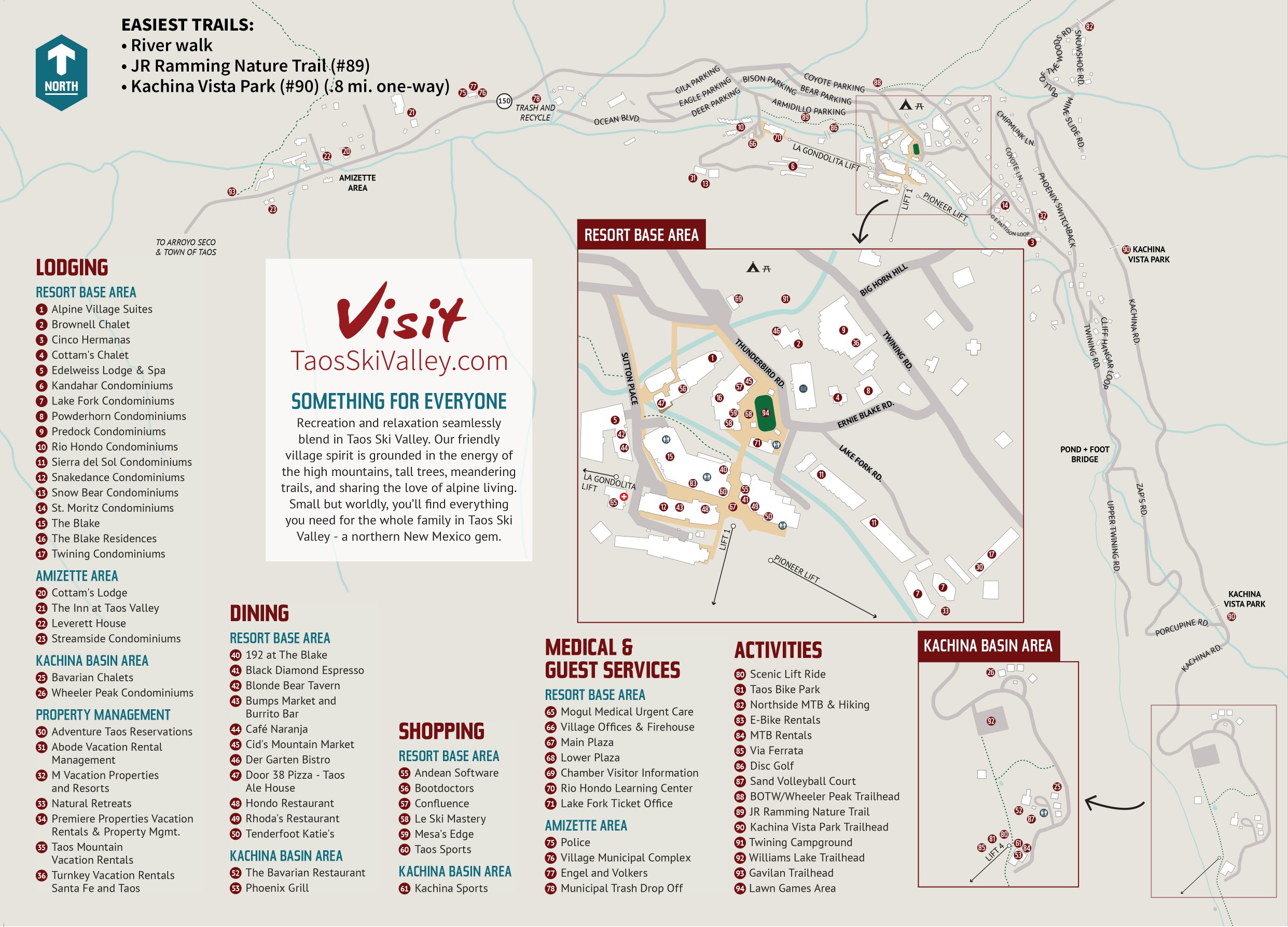
Accommodation at Taos Ski Valley is split between the base village and the town of Taos, 30 minutes down the valley. At the base, The Blake is the flagship hotel - a contemporary, full-service property with ski-in/ski-out access, a spa, and dining. Condos, lodges, and smaller hotels around the base area provide alternatives at various price points, all within walking distance of the lifts. Staying at the base keeps things simple for skiing but limits your evening dining and entertainment options. In the town of Taos, the range broadens to include historic adobe inns, bed and breakfasts, boutique hotels, and vacation rentals, with the full cultural life of the town on your doorstep. The trade-off is the 30-minute commute to the slopes each morning, though a shuttle service runs between town and the ski valley.
Taos Ski Valley is part of the Ikon Pass network, which provides access to a collection of resorts across North America and beyond. Multi-day lift tickets for Taos specifically are also available. The pass covers all 13 lifts and the full mountain, including Kachina Peak when conditions allow. Check for family and multi-day pass options when booking your Taos Ski Valley ski holiday through WeSki to find the best fit for your trip.
Rental facilities are available at the base village, with a range of skis, boots, snowboards, and helmets on offer. The resort's rental shop sits close to the lifts for convenient pickup and drop-off. A few independent shops in the Ski Valley and in the town of Taos provide alternatives, and booking ahead during peak periods - particularly around US holidays and school breaks - is recommended. Given the mountain's steep character, investing in a proper boot fitting is worthwhile if you plan to explore the advanced terrain.
The base village at Taos Ski Valley is small and entirely walkable - everything from the lifts to the hotel and restaurants is within a few minutes on foot. For getting between the Ski Valley and the town of Taos, a shuttle service operates during the ski season, though the 30-minute drive means many visitors choose to rent a car for flexibility. A car is particularly useful for evening dining in town, visits to Taos Pueblo and the art galleries, and day trips to Ojo Caliente or the Rio Grande Gorge. The road between town and the Ski Valley is well maintained but climbs through a mountain valley, so winter driving conditions can apply after fresh snowfall.
Albuquerque International Sunport (ABQ) is the nearest major airport, approximately 230km to the south - a drive of around 2.5 to 3 hours through some of New Mexico's most striking high-desert scenery. Santa Fe Regional Airport (SAF) is closer at roughly 140km, with limited services from select US cities. Denver International Airport (DEN) is around 530km to the north and may suit UK travellers connecting through a major hub. The drive from Albuquerque follows the Rio Grande valley northward and is straightforward in good conditions, though the final section up to the Ski Valley climbs steeply and may require winter tyres or chains.
WeSki offers car rentals from the airport as well as private transfers to Taos Ski Valley. Add them to your Taos Ski Valley ski holiday package for seamless door-to-door travel.
No, though the mountain's reputation for steep terrain is well earned - around 72% of runs are rated advanced or expert. In recent years, Taos has invested in improving its beginner and intermediate terrain, and the ski school is one of the best in North America. Beginners can learn well here, and intermediates have enough quality terrain to enjoy a full trip. That said, the mountain truly comes alive for stronger skiers, and Taos is at its best when you are ready to tackle the steeper lines.
Taos is smaller and more intimate than the big Colorado destinations, with a fraction of the crowds. The snow quality is excellent - the high altitude and southern Rockies position produce dry, light powder - and the expert terrain rivals or exceeds most Colorado resorts for steepness and variety. Where Taos truly stands apart is in culture and character: the combination of the Pueblo heritage, the arts community, and the New Mexican cuisine gives the holiday a depth that a purpose-built Colorado resort simply cannot match.
Taos averages over 8 metres of snowfall per season, and its high-altitude position - the summit reaches 3,804m - produces dry, light powder that skiers here are passionate about. The season typically runs from late November to early April, with the most consistent conditions from December through March. The resort supplements natural snow with snowmaking on key trails, ensuring reliable coverage throughout the season.
North American resorts use a different system from European resorts. Green circles are beginner runs, blue squares are intermediate, black diamonds are advanced, and double black diamonds are expert-only. There is no red-run equivalent - blue squares cover a wider range. At Taos, the ratings are honest and the mountain is steep, so a black diamond here is genuinely challenging. Start conservatively and work your way up, ideally with a lesson to understand the terrain layout.
The town of Taos is one of the most culturally rich small towns in the United States. Taos Pueblo, a UNESCO World Heritage Site, has been continuously inhabited for over 1,000 years. The town has a century-old arts colony tradition with over 80 galleries, a historic plaza, distinctive adobe architecture, and a food scene built on New Mexican traditions. The Rio Grande Gorge Bridge, Earthship houses, and Millicent Rogers Museum are all within easy reach. It is a destination in its own right.
If you stay at the Ski Valley base, you can manage without a car for skiing - the village is compact and everything is walkable. However, a car is strongly recommended for visiting the town of Taos and its cultural attractions, dining in town in the evening, and day trips to places like Ojo Caliente hot springs and the Rio Grande Gorge. A shuttle runs between town and the Ski Valley, but a rental car adds significant flexibility and is the best way to experience the wider area.
The base sits at 2,850m and the summit reaches 3,804m - this is a high-altitude resort. UK visitors arriving from sea level should take acclimatisation seriously. Stay well hydrated, ease into your first day on the slopes, and consider spending a night in Albuquerque or Santa Fe (both at lower elevation) before heading up to the valley. Headaches, fatigue, and breathlessness are common initially but usually pass within a day or two.
 4.9/5
4.9/5I usually book flights, ground transportation, hotel, ski rental and lift tickets myself but this year used WeSki for a trip to Morzine. It was so much easier. Everything worked perfectly - ground transportation arrived on time and there was plenty of feedback throughout the whole process giving you confidence the vacation would go smoothly.

A really useful service that is so much easier to use than other 'all-inclusive' sites. It nicely bridges the gap between a travel agent and booking the trip yourself online. I'll use WeSki every time I go skiing from now on.
We booked a late minute skiing trip to Morzine through we ski. We looked at booking the trip ourselves but could get anywhere near the price quoted by we ski. The company was excellent and we had no problems at all from start to finish. I would definitely use them to book another weekend skiing trip.
Seamless experience from start to finish. I was spending ages trying to sort out a weekend break and managed to do it with we ski in minutes and for the same price as booking it all up yourself. Flight, transfers and accommodation was all as expected and faultless.