EN
EN
 Reliable snow resort
 Backcountry (off-trail) skiing
 Stunning viewsReliable snow resortBackcountry (off-trail) skiingStunning viewsReliable snow resortBackcountry (off-trail) skiingStunning viewsReliable snow resortBackcountry (off-trail) skiingStunning views
Solitude Mountain Resort lives up to its name. Set in Big Cottonwood Canyon in Utah's Wasatch Range, just 50km from Salt Lake City, it's the quieter, more contemplative neighbour in a canyon shared with Brighton. While other Wasatch resorts draw crowds, Solitude has historically attracted skiers who prefer short lift queues, untracked snow, and a pace that lets you actually enjoy the mountain. The resort has a small, European-inspired base village with a handful of restaurants, a few shops, and slopeside accommodation - it's compact and manageable, without any of the sprawl or intensity of the larger Utah resorts. Founded in 1957, Solitude has long been the Wasatch's quieter secret, and even under Deer Valley Resort Company ownership, it's kept that character intact.
The mountain covers around 486 hectares of skiable terrain across 82 runs, served by eight lifts including four high-speed quads. The summit reaches 3,197m with a base at 2,437m, giving a vertical drop of 760m and a longest run stretching to nearly 8km. The terrain splits across beginner, intermediate, advanced, and expert runs with a roughly even balance that favours intermediates. Solitude averages around 12.7 metres of snowfall per season - the same legendary dry Utah powder that blankets the entire Wasatch Range - and the north-facing aspects hold snow quality exceptionally well. The season typically runs from mid-November through late May, with around 161 operating days. A 20km Nordic trail network adds a cross-country dimension.
The base village has a genuine community feel, with a few restaurants, a general store, and the kind of quiet atmosphere that lets you hear the snow falling. For broader dining, nightlife, and city attractions, Salt Lake City is less than 40 minutes down the canyon. The connection to Brighton via a ski gate at the top of the ridgeline means you can access both resorts on the same ticket, effectively doubling your terrain options. For UK travellers wanting Utah's famous powder without the crowds, Solitude is a smart and satisfying choice. Check out Solitude Mountain Resort ski deals to start planning your trip.
Solitude Mountain Resort lives up to its name. Set in Big Cottonwood Canyon in Utah's Wasatch Range, just 50km from Salt Lake City, it's the quieter, more contemplative neighbour in a canyon shared with Brighton. While other Wasatch resorts draw crowds, Solitude has historically attracted skiers who prefer short lift queues, untracked snow, and a pace that lets you actually enjoy the mountain. The resort has a small, European-inspired base village with a handful of restaurants, a few shops, and slopeside accommodation - it's compact and manageable, without any of the sprawl or intensity of the larger Utah resorts. Founded in 1957, Solitude has long been the Wasatch's quieter secret, and even under Deer Valley Resort Company ownership, it's kept that character intact.
The mountain covers around 486 hectares of skiable terrain across 82 runs, served by eight lifts including four high-speed quads. The summit reaches 3,197m with a base at 2,437m, giving a vertical drop of 760m and a longest run stretching to nearly 8km. The terrain splits across beginner, intermediate, advanced, and expert runs with a roughly even balance that favours intermediates. Solitude averages around 12.7 metres of snowfall per season - the same legendary dry Utah powder that blankets the entire Wasatch Range - and the north-facing aspects hold snow quality exceptionally well. The season typically runs from mid-November through late May, with around 161 operating days. A 20km Nordic trail network adds a cross-country dimension.
The base village has a genuine community feel, with a few restaurants, a general store, and the kind of quiet atmosphere that lets you hear the snow falling. For broader dining, nightlife, and city attractions, Salt Lake City is less than 40 minutes down the canyon. The connection to Brighton via a ski gate at the top of the ridgeline means you can access both resorts on the same ticket, effectively doubling your terrain options. For UK travellers wanting Utah's famous powder without the crowds, Solitude is a smart and satisfying choice. Check out Solitude Mountain Resort ski deals to start planning your trip.
Skiing Solitude feels like having the mountain to yourself. The terrain flows across two main areas - the front side, where groomed cruisers wind through the trees, and Honeycomb Canyon, a steep, ungroomed bowl on the backside that holds some of the best expert terrain in the Wasatch. The powder here is everything Utah promises: dry, light, and plentiful. On a storm day, untracked lines can last well into the afternoon simply because there aren't enough people on the mountain to ski them out.
For UK visitors, the North American trail rating system differs from European colour codes. Green circles mark beginner runs (similar to European greens and easy blues). Blue squares cover intermediates, though they span a wider range than European blues - some can feel quite demanding. Black diamonds indicate advanced terrain, and double black diamonds are expert only, featuring steep chutes, cliff bands, and dense trees. There's no direct equivalent to European red runs, so give yourself time to calibrate on the blue squares before pushing into steeper terrain.
Beginner terrain at Solitude is limited but thoughtfully laid out. The lower front side around the Moonbeam area has gentle green runs and a dedicated learning zone where first-timers can build confidence away from the main mountain traffic. The slopes are wide, well-groomed, and mellow enough to make the early stages comfortable. A magic carpet and beginner lifts keep things manageable.
Solitude's beginner terrain represents a smaller proportion of the mountain than at some neighbouring resorts, but what's there is well maintained and benefits from the resort's uncrowded character. You'll have more space to practise than at busier mountains, and the quiet atmosphere makes the learning experience less stressful. Once basic skills are in place, a few longer green runs provide a stepping stone before the transition to blue terrain.
WeSki insider tip: The Moonbeam lift area is the calmest spot on the mountain for beginners - it's slightly off the main circulation route, so you'll share the slopes with fewer people than on the front-side greens.
Intermediates are well served at Solitude. The front side is laced with blue runs that wind through dense pine and aspen forest, with consistent grooming and a rolling, rhythmic pitch that makes for satisfying cruising. The Apex and Eagle Express lifts open up the best selection, with runs like Dynamite and Same Street providing long, uninterrupted descents that take full advantage of the 760m vertical drop.
The real advantage for intermediates here is the space. Where other Wasatch resorts can feel busy on weekends, Solitude's slopes stay comparatively quiet, giving you room to carve without watching your back. Confident intermediates can start exploring the easier black diamond runs on the front side, where the pitch steepens but the grooming softens the transition. And with Brighton connected at the top of the ridge, you can ski over for a change of scenery and ski back - two mountains for the effort of one.
WeSki insider tip: On a powder morning, the groomed blues off Eagle Express hold a thin layer of fresh on top of corduroy - it's the best of both worlds, and the quiet slopes mean you'll be the one making the first tracks.
Honeycomb Canyon is where Solitude's expert terrain earns its reputation. Accessed from the Summit chair, the canyon opens into a vast amphitheatre of steep, north-facing terrain - chutes, cliff bands, dense trees, and open bowls that hold Utah's dry powder in pristine condition. Runs like Honeycomb Return, Fantasy Ridge, and Headwall are serious double black diamond descents that demand strong technique and confidence in variable snow. The canyon's north aspect and high elevation mean the snow stays cold and dry long after the last storm.
On the front side, the upper mountain steepens into challenging black diamond glades and mogul fields. The tree skiing through the aspen and pine forests is technical and rewarding, with the kind of tight spacing that requires precision. After a significant storm, Solitude's expert terrain is among the best in Utah - and because the mountain draws smaller crowds than Snowbird or Alta, powder stashes last significantly longer. Experts who know the Wasatch often save their best storm days for Solitude.
WeSki insider tip: Honeycomb Canyon faces north and holds powder for days - if the front side has been tracked out, hike the summit ridge and drop into the canyon's steeper lines for snow that's still untouched. The locals know this, but there are usually enough lines to go around.
Solitude is a welcoming mountain for snowboarders. The front-side groomers provide excellent carving terrain, and Honeycomb Canyon's natural features - drops, rollers, and steep open faces - are ideal for freeride riding in powder. Two terrain parks cater to freestyle progression. Be mindful of the flat traverse accessing Honeycomb Canyon, which requires momentum on a board. The consistently dry snow makes for exceptional riding conditions, and the low crowds mean you can session your favourite lines repeatedly.
Honeycomb Canyon is Solitude's crown jewel for in-bounds off-piste skiing - a large, steep, north-facing bowl with ungroomed terrain that feels genuinely wild. Beyond the marked boundary, Big Cottonwood Canyon provides backcountry touring access, with established routes leading into the surrounding Wasatch peaks. The terrain is steep, the snowpack can be complex, and proper avalanche safety equipment and training are essential. Several guiding services operate from the Salt Lake Valley for those wanting to explore responsibly.
Solitude's ski and snowboard school provides group and private lessons for all ages and abilities. Children's programmes start from age four, and adult options range from first-timer packages to advanced clinics and guided mountain tours. The instruction is in English, and the teaching environment benefits from the resort's uncrowded character - smaller class sizes and more personal attention are a natural byproduct of quieter slopes.
Solitude maintains two terrain parks with features ranging from beginner-friendly boxes and small jumps to larger hits for more experienced riders. The parks are well maintained and benefit from the consistently good snow conditions. They're modest in scale compared to dedicated park resorts like Brighton next door, but provide a fun addition to a day of varied skiing. Natural terrain features across the mountain add freestyle interest beyond the built parks.

Solitude's quiet character and compact base village make it a comfortable choice for families. The learning area is well separated from the main mountain, the ski school runs children's programmes from age four, and the village is small enough that parents can keep their bearings easily. The lack of crowds is a genuine advantage for families - children have more space on the slopes, lift queues are shorter, and the overall atmosphere is calm and unhurried.
Older children and teenagers benefit from the resort's terrain variety. The progression from groomed blues to the easier blacks on the front side is well graded, and confident teens can start exploring the gladed runs without feeling pushed into anything too extreme. The connection to Brighton via the ridgeline gate adds another dimension - teens can ski between the two resorts independently, which provides a welcome sense of adventure and freedom.
The base village has a general store, a few restaurants, and enough to keep evenings comfortable without needing to drive. For a wider range of family activities and dining, Salt Lake City sits under 40 minutes down the canyon. The 20km of groomed Nordic trails also provide a quieter, alternative snow sport for family members who want a break from the downhill.
Solitude is a place where the mountain and the surrounding Wasatch wilderness are the main attraction. The base village is intimate rather than bustling, and the off-slope experience is rooted in the natural environment. Salt Lake City, less than 40 minutes away, provides the full range of city amenities for days when you want a change of pace.
The Wasatch Range surrounding Solitude provides a dramatic setting for winter activities beyond the piste:
With Salt Lake City close by, non-skiers and rest-day visitors have access to a genuine city's worth of attractions alongside the mountain environment at the resort itself.
Solitude's dining options are concentrated in the compact base village and on the mountain. The selection is limited compared to larger resorts, but the quality is solid, and the village restaurants have a cosy, intimate feel that suits the resort's character. For a broader range, Salt Lake City's restaurant scene is under 40 minutes away.
WeSki insider tip: Book Last Chance Mining Camp for a fondue evening - it's a short cat-track ride to the cabin, and the candlelit setting in a restored mining camp makes it one of the most memorable dining experiences in Utah skiing.
Après-ski at Solitude reflects the resort's personality - relaxed, convivial, and pleasantly low-key. The Thirsty Squirrel at the base area is the natural gathering point, with craft beers, a sun deck, and the easy-going buzz of a small mountain's end-of-day crowd. It's not a party scene - it's the kind of place where you settle into a chair, order a local IPA, and rehash the day's runs with the people at the next table.
The village has enough to sustain a pleasant evening - dinner at the Honeycomb Grill, a drink at the Thirsty Squirrel, maybe a wander through the quiet streets as the snow falls. For a bigger night out, Salt Lake City is down the canyon, and the city's growing bar and brewery culture provides a wider range. But many visitors find that Solitude's quieter rhythm is part of the appeal - after a day in Utah's best powder, a calm evening feels exactly right.
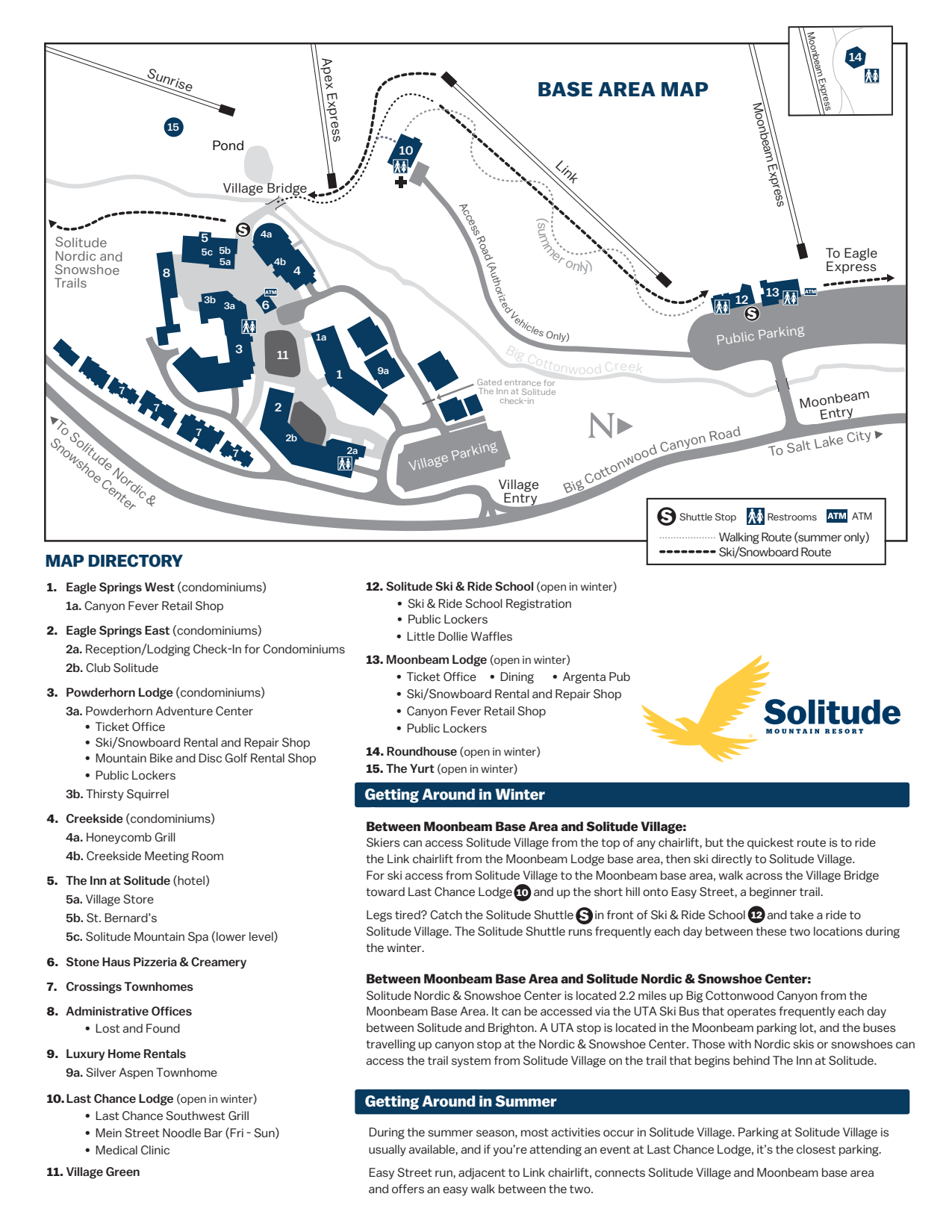
Solitude has slopeside accommodation in the base village, including the Inn at Solitude and a selection of condominiums and townhouses. The village is compact and walkable, with restaurants and the lifts within easy reach. Options range from hotel rooms to multi-bedroom units with kitchens - well suited to families and groups. Staying in the village gives you the quietest, most immersive mountain experience.
Beyond the resort, accommodation options include lodges and cabins in Big Cottonwood Canyon and the wider Salt Lake Valley. Cottonwood Heights, at the canyon mouth, splits the difference between mountain proximity and city access. Salt Lake City itself has the broadest range of hotels and is under 40 minutes from the resort, though the daily canyon drive adds up. The Ikon Pass connection to Brighton means your base works equally well for skiing both mountains.
Solitude is included on the Ikon Pass, which also gives access to neighbouring Brighton and a wide network of resorts across North America and internationally. A combined Solitude-Brighton ticket is available, and the two resorts are connected by a ski gate at the top of the ridgeline. Day tickets and multi-day passes are also sold directly. Check for family and multi-day pass options when booking your Solitude Mountain Resort ski holiday through WeSki to find the best fit for your trip.
Solitude has a rental shop in the base village offering standard and performance equipment for skiers and snowboarders. Additional rental shops in the Salt Lake Valley and Cottonwood Heights can offer wider selections and competitive pricing. Pre-booking is recommended during peak periods. Given Solitude's excellent powder snow, consider renting wider skis if a storm is in the forecast - standard all-mountain skis can feel outmatched in deep Utah powder.
The base village at Solitude is compact and entirely walkable. For getting to and from the resort, the UTA ski bus service runs from Salt Lake City up Big Cottonwood Canyon to both Solitude and Brighton throughout the ski season, providing a practical alternative to driving. If you have a car, the drive from Salt Lake City takes around 40 minutes, and parking at Solitude is free. The canyon road requires snow tyres or chains in winter. The ski gate connection to Brighton at the top of the ridgeline means you can ski between the two resorts without any driving.
Solitude is remarkably accessible from Salt Lake City International Airport (SLC), sitting approximately 50km to the south-east - around 40 minutes' drive up Big Cottonwood Canyon. For UK travellers, there are seasonal direct flights from London to Salt Lake City, or straightforward connections via major US hubs. The short airport-to-slopes transfer is one of the fastest in North America, making Solitude practical even for shorter trips.
WeSki provides car rentals from the airport as well as private transfers to Solitude Mountain Resort. Add them to your Solitude Mountain Resort ski holiday package for seamless door-to-door travel.
Solitude has a dedicated beginner area and ski school, so learning is absolutely possible. The beginner terrain is smaller than at some neighbouring resorts, but the trade-off is that the slopes are uncrowded and the teaching environment is calm. For absolute first-timers, it's a pleasant and pressure-free place to start. Brighton next door has a slightly wider spread of green runs, and the two are linked, so families with beginners can easily access both.
All three share the Wasatch's legendary powder, but the experiences are different. Snowbird and Alta are larger, steeper, and draw bigger crowds - they're expert-focused mountains with significant vertical and more extreme terrain. Solitude is smaller, quieter, and more family-friendly, with a genuine base village and a more balanced terrain mix. Honeycomb Canyon gives Solitude expert terrain that stands up to anything in the Wasatch, but the overall atmosphere is calmer. For skiers who want the powder without the crowds, Solitude is often the smartest choice.
Exceptional. Solitude averages around 12.7 metres of snowfall per season - the same famously dry, light powder that defines the Wasatch Range. The resort's position at the head of Big Cottonwood Canyon catches storms effectively, and the north-facing terrain in Honeycomb Canyon holds snow quality for days after the last storm. Utah's licence plates read "The Greatest Snow on Earth" and at Solitude, on a powder day, it's hard to argue.
Yes. Solitude and Brighton are connected at the top of the ridgeline by a ski gate, and a combined ticket or Ikon Pass gives access to both. Together, the two resorts provide over 900 hectares of terrain with quite different characters - Solitude leans towards groomed cruising and expert backcountry, while Brighton adds freestyle parks and a strong beginner programme. It's easy to ski one in the morning and the other after lunch.
UK skiers familiar with the European colour system should note the North American differences. Green circles mark beginner runs (equivalent to European greens and easy blues). Blue squares cover intermediates but span a wider range than European blues - some can be quite steep. Black diamonds indicate advanced terrain, and double black diamonds are expert only. There's no red run equivalent. At Solitude, the blacks in Honeycomb Canyon are genuinely challenging, so calibrate on the front-side blues before heading to the backside.
Honeycomb Canyon is Solitude's backside terrain - a large, north-facing bowl of steep, ungroomed runs accessed from the Summit chair. It's the most advanced area of the resort, with sustained black and double black diamond descents through chutes, cliff bands, and dense trees. The north aspect holds powder quality longer than the front face, making it the prime destination after a storm. For expert skiers, it's the reason to choose Solitude.
Yes. Solitude maintains 20km of groomed Nordic trails for both classic and skate skiing. The trails wind through the forest at the base of the resort and provide a scenic, peaceful alternative to downhill skiing. Nordic trail passes are separate from alpine lift tickets. It's a genuine asset for families with mixed interests or for anyone wanting a gentler day on snow.
 4.9/5
4.9/5I usually book flights, ground transportation, hotel, ski rental and lift tickets myself but this year used WeSki for a trip to Morzine. It was so much easier. Everything worked perfectly - ground transportation arrived on time and there was plenty of feedback throughout the whole process giving you confidence the vacation would go smoothly.

A really useful service that is so much easier to use than other 'all-inclusive' sites. It nicely bridges the gap between a travel agent and booking the trip yourself online. I'll use WeSki every time I go skiing from now on.
We booked a late minute skiing trip to Morzine through we ski. We looked at booking the trip ourselves but could get anywhere near the price quoted by we ski. The company was excellent and we had no problems at all from start to finish. I would definitely use them to book another weekend skiing trip.
Seamless experience from start to finish. I was spending ages trying to sort out a weekend break and managed to do it with we ski in minutes and for the same price as booking it all up yourself. Flight, transfers and accommodation was all as expected and faultless.