FR
FR
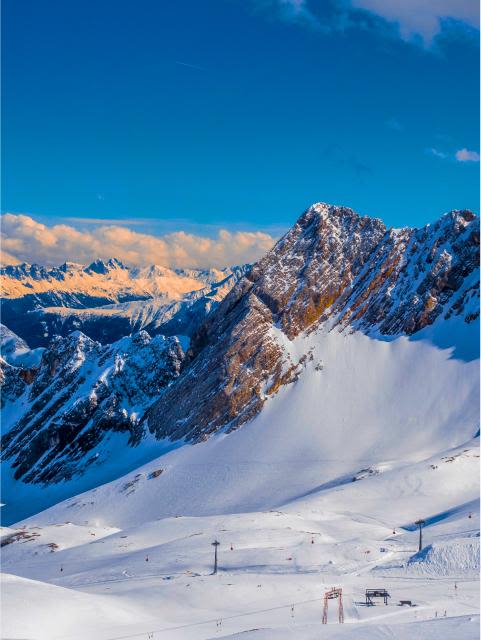
The Zugspitze area is a cross-border collection of ski resorts around Germany's highest mountain - the Zugspitze at 2,962 m. The area spans the border between Bavaria and the Austrian Tyrol, with Garmisch-Partenkirchen on the German side and Ehrwald-Lermoos and Berwang on the Austrian side. The Zugspitze itself is a landmark - visible for hundreds of kilometres, crowned by a gold cross, and home to Germany's highest glacier ski area. The skiing around it is spread across several separate sectors rather than one linked domain, but a shared pass covers everything, and the variety between Bavarian resort town, Austrian Tyrolean villages, and high-altitude glacier gives the area a distinctive range.
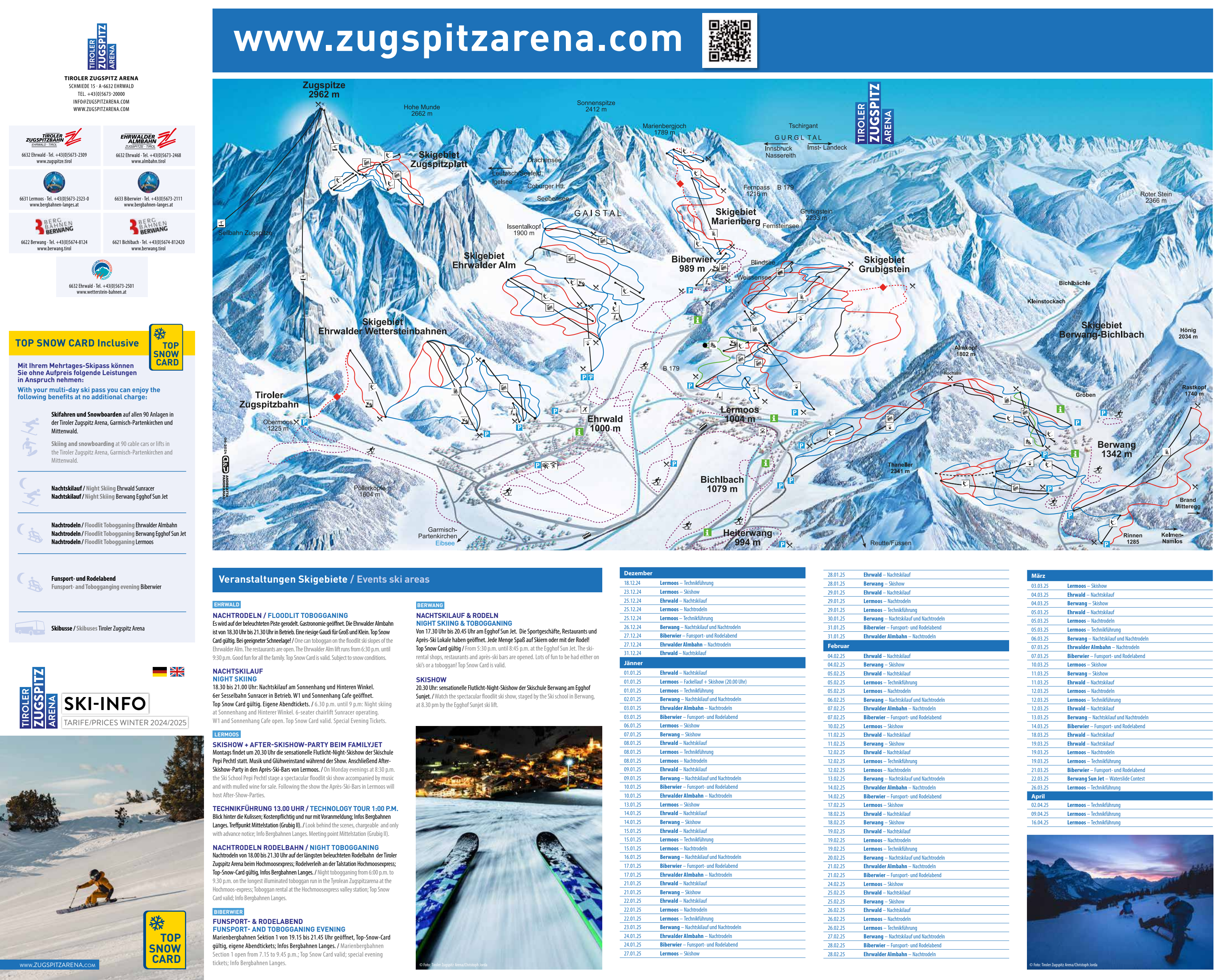
The combined area covers around 60 km of piste served by 33 lifts, sitting between 700 m and 2,720 m on the Zugspitzplatt glacier. There are 42 runs: 7 green, 14 blue, 14 red, and 7 black. The Zugspitze glacier operates from late November to early May; the lower areas run from mid-December to mid-April. The main sectors include Garmisch-Classic (the Hausberg-Kreuzeck-Alpspitze area), the Zugspitze glacier, the Ehrwalder Alm, the Grubigstein above Lermoos, and the Berwang ski area.
Garmisch-Partenkirchen is the best-known base - a famous Bavarian resort town with Winter Olympics heritage and a lively main street. Ehrwald and Lermoos are quieter Austrian villages on the opposite side of the Zugspitze. Berwang is a small, traditional village further along the Austrian side. Between them, you get a mix of glacier skiing, intermediate cruising, and family-friendly terrain across two countries. Browse Zugspitze ski deals on WeSki to start planning your trip.
| Country | Germany and Austria |
| Region | Bavaria (Germany) / Tyrol (Austria) |
| Total piste km | 60 km (combined across all sectors) |
| Altitude | 700 m (Garmisch-Partenkirchen) - 2,720 m (Zugspitze glacier) |
| Linked resorts | 3 Garmisch-Partenkirchen [Germany] Ehrwald-Lermoos [Austria] Berwang [Austria] |
| Lifts | 33 |
| Runs | 42 (7 green, 14 blue, 14 red, 7 black) |
| Season | Late November - early May (Zugspitze glacier); mid-December - mid-April (lower areas) |
| Ski pass name | Zugspitze Arena pass / Tiroler Zugspitz Arena pass |
| Nearest airports | Innsbruck (~1 hr) Munich (~1 hr 30 min) |
| Glacier skiing | Yes - Zugspitzplatt glacier (2,720 m), Germany's highest ski area |
| WeSki services | Transfers: all 3 resorts (private and shared to Garmisch-Partenkirchen and Ehrwald-Lermoos; private to Berwang and Zugspitze). No WeSki lessons or ski equipment hire currently available. Rental shops and ski schools available locally |
Garmisch-Partenkirchen is Germany's most famous ski resort - a sizeable Bavarian town at 700 m that hosted the 1936 Winter Olympics and continues to host the annual New Year's Day ski jumping event at the Große Olympiaschanze, part of the Four Hills Tournament. The town has a picturesque centre with painted facades, good restaurants, and a bustling atmosphere. The skiing is split between two areas: Garmisch-Classic (the Hausberg-Kreuzeck-Alpspitze sector, reaching 2,050 m, with the famous Kandahar World Cup downhill course) and the Zugspitze glacier (2,720 m, accessed by cable car from the Eibsee or by cog railway via the Zugspitzplatt). The Kandahar downhill is one of the most demanding courses on the World Cup circuit and is open to the public. The glacier provides the highest skiing in Germany - wide, open runs above the treeline with views across four countries on a clear day.
Ehrwald and Lermoos are two traditional Tyrolean villages on the Austrian side of the Zugspitze, connected by the Zugspitz Arena pass. Ehrwald sits at 994 m at the foot of the Zugspitze's dramatic west face, with the Ehrwalder Alm providing a family-friendly ski area at altitude - wide, sunny slopes that are ideal for beginners and intermediates. The Tiroler Zugspitzbahn cable car from Ehrwald also provides access to the Zugspitze summit and glacier from the Austrian side. Lermoos (1,004 m), a few kilometres along the valley, has the Grubigstein ski area - a more varied mountain reaching 2,100 m with good reds and some steeper terrain. Both villages have a relaxed, traditional Austrian atmosphere with good Gasthöfe and mountain restaurants.
Berwang is a small, traditional village at 1,336 m - the highest village in the Zugspitz Arena area - in a quiet, sunny valley east of Lermoos. The ski area is compact (around 36 km of piste) and well-suited to families and intermediates, with gentle blues and well-groomed reds on a sunny, open mountainside. The village has a handful of hotels and guesthouses and a genuinely local Tyrolean character. It's connected to the Berwangertal-Bichlbach-Heiterwang ski area, and the higher base altitude means better snow conditions than the lower valley resorts. It's the calmest and most traditional base in the Zugspitz Arena.
The Ehrwalder Alm above Ehrwald is one of the best beginner areas in the region - a wide, sunny plateau at altitude with gentle slopes separated from faster traffic and a calm, family-oriented atmosphere. Berwang also has good beginner terrain on its sunny, well-groomed slopes. In Garmisch, the Hausberg area at the base of Garmisch-Classic has a nursery zone, though the terrain above gets steeper quickly. The Zugspitze glacier has wide, open blues at altitude, but the thin air at 2,700 m can tire beginners out. Start at the Ehrwalder Alm or Berwang for the most comfortable learning experience.
WeSki does not currently have lessons or ski equipment hire available in the Zugspitze area. All resorts have local ski schools with English-speaking instructors, and rental shops are widely available.
WeSki tip: The Ehrwalder Alm is a brilliant beginners' mountain - wide, sunny, and at altitude, so the snow quality is good. It's accessed by gondola from Ehrwald and feels like a separate, dedicated learning area. Once you're confident, the Grubigstein above Lermoos is the natural next step for more varied terrain.
With 14 blues and 14 reds spread across the sectors, intermediates have a good variety. The Garmisch-Classic area has the most range - the runs from the Alpspitze (2,050 m) and Kreuzeck back to Garmisch have good vertical through the trees. The Grubigstein above Lermoos has varied reds with consistent pitch and views across to the Zugspitze. The glacier provides a completely different experience - wide, open runs above the treeline at 2,700 m with panoramic views. Skiing different sectors on different days keeps the week interesting.
WeSki tip: Spend a morning on the Zugspitze glacier for the experience and the views - on a clear day you can see across to the Dolomites, the Swiss Alps, and the Czech Republic. The skiing itself is relatively limited (a handful of runs), but the setting is extraordinary. Then head to the Garmisch-Classic or Grubigstein for a full afternoon of more varied terrain.
The Kandahar World Cup downhill at Garmisch-Classic is the headline run for advanced skiers - a demanding, sustained course that's open to the public outside race days. The steep runs off the Osterfelderkopf and through the Höllentalklamm are also challenging. On the Austrian side, the Grubigstein has some steeper reds and blacks. Off-piste is limited by the moderate size of the ski areas, but the glacier terrain above 2,500 m has some interesting lines, and the Garmisch-Classic sector has tree skiing after fresh snow. For more extensive terrain, Innsbruck and the Stubai Glacier are about an hour's drive.
WeSki tip: The Kandahar downhill course at Garmisch-Classic is open to the public and worth a run - it's a proper World Cup piste with genuine pitch. The start section from the Kreuzjoch is the steepest part. The Four Hills Tournament ski jumping on New Year's Day (1 January) is one of the great sporting spectacles in the Alpine calendar - the atmosphere in Garmisch is extraordinary.
The Tiroler Zugspitz Arena pass covers the Austrian resorts (Ehrwald, Lermoos, Berwang, and neighbouring areas) on a single ticket. The Garmisch-Classic and Zugspitze glacier have their own German passes. A combined Zugspitze Arena pass covering both countries is available for longer stays. Passes are available from one day up to the full season, with discounted rates for children, teens, and seniors. The Top Snow Card extends coverage even further, including Innsbruck's ski areas.
WeSki does not currently have ski equipment hire available in the Zugspitze area, but rental shops are widely available in Garmisch-Partenkirchen, Ehrwald, Lermoos, and Berwang.
WeSki tip: If you're staying on the Austrian side and want to ski the Zugspitze glacier, check whether the combined pass covers both countries - the pass structure can vary by season. The Tiroler Zugspitzbahn from Ehrwald reaches the summit from the Austrian side, so you can access the glacier without needing to go via Garmisch.
The area is well positioned between two major cities. Innsbruck is about 1 hour's drive to the Austrian resorts, via the scenic Fernpass or the Seefeld plateau. Munich is around 1 hour 30 minutes to Garmisch-Partenkirchen via the A95 motorway. By train, Garmisch-Partenkirchen is on the Munich-Innsbruck railway line, with direct services from Munich taking about 1 hour 20 minutes. The Bayerische Zugspitzbahn cog railway runs from Garmisch to the Zugspitzplatt glacier station. Ehrwald and Lermoos are on the Austrian side of the pass, reached by bus from Garmisch (about 20 minutes) or by the Außerfern railway.
WeSki has private and shared transfers to Garmisch-Partenkirchen and Ehrwald-Lermoos, plus private transfers to Berwang and the Zugspitze area. Add them to your booking for a straightforward door-to-door trip.
The Zugspitze glacier opens from late November and stays open until early May. The lower areas (Garmisch-Classic, Ehrwalder Alm, Grubigstein, Berwang) typically operate from mid-December to mid-April. The glacier provides the most reliable snow, and conditions on the Garmisch-Classic sector can be variable given the relatively low altitude (the town sits at just 700 m). Snowmaking is good on the main runs. January to mid-March sees the most consistent conditions across all sectors.
German and Austrian school holidays in February and the Christmas-New Year period are the busiest times. The Four Hills Tournament ski jumping on New Year's Day draws enormous crowds to Garmisch. If you've got flexibility, early January (after the jumping) and the first half of March are quieter. The glacier is a draw for early and late-season skiing, and the views from 2,720 m are at their clearest in winter on cold, high-pressure days.
Yes. The Ehrwalder Alm above Ehrwald and Berwang's slopes are well-suited to beginners, with wide, gentle terrain and a calm atmosphere. WeSki does not currently have lessons or ski equipment hire available, but all resorts have local ski schools and rental shops.
The combined area covers around 60 km of piste served by 33 lifts, ranging from 700 m to 2,720 m on the Zugspitze glacier. There are 42 runs across several sectors in Germany and Austria. The sectors are not linked by lifts but share a combined pass.
The Zugspitze is Germany's highest mountain at 2,962 m, straddling the border between Bavaria and Tyrol. The summit has a viewing platform, a gold cross, and panoramic views across four countries. The Zugspitzplatt glacier below the summit provides Germany's highest ski area at 2,720 m, with wide, open runs above the treeline. It's accessed by cable car from Garmisch (Eibsee) or Ehrwald.
Yes. Garmisch-Partenkirchen is in Bavaria, Germany. Ehrwald, Lermoos, and Berwang are in Tyrol, Austria. The Zugspitze summit sits on the border. Combined passes cover both countries. The Austrian side is accessed via the Fernpass or directly from Innsbruck.
The Kandahar is the World Cup downhill course at Garmisch-Classic, named after Field Marshal Lord Roberts of Kandahar who founded the Kandahar Ski Club. It's one of the most demanding courses on the circuit and is open to the public outside race days. The course drops from the Kreuzjoch to Garmisch with sustained steep sections.
The Zugspitze glacier operates from late November to early May. The lower areas run from mid-December to mid-April. Garmisch's low altitude (700 m) means conditions at valley level can be variable; the glacier and higher Austrian areas hold snow better.
Fly to Munich (about 1 hr 30 min drive to Garmisch) or Innsbruck (1 hr to the Austrian resorts). By train, Garmisch-Partenkirchen is about 1 hr 20 min from Munich by direct service. WeSki has private and shared transfers to Garmisch-Partenkirchen and Ehrwald-Lermoos, plus private transfers to Berwang.
No. The Zugspitze area is a collection of separate ski sectors covered by a shared pass. Garmisch-Classic, the Zugspitze glacier, the Ehrwalder Alm, the Grubigstein, and Berwang are all separate. You'll need to drive or take a bus between them. Distances are short - the resorts sit within a 20-minute radius.
Start building your dream ski trip today with our one-stop ski shop - hundreds of resorts, unlimited combinations.
 4.9/5
4.9/5Je réserve habituellement moi-même les vols, les transferts, l'hôtel, la location du matériel de ski et les forfaits ski, mais cette année j'ai utilisé WeSki pour un séjour à Morzine. C'était tellement plus simple. Tout a parfaitement fonctionné - les transferts sont arrivés à l'heure et il y avait beaucoup de retours d'information tout au long du processus, ce qui vous donne confiance que les vacances se dérouleront sans problème.

Un service vraiment utile qui est beaucoup plus facile à utiliser que d'autres sites "tout compris". Il comble parfaitement le fossé entre une agence de voyage et la réservation du séjour par vous-même en ligne. J'utiliserai WeSki chaque fois que j'irai au ski à partir de maintenant.
Nous avons réservé un séjour au ski de dernière minute à Morzine via WeSki. Nous avions envisagé de réserver le séjour nous-mêmes, mais nous n'avons pas pu trouver un prix aussi avantageux que celui proposé par WeSki. L'entreprise a été super et nous n'avons rencontré aucun problème du début à la fin. Je passerai certainement de nouveau par eux pour réserver un autre week-end au ski.
Une expérience fluide du début à la fin. Je passais des heures à essayer d'organiser un week-end et j'ai réussi à le faire avec WeSki en quelques minutes et pour le même prix que si je l'avais réservé moi-même. Le vol, le transfert et l'hébergement étaient tous comme prévu et nous n'avons rencontré aucun problème.
Weski Europe BV (numéro d'enregistrement 87334100 à la chambre de commerce) est un membre enregistré de SGR. Vous pouvez vérifier cela sur www.sgr.nl/english. Les vacances répertoriées sur ce site web sont couvertes par la garantie de SGR, selon les termes du programme de garantie SGR. Sous la garantie SGR, les consommateurs verront la somme de leur voyage prépayée remboursée si leur contrepartie est incapable de remplir ses obligations contractuelles en raison d'une incapacité financière. Dans la mesure où l'accord comprend le transport et que la destination a déjà été atteinte, le voyage de retour sera organisé.