EN
EN
 Classic mountain charm
 Stunning views
 Backcountry (off-trail) skiingClassic mountain charmStunning viewsBackcountry (off-trail) skiingClassic mountain charmStunning viewsBackcountry (off-trail) skiingClassic mountain charmStunning viewsBackcountry (off-trail) skiing
Situated in the heart of the Canadian Rockies, Lake Louise Ski Resort offers a breathtakingly vast and pristine ski area with over 1,699 ha/4,200 ac of skiable terrain. This resort, famed for its stunning scenic beauty, encompasses varied terrain across four mountain faces, reaching elevations of up to 2,637 m/8,651 ft. With 145 km (90 mi) of world-class slopes, Lake Louise caters to skiers and snowboarders of all abilities, from gentle runs for beginners to challenging bowls and steeps for the experienced. The ski season here extends from early November to late May, characterized by reliable snow conditions and plenty of crisp, clear days. Beyond skiing, the resort area is a hub for winter activities like snowshoeing and ice skating, set against the backdrop of the iconic, frozen Lake Louise. The nearby village offers cozy accommodation, inviting dining options, and a tranquil atmosphere. Lake Louise Ski Resort, with its awe-inspiring surroundings and diverse terrain, is more than just a ski destination; it's a winter wonderland experience.
Situated in the heart of the Canadian Rockies, Lake Louise Ski Resort offers a breathtakingly vast and pristine ski area with over 1,699 ha/4,200 ac of skiable terrain. This resort, famed for its stunning scenic beauty, encompasses varied terrain across four mountain faces, reaching elevations of up to 2,637 m/8,651 ft. With 145 km (90 mi) of world-class slopes, Lake Louise caters to skiers and snowboarders of all abilities, from gentle runs for beginners to challenging bowls and steeps for the experienced. The ski season here extends from early November to late May, characterized by reliable snow conditions and plenty of crisp, clear days. Beyond skiing, the resort area is a hub for winter activities like snowshoeing and ice skating, set against the backdrop of the iconic, frozen Lake Louise. The nearby village offers cozy accommodation, inviting dining options, and a tranquil atmosphere. Lake Louise Ski Resort, with its awe-inspiring surroundings and diverse terrain, is more than just a ski destination; it's a winter wonderland experience.
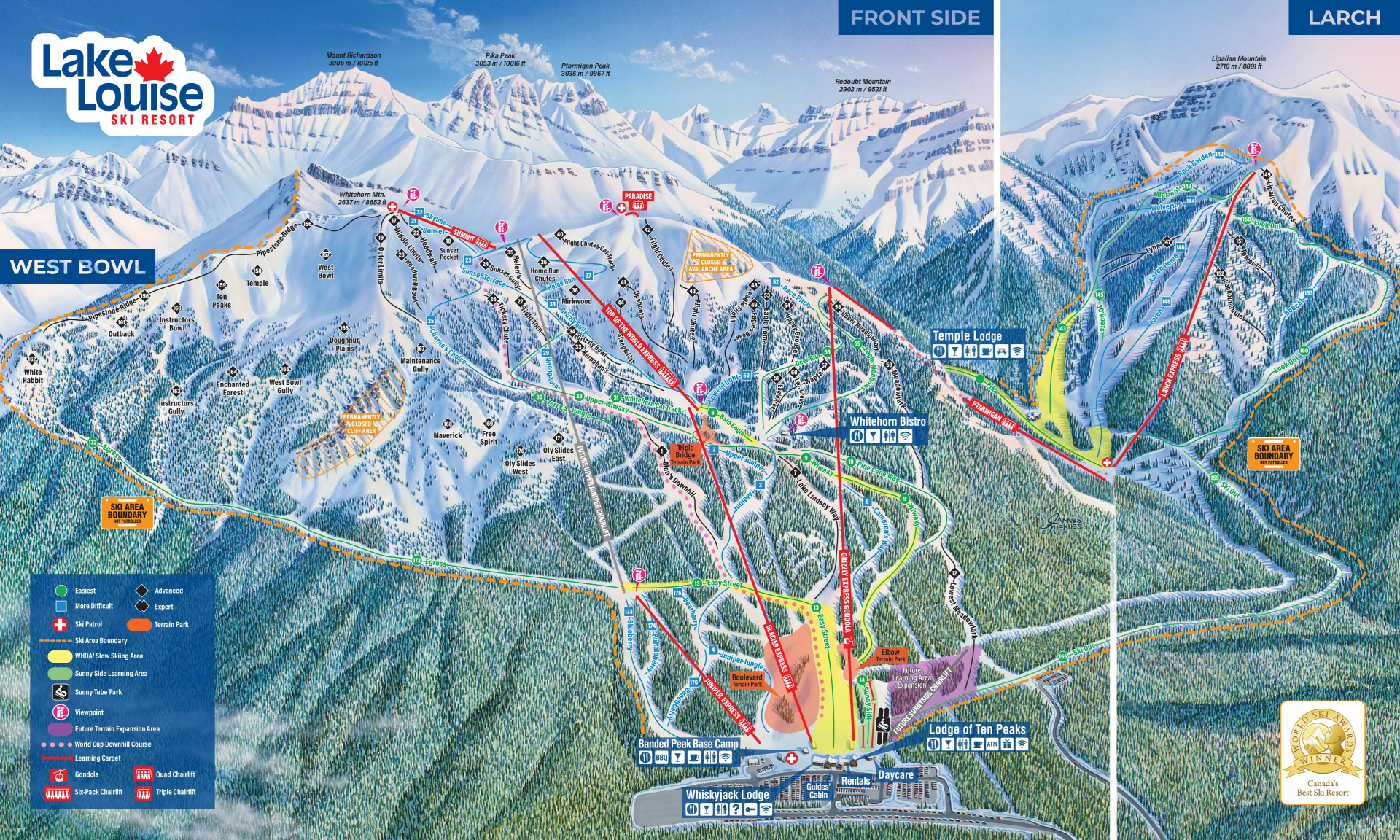
Lake Louise splits into three areas, each with a different feel. The front side has the gentler skiing, with broad, open groomers running down towards the lake and a learning area by the base lodge. Behind it, the back bowls are a wide expanse of steep, mostly ungroomed terrain, where strong skiers head for the chutes, tree lines, and open faces. Between the two sits the Larch area, a spread of tree-lined groomers and glades. A green or blue run comes off nearly every lift, so beginners can explore the whole mountain rather than stay near the learning area, and mixed-ability groups can ride up together and each take their own way down.
Getting around is easy once you know the layout. The front side has the fastest lifts: a gondola and two high-speed quads. From there, a six-seater carries you up to the 2,637m summit, where the back bowls begin. The back side is slower, with two older fixed-grip chairs, and a few of the links between areas are flat catwalks, so it helps to carry your speed. Most people ski the mountain as a loop, starting on the front side, crossing to Larch and the back bowls, then working back round.
Important for international visitors: One thing worth knowing if you've mostly skied in Europe is that North America grades its runs differently. Green circles are beginner terrain, roughly like European greens and easy blues. Blue squares are intermediate, but they cover a wide span, so a confident intermediate may find some on the tougher side. Black diamonds are advanced, and double black diamonds are expert-only, often steep chutes, mogul fields, or cliff bands. There's no direct equivalent to the European red, so the blue square does a lot of the work across the middle of the range, worth bearing in mind when you're picking runs.
Beginners have it good at Lake Louise, because there's a green run off nearly every chair, so you're not confined to the bottom of the hill while you learn. Most people start in the learning area by the base lodge, where carpet lifts and a marked slow zone on the lower part of Wiwaxy give you gentle, protected space to find your balance. From there, Wiwaxy is a great run to get to know, a long, wide green that rolls all the way down the front side from mid-mountain, with Deer Run and Eagle Meadows feeding into it from higher up if you want to stretch it into one long descent.
As you grow more confident, you can mix in the easy front-side blues, like Juniper and Cameron Way, without any big jumps in difficulty. The gondola helps, as well. It carries you up to mid-mountain, opens up the gentle greens on the back side, and gives you a way out if you are not ready for the run down, since you can ride it back to the base rather than ski.
WeSki insider tip: Once you're comfortable on the greens, take the gondola over towards the Larch area and ski Lookout. It's one of the gentlest runs on the mountain, and a change of scene from the front-side beginner slopes, with tree-lined views and the satisfaction of getting yourself around a big hill.
There's a lot of intermediate terrain at Lake Louise, spread right across the mountain, so you can ski all week without repeating yourself. The front side is a good place for covering ground, with wide, well-groomed blues where you can carry speed and link long descents. Meadowlark, out on the far edge of the front side and reached from the top of the gondola, is a favourite, especially first thing after it's been groomed. Over the back, the Larch area is intermediate heartland, with tree-lined cruisers, well-sheltered snow, and Rock Garden, a fun run that picks its way through a field of boulders.
When you're ready to push on, the Larch runs steepen up, and there's the mountain's longest run to aim for. At a full 8km from the summit to the base, it's worth linking together once, as much for the way the terrain shifts on the way down as for the distance.
WeSki insider tip: You don't have to be an expert to ski the famous back bowls. Boomerang is the one blue run back there, not steep but often left ungroomed, so it makes a good first taste of the bowls and their views, and a gentle way to try your first turns in powder.
For strong skiers, the back bowls are the highlight of Lake Louise. Reached by heading over the summit, they're a vast, mostly ungroomed expanse of steep open faces, narrow chutes, and tight gullies. The best known is Whitehorn 2, a set of eight double-black gullies off the Summit chair that rank among the steepest lines on the mountain. Nearby, the Eagle Ridge chutes fall off the ridge in a run of technical, no-fall-zone descents, ER3 among them, a line steep enough to host freeride competitions.
West Bowl is another highlight. Brought inside the resort boundary in recent years, it's now patrolled and avalanche-controlled but still feels like true backcountry, open snowfields giving way to glades and gullies lower down. Because the back bowls cover so much ground, fresh snow lasts, and there are untracked lines to be found well after a storm has passed. If you want more still, the SkiBig3 tri-area pass adds Sunshine Village, whose high, snow-holding terrain rounds out the expert options nicely.
WeSki insider tip: For tree skiing that most people ski straight past, head for the Ptarmigan Glades on the front side. They take a short hike from the top of the gondola, which is enough that most skiers skip them, so you can often find fresh, untracked lines through the widely spaced trees even late in the day.
Lake Louise is a proper snowboarder's mountain, with every trail and park open to boards. Its natural terrain is the real draw. The wide-open back bowls leave room for big carving turns, their gullies ride like natural halfpipes, and the long tree runs in Larch and off the Top of the World are a pleasure on a board. When you want to session features, five progressive parks sit together on the front side, running from a gentle beginner park up to bigger jumps and technical lines, all off the same chair so you can lap them fast. The main thing to plan around is the flat traverses between areas. Keep your speed up, or you'll end up unstrapping and walking.
A lot of what makes Lake Louise special is off the groomers, and much of it sits inside the resort boundary. The back bowls are the heart of it, wide, ungroomed alpine terrain that skis like backcountry but is patrolled and avalanche-controlled, so you can ride it without touring gear. After snow, the Larch and Ptarmigan glades hold powder in the trees for days. Marked gates lead further out to sidecountry like Wild West and Purple Bowl, but these are unpatrolled, so you need a beacon, shovel, and probe, the training to use them, and ideally a guide. Conditions shift fast in the Rockies, so check the patrol's daily bulletin before you drop in anywhere, and local operators run guided trips if you want to head deeper into the park.
The Lake Louise Snow School takes skiers and boarders from first-timers to strong skiers wanting to tackle steeper terrain, with private lessons and group classes to choose from. The mountain's layout helps here. With easy, moderate, and hard terrain off nearly every lift, an instructor can always find the right pitch to work on without hauling you across the resort. A private lesson can double as a guided tour if you'd rather be shown around than drilled on technique. Early First Tracks sessions get you out before the lifts open to everyone, and adaptive lessons run through Rocky Mountain Adaptive for skiers with disabilities.
Freestyle is a big part of Lake Louise, with five terrain parks laid out for progression and around 60 features between them, all on the front side off the Glacier Express chair. You build up through them. Grizzly Cubs and Elbow are the starting points, with small kickers and ride-on boxes for your first hits, before Triple Bridge steps things up with medium jumps, rails, and tubes to link into proper lines. Boulevard and Easy Street are where it gets serious, with bigger, more technical rails and large jump lines for confident riders. The crew shapes and maintains the features through the season, and there's a snow-cross course over in the Juniper area if you fancy a change from jumps and rails.
Lake Louise works well for families, and that comes down to a mix of things: the layout, the manageable size of the place, and the services and activities on hand. Since there's a run of every level off nearly every chair, a mixed-ability family can ride up together and regroup at the bottom rather than splitting up for the day. The village is small enough that everything stays manageable, and there's a licensed daycare at the base lodge that takes children from infancy, so the youngest can be looked after while everyone else skis.
For younger children learning, the Sunny Side area sits right by the base, with carpet lifts and gentle slopes kept clear of the faster runs, and the ski school takes them from age three, with snow-garden zones and indoor warm-up spaces. Older children and experienced young skiers have more to work with. The five terrain parks build from first-timer features up to big jumps and rails, and Larch's tree runs are lively enough to keep them coming back.
There's just as much for families away from the pistes. The frozen lake becomes a skating rink in winter, with an ice castle carved beside it, and there's tubing at the base, horse-drawn sleigh rides, and a sightseeing gondola for a look out over the valley and its wildlife. When it comes to eating, the base and mid-mountain lodges do hearty, familiar food that suits hungry children, and for a smarter night out, the Fairmont Chateau by the lake and the restaurants in Banff cover everything from casual to special.
Because Lake Louise sits inside a national park, life off the slopes leans towards the outdoors. The setting opens up winter activities beyond the usual, from skating on the frozen lake to walking through canyons of frozen waterfalls, while the town of Banff, 45 minutes away, adds museums, restaurants, shops, and hot springs when you want a change. Whether you're after something active or simply scenic, here's what's worth doing beyond the skiing.
Eating around Lake Louise splits between the mountain and the village, where the food is hearty and Canadian, and the town of Banff, where the choice opens right up. What ties it together is the local larder. This is Alberta beef and Rocky Mountain game country, so bison, elk, and locally raised beef turn up on menus alongside seasonal, often foraged ingredients. By day it's mountain fuel; by evening it's anything from a plate of game to a bowl of ramen, especially over in Banff, where the scene runs from farm-to-table Canadian to Italian and Japanese.
WeSki insider tip: Have poutine at least once. The Canadian staple of chips, cheese curds, and gravy is proper mountain fuel, and you'll find a good version at most casual spots around the resort and in Banff.
Après at Lake Louise is a relaxed, fireside affair. As the lifts wind down, the slope-side deck at the base is the first stop for a beer, with live music at weekends, and from there things move into the village, where a handful of hotel bars and pubs make cosy spots for a drink, some with an open fire or a view of the lake. For a livelier night, Banff is about 45 minutes away, with a proper spread of bars, pubs, live music, and craft breweries, and most hotels can help arrange transport.
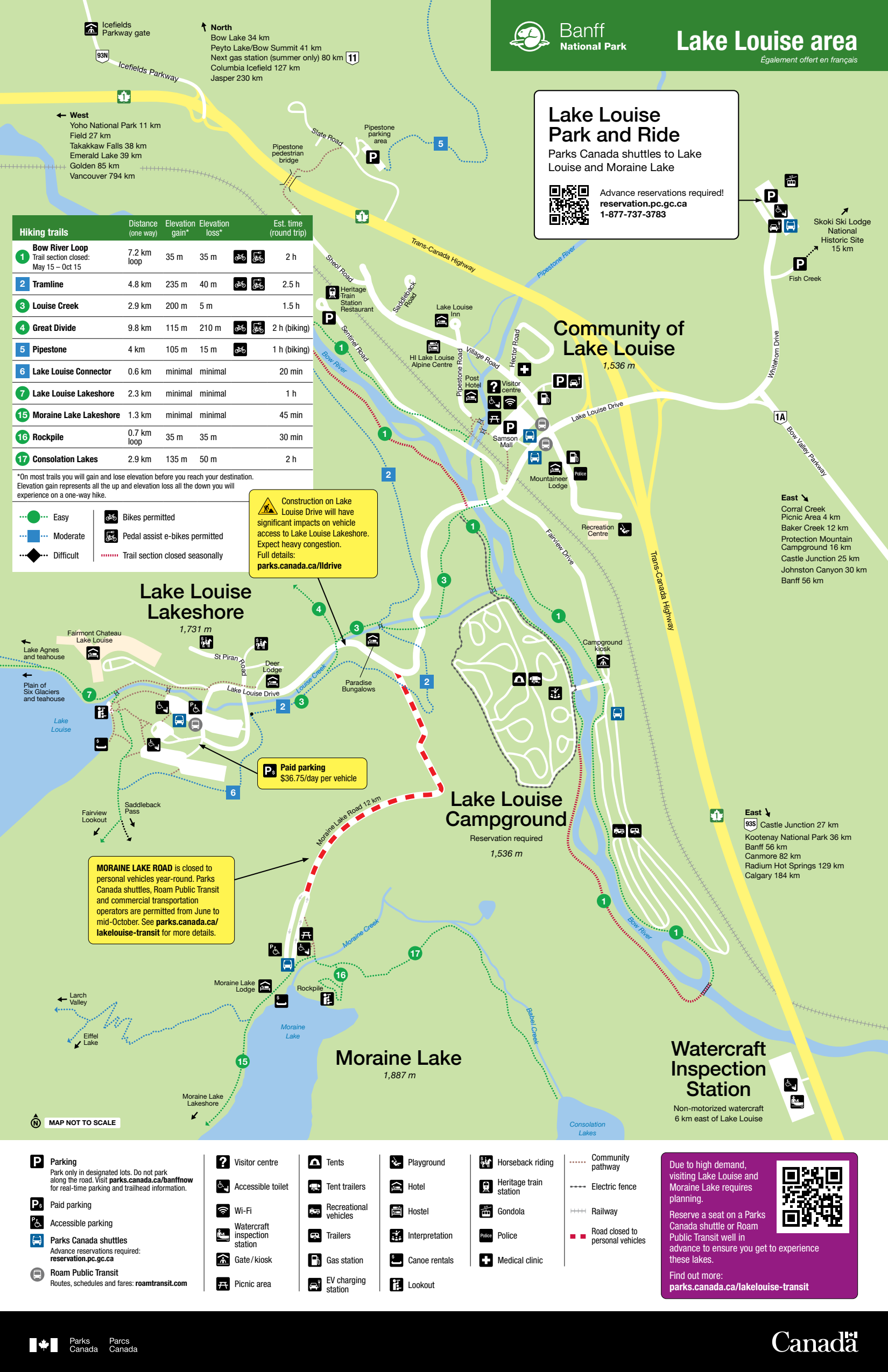
Accommodation at Lake Louise runs from cosy timber lodges and self-catering cabins to grand, historic hotels, offering a fair spread of character for such a small place. Most sit in or around the little village, a short way from the lake and the ski hill, ranging from relaxed, rustic lodges to more polished, full-service hotels with spas and fine dining. The grandest is the Fairmont Chateau Lake Louise, right on the lakefront.
Staying here is quiet and close to nature. Lake Louise village itself is a tiny hamlet in the middle of Banff National Park, walkable end to end, with a grocery store and a few restaurants but not much bustle. In return you get calm mornings and evenings under the dark, star-filled skies of the national park. The frozen lake and its trails sit right on the doorstep, and the ski hill is a few kilometres across the valley.
A standard Lake Louise lift pass covers all 13 lifts and the full 4,200 acres, which is more than enough for most trips. If you want to range further, the SkiBig3 pass adds neighbouring Sunshine Village and Mt Norquay, bringing the total to around 8,000 acres across the three resorts, with free shuttles running between them. Multi-day passes tend to work out better value the longer you ski. WeSki also offers the Ikon Pass for those who want it, which covers all three Banff resorts along with dozens more worldwide, useful if you're pairing Lake Louise with other Ikon destinations.
Check the multi-day pass options when booking your Lake Louise ski holiday with WeSki to find the best fit for your trip.
You've got a few rental options without leaving Lake Louise. The resort's own shop is right at the base, handy for grabbing gear on the way to the lifts and for swapping a ski or board mid-morning if something isn't working for you. Down in the village, Wilson Mountain Sports is the one to use if you'd rather get sized and fitted the evening before, so you're ready to go first thing. Between them you'll find the full range, from skis, boards, boots, and helmets to higher-end performance and demo models if you fancy trying something better. It's worth booking ahead over the busy weeks around Christmas and February, when the shops get stretched.
Day to day, getting around Lake Louise is simple. The village is small and easily walked end to end, and the base of the ski hill has everything you need for the day, from rentals to lunch, in one place. The slopes sit a few kilometres across the valley, but a free shuttle runs between the Lake Louise hotels and the base throughout the ski day, with room for your gear, so most people never bother driving to the slopes.
A hire car gives you more freedom, useful for dinner out or a look around the national park, but it's far from essential. Taxis exist but are thin on the ground, so book ahead if you need a lift in the evening. And when you fancy a change of scene, the town of Banff is about 45 minutes down the highway, an easy day out for its shops, restaurants, and hot springs.
The nearest airport is Calgary International (YYC), about 185km east of Lake Louise. From there it's a straightforward drive west on the Trans-Canada Highway, around two to two and a half hours depending on traffic and conditions, and a scenic one, with the Rockies rising ahead of you as you go. Calgary is a major international gateway, so you'll find some direct seasonal flights along with easy connections through the main North American hubs.
WeSki offers car hire from the airport along with private and scheduled transfers to Lake Louise, so you can add door-to-door travel to your package and skip the logistics.
Yes. Lake Louise has good beginner terrain, with a dedicated learning area by the base and, unusually, a green run off nearly every lift, so you can get around much of the mountain rather than stay in one corner. The greens (roughly equivalent to European greens and easy blues) are wide, gentle, and well groomed, and the gondola gives easy access to mid-mountain with nothing steep to tackle on the way down. It's a bigger resort than beginners might expect, but the front-side progression from greens to easy blues is nicely laid out.
Both are part of SkiBig3 and share the pass, but they ski quite differently. Lake Louise is known for its long runs, its back bowls and tree skiing, and a layout with a run of every level off most lifts, which makes it easy for mixed-ability groups. Sunshine Village sits higher, it has the highest top elevation of any resort in Canada, so it tends to get more snow and holds a longer season, often into late May, and it has a small village up on the mountain. Plenty of people ski both across a trip, since they're linked by the free shuttle.
Lake Louise gets cold, dry Rocky Mountain snow, the light, powdery sort, and its high, north-facing terrain keeps it in good shape. The resort averages around 4.5 metres a year, and the season runs from early November into early May. Because it's so cold, the snow tends to stay light rather than turn heavy and wet, and snowmaking backs up the natural cover on the main runs.
North America grades runs differently from Europe. Green circles are beginner terrain, close to European greens. Blue squares are intermediate but cover a wide span, so some will feel more like a European red. Black diamonds are advanced and steep, and double black diamonds are expert-only. There's no direct equivalent to the European red, so blue squares can vary a lot in difficulty, worth bearing in mind when you pick your runs.
Yes. There are children's programmes from age three, a beginner area kept clear of the faster runs, and a family-friendly base lodge with daycare for little ones. The village is small and easy to manage with young children, and the shuttle and gondola make getting to and around the mountain simple. Teenagers have the terrain parks and the back bowls to grow into, while anyone not skiing can skate on the frozen lake, ride the sightseeing gondola, or get out into the national park.
Banff is about 60km from Lake Louise, roughly a 45-minute drive along the Trans-Canada Highway. It makes an easy day or evening trip for its restaurants, bars, and shops, reached by car or on the free winter shuttle that links the two. A hire car gives you more freedom for evenings out, though WeSki's transfers mean you don't need one.
The season runs from early November into early May. Early on, the cold and the snowmaking usually give a good base to start on. January and February bring the deepest, driest snow, along with the coldest spells, often below -20°C. March and April are milder, with longer days and often good spring conditions. The busiest weeks are around Christmas and the February holidays, so book early if those are your dates.
 4.9/5
4.9/5I usually book flights, ground transportation, hotel, ski rental and lift tickets myself but this year used WeSki for a trip to Morzine. It was so much easier. Everything worked perfectly - ground transportation arrived on time and there was plenty of feedback throughout the whole process giving you confidence the vacation would go smoothly.

A really useful service that is so much easier to use than other 'all-inclusive' sites. It nicely bridges the gap between a travel agent and booking the trip yourself online. I'll use WeSki every time I go skiing from now on.
We booked a late minute skiing trip to Morzine through we ski. We looked at booking the trip ourselves but could get anywhere near the price quoted by we ski. The company was excellent and we had no problems at all from start to finish. I would definitely use them to book another weekend skiing trip.
Seamless experience from start to finish. I was spending ages trying to sort out a weekend break and managed to do it with we ski in minutes and for the same price as booking it all up yourself. Flight, transfers and accommodation was all as expected and faultless.