EN
EN
Ski-in ski-out is one of those terms that sounds straightforward until you start looking at actual properties. The phrase crops up in almost every resort listing, but what it means in practice varies a lot - from stepping directly onto a piste to a short walk with skis over one shoulder. This guide explains the different levels of slope-side access, what drives the price difference, and how to decide whether it's the right fit for your trip. If you're already sold on the idea and want to start searching, our guide to how to find ski-in ski-out accommodation covers the practical steps. And if you'd rather browse what's available, our list of the best ski-in ski-out resorts and hotels is a good place to start.
At its simplest, ski-in ski-out means you can clip into your bindings at your accommodation and ski directly onto a piste - and at the end of the day, ski back to your door without removing your skis. No shuttle bus, no car, no walk through town carrying equipment. The door-to-slope connection works in both directions.
In reality, the experience sits on a spectrum. Some properties are literally on the piste - you step outside and you're on groomed snow. Others involve a short tracked path, a gentle slope to a lift station, or a covered walkway to a gondola mid-station. All of these get marketed as ski-in ski-out, and technically they are, but the convenience gap between them can be significant.
What most people are actually looking for when they search for ski-in ski-out is the removal of friction: no faffing with boots in the street, no waiting for a crowded navette, no ten-minute uphill trudge in ski boots at four in the afternoon. That's the value proposition, and it's worth understanding exactly how much friction a given property removes before you commit.
Not all ski-in ski-out is created equal, and the differences matter more than most listings suggest. Here are the main categories you'll encounter:
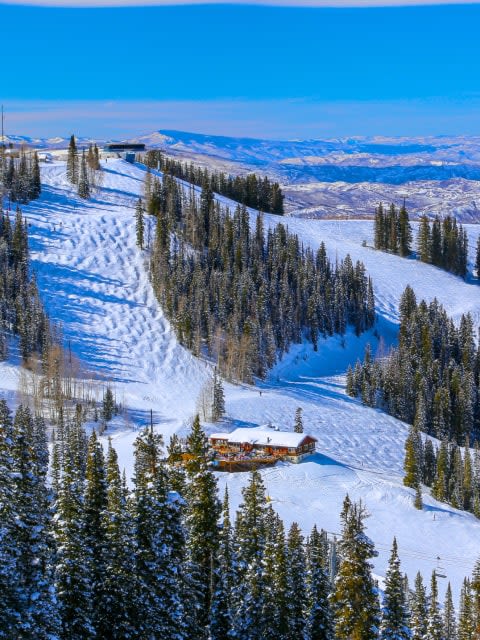
True piste-side. Your building sits directly on or immediately beside a marked run. You walk out in ski boots, click in, and you're skiing. Coming home, you ski to within a few metres of your door. This is the gold standard, and it's reflected in the price. Resorts like Val Thorens, Avoriaz, and parts of Les Arcs are purpose-built around this concept.
Lift-adjacent. Your accommodation is a short walk - usually under five minutes in ski boots - from a lift station. You're not skiing from the door, but you're close enough that the convenience factor is still high. Many properties in traditional villages like Lech or Zermatt fall into this category.
Ski-in only or ski-out only. Some properties let you ski back to the door but require a short walk or shuttle to reach the lifts in the morning, or vice versa. A hillside hotel above the village, for instance, might have a run passing directly behind it but sit a five-minute walk from the nearest chairlift. This is more common than fully bi-directional access.
Tracked path or funicular access. A handful of higher-end properties maintain private tracked paths or even short funicular railways connecting the building to the slopes. These are technically ski-in ski-out, but the experience involves a transition step that a true piste-side property doesn't.
Ski-in ski-out properties typically cost more than equivalent accommodation further from the slopes. The premium isn't fixed - it shifts depending on several factors that are worth understanding before you decide how much of your budget to allocate here.
Resort design. Purpose-built resorts like Avoriaz, Les Arcs, and Pas de la Casa were designed so that most accommodation is slope-side. Because ski-in ski-out is the norm rather than the exception, the premium is smaller. In traditional villages where only a handful of properties sit close to the slopes, scarcity drives the price up.
Season and timing. Peak weeks - school holidays, Christmas, February half term - push the premium higher because demand for convenience spikes. In quieter weeks, the gap between slope-side and village-centre accommodation narrows.
Property type. A slope-side apartment in a purpose-built block is a very different proposition from a slope-side boutique hotel or catered chalet. The ski-in ski-out element is the same, but the overall cost is shaped by the accommodation itself.
It's also worth noting that the premium isn't always as steep as people assume. In the right resort, at the right time, a well-located apartment with direct slope access can cost a similar amount to a larger property further from the lifts. The key is knowing which resorts make ski-in ski-out accessible across different budgets.
The obvious benefit is convenience, but that word undersells it. What ski-in ski-out actually changes is the rhythm of your day. Without it, the morning routine typically involves: putting on ski boots indoors, walking to a bus stop or through town, waiting, arriving at a lift station, queuing, and then starting to ski. That sequence can take anywhere from fifteen minutes to forty-five, depending on the resort layout and the time of morning.
With slope-side access, you skip most of that sequence. Boots on, step outside, ski. The same applies in reverse at the end of the day - when legs are tired and the last thing anyone wants is a walk in rigid boots carrying poles. For families with young children, this compression of the daily routine can be transformative. No shepherding small children through busy streets, no forgotten gloves left on the bus.
There's a subtler advantage too: flexibility. When you can ski to your door and back in minutes, popping inside for a coffee, a change of layers, or a midday rest becomes practical rather than logistically awkward. For groups where ability levels vary, or for anyone who wants to take the day at their own pace, that flexibility matters.
Ski-in ski-out isn't always the right priority, and it's worth being honest about when the premium doesn't pay for itself.
If you're in a compact resort where the lifts are a two-minute flat walk from most accommodation, the practical difference between slope-side and village-centre is minimal. Resorts like Obergurgl, Alpbach, or Montgenevre are small enough that almost nothing is far from the slopes, regardless of where you stay.
If your main priority is village atmosphere - restaurants, bars, shops, a sense of place - then being right on the piste can sometimes mean being away from the centre. Purpose-built slope-side developments are efficient, but they don't always have the character of a traditional village core. In resorts where the two don't overlap, it's a trade-off worth thinking through.
And if you're a confident skier who doesn't mind the morning walk and prefers to spend the accommodation budget on a larger space or a better-equipped kitchen, then slope-side access may not be the thing that makes the biggest difference to your week.
The phrase 'ski-in ski-out' is used liberally in property listings, and it's not regulated. A ten-minute walk to a drag lift and a true piste-side location can both be marketed the same way. Here's how to check what you're actually getting.
Start with the resort's piste map. Locate the property and see which run or lift sits closest. If the listing claims slope access but the nearest piste is across a road or down a hill, that's a walk, not a ski. Satellite imagery is useful for checking the actual distance and terrain between a building and the nearest marked run.
Look for specifics in the listing. Phrases like 'ski-to-door' or 'direct piste access' are stronger signals than 'ski-in ski-out area' or 'close to the slopes'. If the description mentions a shuttle, a footpath, or a 'short walk to the gondola', it's not true piste-side access, even if the headline says otherwise.
When you're booking through a package provider, it's worth asking the question directly: can you ski from the door to a piste without removing your skis, and can you ski from a piste back to the door? A yes to both is the standard. Anything else is worth understanding before you commit.
That depends on your priorities and the resort you're visiting. For families with young children, or for anyone who finds the daily boot-walk-bus routine draining, the time saved each morning and afternoon can transform the week. In purpose-built resorts, the premium is often smaller than expected. In traditional villages where slope-side properties are rare, the gap is larger. The best approach is to compare the actual cost difference for your dates rather than assuming it's always a significant jump.
Both are widely available. Many purpose-built resorts - Avoriaz, Les Arcs, Flaine, Val Thorens - were designed so that apartment residences sit directly on the slopes. Self-catered apartments with piste-side access are common in these resorts and tend to be more affordable than slope-side hotels or chalets. If you prefer the flexibility and space of an apartment, you don't need to give up on ski-in ski-out to get it.
The terms overlap, but 'slope-side' is sometimes used more loosely. A property can be slope-side in the sense of overlooking the piste without having direct ski access to it - there might be a road, a car park, or a drop between the building and the snow. Ski-in ski-out specifically means you can ski to and from the building. When comparing properties, focus on the functional question: can you put your skis on at the door and ski away?
Most ski-in ski-out properties include a ski storage room, often heated, where you can leave boots and skis overnight. You'll still want somewhere to dry boots properly. The advantage is that the storage is typically right by the slope access point, so you walk a few steps in indoor shoes, swap into boots, collect your skis, and go. It removes the need to carry equipment through corridors, lobbies, or streets.
Look beyond the headline. Check the piste map to see how close the property is to a marked run, and use satellite imagery to confirm the route between the building and the slopes. Phrases like 'ski-to-door' are stronger signals than 'ski-in ski-out area'. Our guide to how to find ski-in ski-out accommodation walks through the verification process in more detail.
Thinking about giving ski-in ski-out a try? Use WeSki’s AI trip planner to find resorts and properties that match your priorities - just tell it what matters to you and get a personalised shortlist in seconds