EN
EN
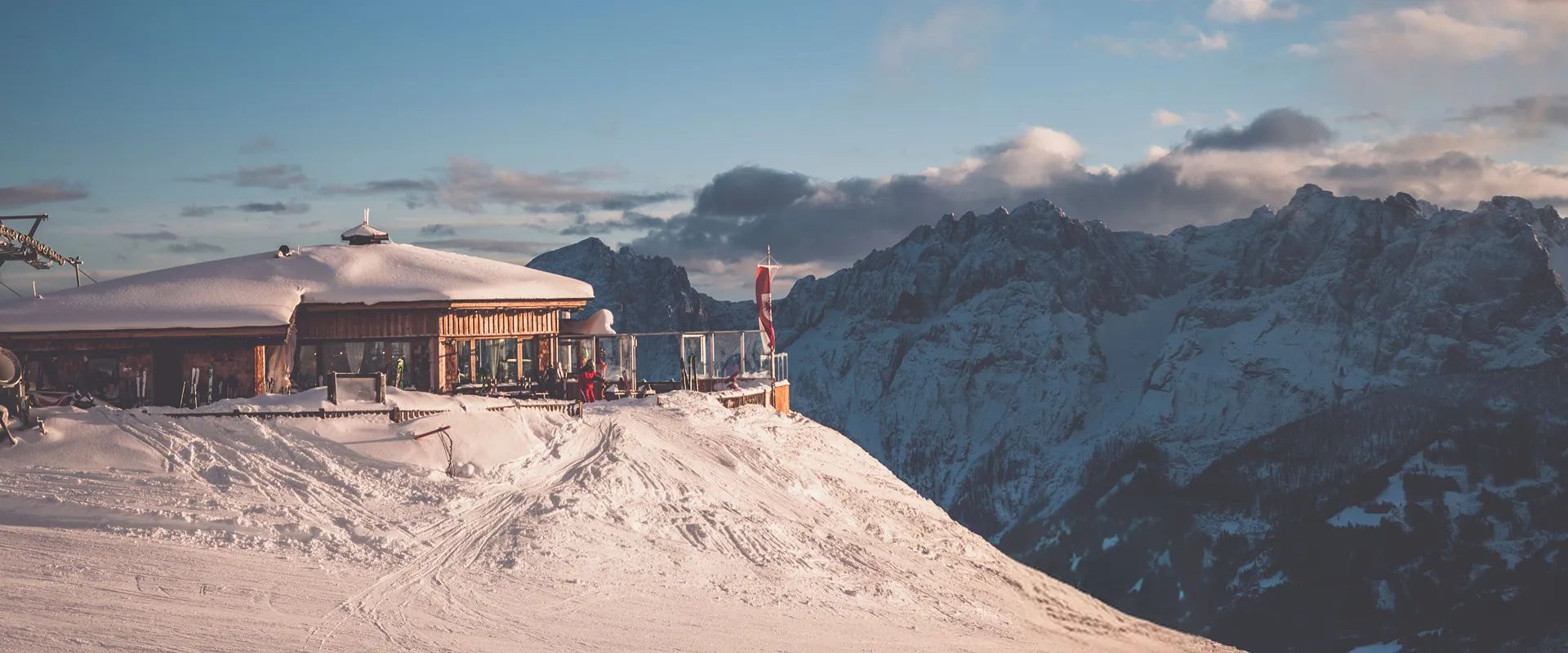
One of the best parts of a ski day has nothing to do with skiing. Midway through the morning or early afternoon, you'll stop at a restaurant perched on the mountainside, sit down to a hot meal with panoramic views, and wonder why nobody mentioned this before you booked. Mountain restaurants are a central part of the ski holiday experience, and for many people they become a highlight that rivals the skiing itself. If you're already thinking about where to eat, our guide to the best mountain restaurants in the Alps is a good place to start. And if you want practical tips for finding them on the slopes, our guide on how to find the best mountain restaurants covers everything from piste maps to timing.
A mountain restaurant is any place to eat that sits on or beside the ski slopes, accessible on skis rather than by car. They range from simple self-service huts serving soup and chips to full-service restaurants with tablecloths, wine lists, and menus that would hold their own in any city. What connects them all is location - you ski up to the door, leave your skis in a rack outside, and walk in wearing ski boots.
In the Alps, the tradition runs deep. Austria and Italy in particular have built entire culinary cultures around on-mountain dining. The Italian Dolomites are known for rifugios where you can sit for hours over a long lunch, while Austrian ski areas tend to have lively huts with live music and large sun terraces. French resorts vary more widely - some have excellent mountain dining, others lean toward functional refuelling stops. Switzerland sits at the higher end, with mountain restaurants that often match the quality (and price) of valley-floor fine dining.
The key thing to understand is that a mountain restaurant isn't a compromise. It's not a service station on the way to more skiing. For experienced skiers, choosing where to eat lunch is often planned the night before and treated as one of the day's main events.
The menu depends heavily on the country and the style of restaurant. In Austria, expect hearty dishes like kaiserschmarrn (a shredded pancake with fruit compote), goulash, schnitzel, and germknoedel (a sweet yeast dumpling). Italian mountain restaurants lean toward pasta, polenta, speck platters, and wood-fired pizza - portions tend to be generous and the quality is consistently high. French mountain dining ranges from croque-monsieurs and tartiflette at casual spots to duck confit and gratin dauphinois at sit-down restaurants. Swiss mountain restaurants often feature rosti, fondue, and raclette.
Most mountain restaurants also serve simpler options - burgers, chips, sandwiches, soups - so there's always something for less adventurous eaters or children. Hot chocolate is universally excellent at altitude, and most places serve local beers and wines alongside soft drinks. A growing number of restaurants now cater to dietary requirements, though it's worth noting that remote huts may have more limited options than larger terrace restaurants.
The real discovery for many first-time skiers is how good the food can be. Mountain dining in the Alps has moved well beyond the functional, and in some resorts the restaurant scene is a real draw in its own right - though the standard varies, and not every mountainside stop will be memorable.
A typical ski day runs from around 9am to 4pm, with lunch usually taken between noon and 1:30pm. Most skiers break for at least 45 minutes, and an hour or more is common - especially on sunny days when the terrace is the main attraction. There's no pressure to eat quickly. Mountain restaurants expect people to linger, and taking a proper midday break is how experienced skiers pace their energy across the full day.
Timing matters more than you might think. Arriving at a popular restaurant at 12:15pm on a busy week often means a queue for both food and seating. The insider approach is to ski hard in the morning, eat slightly earlier (around 11:30am) or slightly later (after 1pm), and avoid the peak rush entirely. Some restaurants take reservations - particularly the higher-end ones - and booking ahead can be the difference between a relaxed lunch and a scramble for a table.
You don't need to return to the valley for lunch. In fact, most skiers prefer eating on the mountain because it saves time and keeps you in the middle of the ski area. After lunch, you're straight back on the slopes with no lift queue to rejoin the action.
Not all mountain restaurants are the same, and knowing the differences helps you plan your day. Self-service restaurants are the most common type in larger ski areas. You pick up a tray, choose from a buffet-style counter, and pay at the till before finding a seat. These are quick, practical, and usually the most affordable option. The food quality varies - some self-service spots are basic, while others serve notably good hot dishes.
Table-service restaurants are where things get more interesting. You sit down, order from a menu, and the food is brought to your table. These tend to be quieter, the food is cooked to order, and the overall experience is closer to eating out in a village. In popular resorts, the best table-service mountain restaurants book up quickly during peak weeks.
Mountain huts - known as refuges (France), rifugios (Italy), or Hutten (Austria) - are often the most atmospheric places to eat. They tend to be smaller, family-run, and located slightly away from the main pistes. Finding a good hut usually means asking locals or an instructor for recommendations, because the best ones aren't always on the obvious routes.
Umbrella bars and terrace stops are lighter options - a deckchair, a drink, maybe a snack plate or a bowl of chips. These are useful for a mid-morning break rather than a full lunch, and they're often positioned at scenic viewpoints or beside popular runs.
Mountain restaurant prices vary enormously depending on the resort and the country. As a general rule, Austria and Italy tend to be more moderate, while France and especially Switzerland sit higher. Self-service is cheaper than table service, and remote huts can be either very affordable or quite expensive depending on their reputation.
Most mountain restaurants accept card payments, though a handful of smaller huts in Austria and Italy may still be cash-only. It's worth carrying a small amount of local currency in your ski jacket pocket just in case. Tipping customs vary by country - in Austria and Germany, rounding up the bill is standard; in France, service is often included; in Switzerland and Italy, a small tip is appreciated but not expected.
One practical consideration: prices aren't always displayed prominently in table-service restaurants. If you're watching your spend, self-service restaurants typically show prices on the counter display, which makes budgeting simpler. Drinks are often the most marked-up item, so water from a fountain or tap (where available) can help keep the bill in check.
Mountain restaurant etiquette is informal, but a few things are worth knowing. You'll eat in your ski boots and base layers - nobody changes for lunch on the mountain. Helmets, goggles, and gloves go on the table or under your chair. Most restaurants have ski racks outside, and while theft is rare, it's sensible not to leave brand-new skis unattended at a busy spot.
On shared tables - common in Austrian and German-speaking resorts - it's completely normal to ask whether a seat is free and join strangers. A quick 'Ist hier noch frei?' goes a long way. In France and Italy, seating tends to be more separated, and you'll usually be shown to your own table at full-service restaurants.
Sun terraces fill up fast on clear days, and there's an unwritten rule about reserving seats with jackets or gloves while you queue for food - acceptable in most places, but don't leave a table claimed for 20 minutes while you're still on the slopes. If you're with a group, it helps to have one person grab a table while the others order.
For most mountain restaurants, you can simply turn up and find a seat. The exception is high-end table-service restaurants in popular resorts during peak weeks - these can fill up by mid-morning, particularly during February half term and Christmas. If you have a specific restaurant in mind, it's worth checking whether they take reservations. Many now accept bookings by phone or through their website.
In some resorts, yes. Many ski areas sell pedestrian lift passes that allow non-skiers to ride the gondola or cable car up to mountain restaurants. This is especially common in Swiss and Austrian resorts, where mountain dining is a tradition that extends well beyond the skiing community. It's a good option for non-skiing members of a group who still want to join everyone for lunch.
Most mountain restaurants are very family-friendly. Children's menus are common, portions are flexible, and the atmosphere is relaxed. High chairs aren't always available at smaller huts, but larger terrace restaurants usually have them. The main thing to plan for is timing - children tend to get hungry earlier, so an 11:30am lunch often works better than waiting until 1pm.
Mountain restaurants serve full meals during the ski day, typically between 10am and 3:30pm. Après-ski bars are focused on drinks and socialising after the lifts close, usually from around 3pm onwards. Some places function as both - a quiet lunch spot during the day that transforms into a lively après venue by late afternoon. Our guide to what après ski is and how it works covers the tradition in more detail.
Eating on the mountain saves time and keeps you in the heart of the ski area. Unless your accommodation is directly beside a lift, heading back to the village for lunch typically costs you an hour or more of skiing time. Mountain restaurants are designed for exactly this purpose, and in many resorts the best food is actually on the slopes rather than in the valley.
Curious which resorts have the best mountain dining? Try WeSki’s AI trip planner - tell it what matters to you and get a personalised shortlist of resorts in seconds.