EN
EN
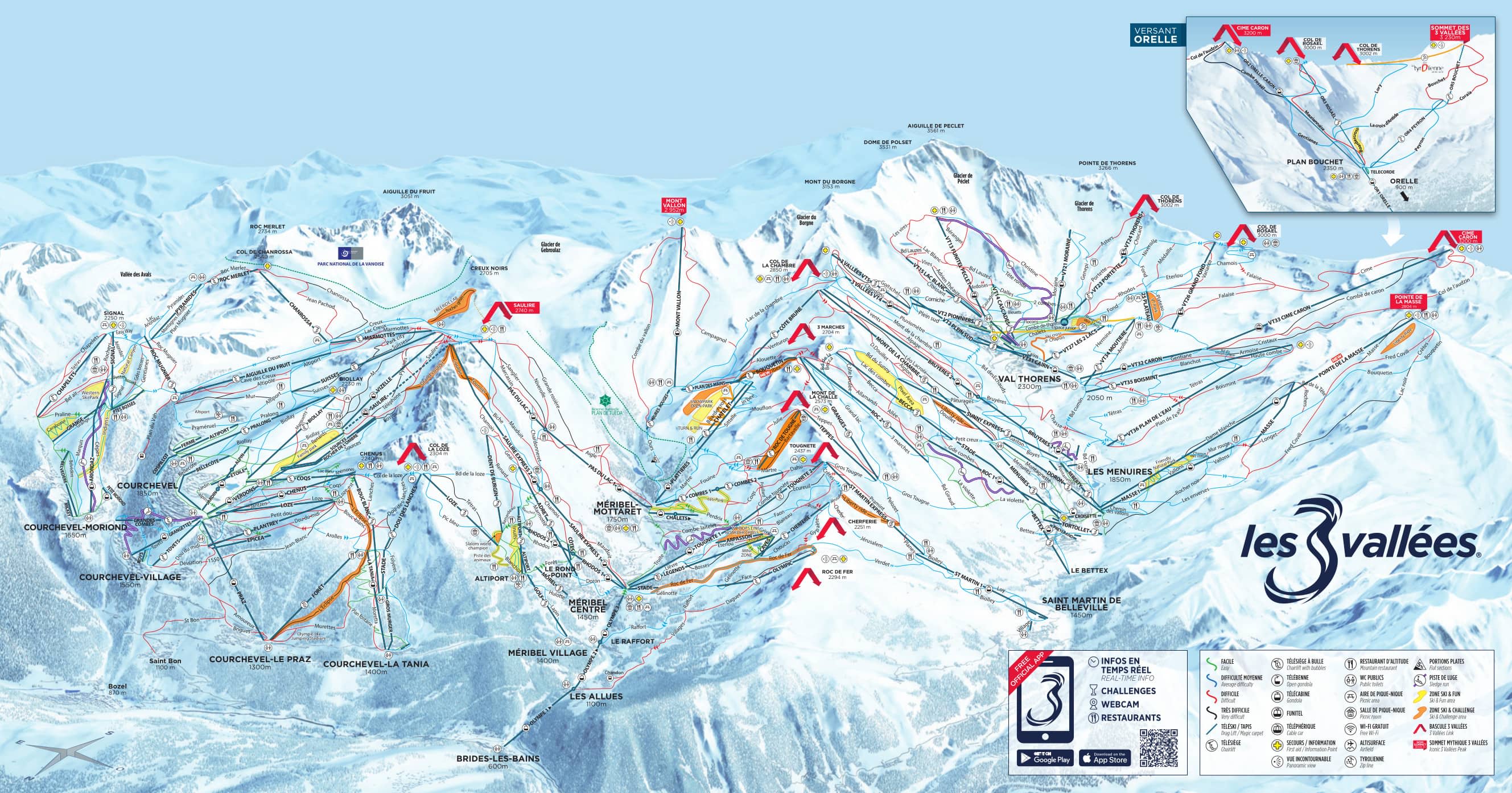
Les Trois Vallées, or the Three Valleys, is the largest linked ski area in the world, featuring around 600 km of piste joined entirely by lifts and slopes, with no roads in between. The valleys that give the area its name are Saint-Bon, Les Allues, and Belleville, and each is home to its own resorts. Saint-Bon has Courchevel and La Tania, Les Allues has Méribel with the spa town of Brides-les-Bains at its foot, and Belleville, the longest of the three, spans from Saint-Martin-de-Belleville and Les Menuires to Val Thorens at its head.
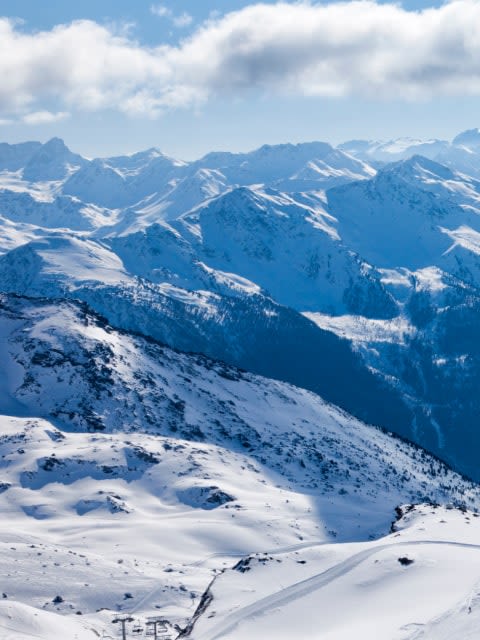
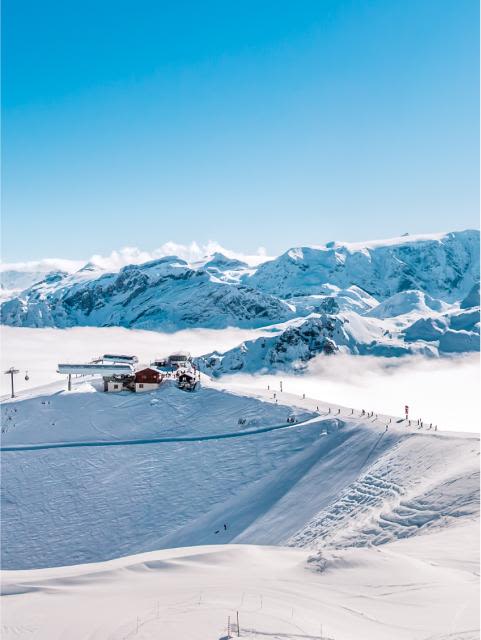
In the Three Valleys, you'll spend most of your time skiing or snowboarding above the treeline. Much of the area's terrain sits above 1,800 m, which keeps the snow cold and dry well into the spring, and the height also buys the views. Twenty-five summits are reachable by lift, ten of them above 2,500 m, including the Cime de Caron, where a cable car carries skiers and pedestrians to a platform at 3,200 m looking across the French, Italian, and Swiss Alps. Lower down, the area has a second character entirely, with narrow valleys and pistes dropping through spruce forest towards the older villages.
Beyond skiing and snowboarding, the Three Valleys is well known for its activities, culinary scene, and nightlife. Après-ski is a major attraction, particularly in Val Thorens, where La Folie Douce runs afternoon parties out on the slopes and the bars in the pedestrianised centre fill up once the lifts stop. Off the slopes, there are plenty of memorable ways to enjoy the mountain scenery, whether that's riding Europe's highest zip line, tobogganing through the forest, snowshoeing, or relaxing in thermal baths. And then there's the food, with a well-regarded restaurant scene ranging from mountain terraces serving Alpine comfort food to a cluster of Michelin-starred kitchens in Courchevel and the Belleville valley.
| Country | France |
| Region | Savoie, Northern Alps |
| Total piste km | 600 km |
| Altitude | 1,300 m (Brides-les-Bains) - 3,230 m (Cime de Caron) |
| Linked resorts | 8 Courchevel Méribel Les Menuires Val Thorens La Tania St Martin de Belleville Brides-les-Bains Les Allues |
| Lifts | 156 |
| Runs | 328 (36 green, 112 blue, 118 red, 62 black) |
| Season | Early December - late April (glacier skiing on Peclet extends to early May in good years) |
| Ski pass name | Three Valleys ski pass |
| Nearest airports | Chambéry (~1 hr 15 min) Lyon (~2 hr 15 min) Geneva (~2 hr 30 min) Grenoble (~2 hr 30 min) |
| Glacier skiing | Yes - Glacier de Peclet above Val Thorens |
| WeSki services | Lessons: Courchevel, La Tania, Méribel, Val Thorens, Les Menuires, St Martin de Belleville Transfers: all 8 resorts (private to all; shared to Courchevel, La Tania, Méribel, Val Thorens, Les Menuires; scheduled to Val Thorens) Ski equipment hire: Courchevel (1300, 1550, 1650, 1850), La Tania, Méribel (Centre, Mottaret, Village), Val Thorens |
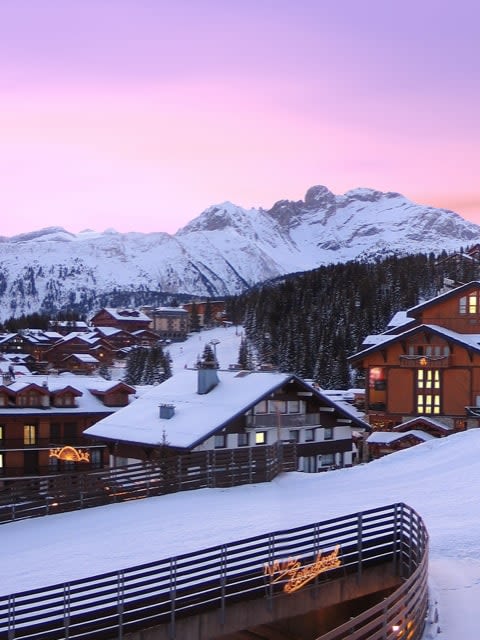
Courchevel is made up of four villages on the same mountainside, linked by pistes, lifts, and a free bus. Le Praz sits at 1,300m, Courchevel Village at 1,550m, Moriond at 1,650m, and Courchevel 1850 at the top. The skiing faces north across all four villages, which keeps the snow in good condition, and long blues run through the trees down to Le Praz and La Tania. Above 1850, the Saulire ridge opens into the steepest terrain in the area, including the Grand Couloir.
Each village offers something different within the same ski area. Le Praz is a year-round working village with good restaurants, Olympic ski jumps, and a gondola that runs up to Courchevel 1850 in about six minutes and keeps going into the evening. Courchevel Village sits in the middle, with accommodation mostly in apartments and chalets and lifts leaving from the centre. Moriond sits on its own side of the valley, with wide groomed runs that stay quiet. Courchevel 1850 is where the designer shops, Michelin restaurants, five-star hotels, and altiport are concentrated.
Méribel's skiing runs down both flanks of the valley, mostly blues and reds that wind through forest lower down and open out above the treeline. Mont Vallon, the summit at the head of the valley at 2,952 m, gives one of the longest descents in the area, and the Roc de Fer lower down has the course cut for the women's Olympic races in 1992.
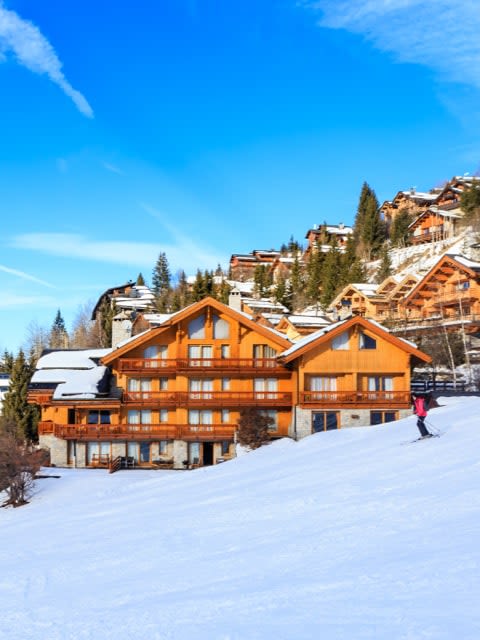
Méribel is made up of several villages spread along the hillside, built almost entirely in low-rise wood and stone. Méribel Centre is the largest and holds most of the bars, restaurants, and shops, along with the Parc Olympique ice rink and pool. Méribel Village is a small chalet hamlet further along the road, with its own chairlift and a quiet, residential feel. Mottaret is the highest, built around ski-in, ski-out accommodation, and it sits closest to the lifts that cross into the neighbouring valleys. Après-ski starts on the slopes above Méribel Centre at La Folie Douce and Le Rond-Point, and carries on in the village once the lifts close.
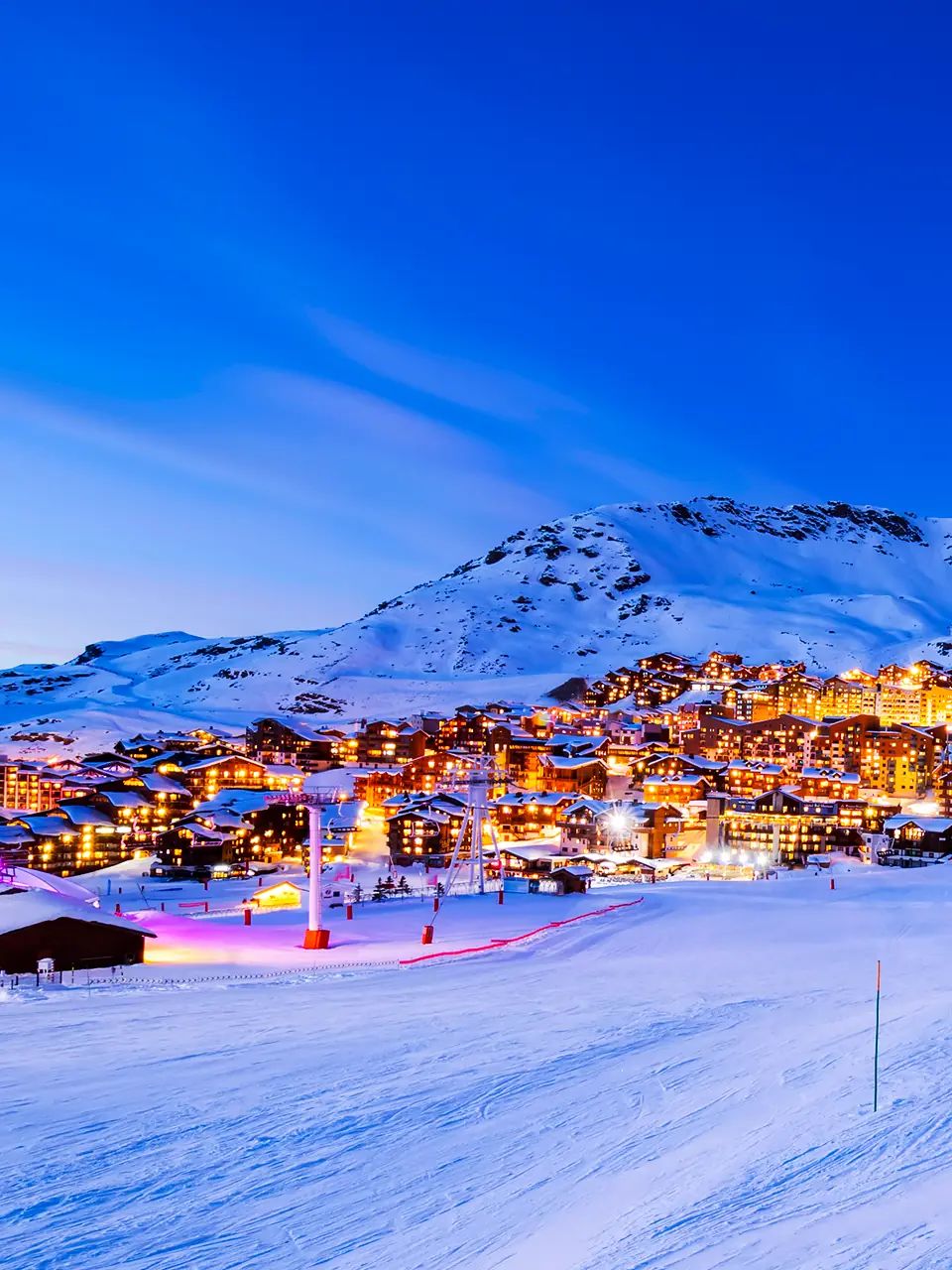
Val Thorens is the highest resort in Europe at 2,300m, and almost all of its skiing sits above 2,000m. The terrain is entirely above the treeline, a wide bowl of open pistes where long blues and reds fan out from the village in every direction, and most accommodation is ski-in, ski-out. At the top of the resort, the Cime de Caron cable car climbs to 3,195m and serves steep blacks for advanced skiers, while the Péclet funitel provides direct access to pistes on the edge of the glacier.
Known for its après-ski, Val Thorens has a party scene that draws skiers and non-skiers alike. It gets going at midday at La Folie Douce on the mountain and carries on into the bars and clubs of the pedestrianised centre late into the night. Restaurants range from mountain terraces to fine dining in the resort. Despite its reputation for nightlife, Val Thorens is also a popular family destination, with gentle green runs right beside the village. Off the slopes, there's plenty to do for every age, from sledging and a long toboggan run to a leisure centre with a pool.
Les Menuires skis both sides of the Belleville valley. The main slopes above the village are mostly long blues and reds that run straight back into the resort, with gentle greens and learning areas close to the centre. Its ski area also includes La Masse, a mountain of its own on the opposite side of the valley, and it's where stronger skiers tend to head. Because it doesn't link onward to the rest of the Three Valleys, La Masse stays uncrowded, and its north-facing slopes, served by a gondola climbing to 2,804m, hold their snow well and carry black runs and routes into the off-piste of the Vallée des Encombres.
Les Menuires was built in 1964 under the French government's Plan Neige, in high-density blocks designed to put the slopes close to every door. The architecture drew heavy criticism at the time, but it's now treated as a reference point for building at altitude. La Croisette is the resort's original centre, with shops, bars, and restaurants, while the villages of Reberty and Les Bruyères came later. When you want a break from skiing, there's a 4km toboggan run to race down, dog sledding and snowshoeing through the snow, and two pools to warm up in.
La Tania is the youngest village in the Three Valleys, opened in December 1990 to house people working at the 1992 Albertville Olympics. At 1,400m, it's one of the lowest bases in the area, but its slopes face north-west and hold their snow well. Its biggest draw is the forest, and the mountainside it shares with Le Praz has the best tree skiing in the Three Valleys. Beginners have gentle greens and a marked learning area, intermediates have rolling blues winding through the spruce, and advanced skiers have steeper blacks dropping down towards Le Praz.
The centre is fully pedestrian, and the gondola, shops, and ski school are all a few minutes' walk apart. There's a small cluster of bars and restaurants, including a Michelin-starred kitchen, and the village suits anyone who'd like to stay somewhere small and walkable, surrounded by forest.
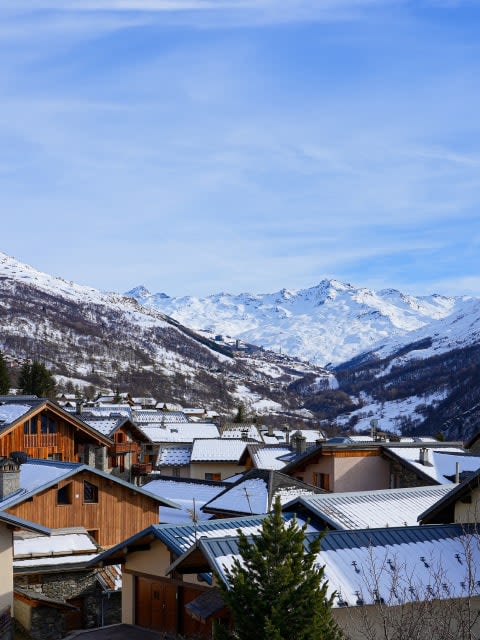
Saint-Martin-de-Belleville is a traditional Savoyard village at 1,450m, set on a sunny slope below the treeline, with stone and timber houses, narrow streets, and a scattering of hamlets around it. Just outside the village, the Notre-Dame-de-la-Vie sanctuary is one of the valley's finest examples of baroque architecture, and the village has its own historical museum. There's a handful of good restaurants too, including a Michelin-starred kitchen in the neighbouring hamlet of Saint-Marcel.
A gondola and chairlift climb from the village centre into the ski area. Beginners have a nursery slope in the village and long, gentle blues running back down into it, while intermediates have rolling blues and reds through open farmland. Advanced skiers have steeper runs on the slopes above the village, along with off-piste routes that finish in Saint-Martin itself on a good powder day. Off the slopes, there's snowshoeing, tobogganing, and marked winter paths leading out through the hamlets.
Brides-les-Bains is a thermal spa town at the foot of the Méribel valley, and a popular base for visitors who want to pair their skiing with a proper spa experience. The town has no slopes or lifts of its own, so it has the Olympe gondola which links it to the ski area, climbing up to Méribel and the rest of the Three Valleys. On the way back, you can ski down through the trees to Le Raffort and take the last stage of the gondola into town.
The town has the feel of a small French spa town, with Belle Époque buildings and a main street lined with cafés, bars, and restaurants serving traditional Savoyard cooking. The Grand Spa Thermal is the main draw, with thermal pools, saunas, hammams, and a range of treatments. In the evenings, the town also has a casino and a cinema. If you fancy a day away from the pistes, you can head out on a guided snowshoe walk or take in the whole valley from above on a tandem paragliding flight.
Les Allues is the original village of the Méribel valley, a working Savoyard village at 1,100m that was here long before the ski resort above it. It has no slopes of its own, but it has a station on the Olympe gondola, so Méribel's slopes and the rest of the Three Valleys are just a short ride above. In good snow, you can ski all the way back down to the village.
The village has kept its authentic character, with narrow streets, traditional farm buildings, and chalets, and a community that lives here year-round. Everything you need is within a short walk, including a bakery, a small supermarket, a ski hire shop, and a handful of bars and restaurants serving traditional Alpine food. Most accommodation is in self-catered chalets and apartments, and for a bigger night out, Méribel Centre is a short gondola or free bus ride away.
The Three Valleys has gentle terrain across all of its resorts. Beginner slopes here are wide and open, and many of them sit up high, where the snow stays dependable through the season. Thanks to the elevation, even the easiest runs come with the kind of views you'd normally only get from much further up the mountain. Whether it's your first time skiing or snowboarding, or you haven't been on a mountain in a few years, you'll have plenty of space to learn comfortably. Each resort has its own learning areas, marked on the piste map and set apart from the faster runs, so you'll be among other skiers and snowboarders at your level. For guided instruction, ski schools across the area run beginner lessons for adults and children.
Val Thorens and Courchevel are particularly well set up for beginners. Val Thorens has one of the largest beginner areas in the Three Valleys, right at the edge of the resort and open from the very start of the season, and Courchevel has learning areas in all four of its villages. Les Menuires is also a good choice for first-timers, with enclosed green runs served by magic carpets, and Méribel has wide, gentle runs on the plateau above the village. Beyond these, beginners are well looked after across the whole area, so wherever you choose to stay, you'll find somewhere comfortable to learn.
Most of the terrain in the Three Valleys is blue and red, providing plenty of ground for confident skiers. The intermediate runs here tend to be long, often dropping a thousand metres from ridge to village, and the skiing changes in character as you descend. There's a good balance of comfortable blues and more challenging reds. In Méribel and Courchevel, intermediate pistes run through the trees as well as across open ground higher up, and above Courchevel 1850 they form a bowl of interlinked runs you can lap all day. In the Belleville valley, Val Thorens and Les Menuires have wide, treeless cruising, while Saint-Martin-de-Belleville has quiet rolling blues dropping through old farmland into the village.
If you have the time, crossing into a neighbouring valley makes a good day out, and it's within reach of an experienced intermediate skier. The Col de la Loze is a gentle crossing between Courchevel and Méribel, with blue runs on either side. Give yourself the morning for it and check the closing times of the lifts you'll need to get back.
Every valley here has terrain that's challenging and interesting for advanced skiers and snowboarders. Courchevel has the most technical, including the Grand Couloir, which is the steepest marked run in the area. Val Thorens is the highest resort in the The Three Valleys and is ringed by glaciers, with cold snow that lasts well into spring. It's a great starting point for off-piste and touring, and its Cime de Caron cable car serves committing pistes, including one that drops into the neighbouring Maurienne valley. Although Méribel has less steep terrain, it does have two serious runs: Couloir Tournier and La Face, the black run built for the women's downhill at the 1992 Olympics. Les Menuires has a relatively quiet set of blacks on La Masse. And for a taste of racing, Courchevel's L'Éclipse, the World Championship downhill course, is open outside race weeks.
Every valley here has terrain that's challenging for advanced skiers and snowboarders. Courchevel has the most technical, including the Grand Couloir, the steepest marked run in the area, and L'Éclipse, the World Championship downhill course, which is open outside race weeks. Val Thorens is the highest resort in the Three Valleys, ringed by glaciers, and its Cime de Caron cable car serves steep, committing blacks. Méribel has two serious runs in the Couloir Tournier and La Face, built for the women's downhill at the 1992 Olympics, and Les Menuires has a quiet set of blacks on La Masse.
The Three Valleys has a lot of open ground above the treeline, giving snowboarders long descents with plenty of natural features to ride between the pistes. Wide bowls, rolling ridges and gullies work as freestyle terrain in their own right, and the snow usually stays dry well into the spring. Val Thorens in particular has become a centre for the sport. It sits highest and holds its snow longest, which makes it a strong base, and it hosts an early-season board week and freestyle competitions through the winter. Méribel-Mottaret and Les Menuires both have good access to open slopes and off-piste. Lower down, the tree runs around La Tania and Le Praz give snowboarders terrain to ride when the weather closes in higher up.
For freestyle sessions, the area has parks at every level. The Open Park above Mottaret and the Val Thorens snowpark are the two biggest set-ups, with lines of jumps, rails and boxes. For learning or easing in, the Family Park in Courchevel and the Pixel Area in Les Menuires have smaller features and progression lines. Most of the parks have a boardercross course alongside them, a banked track you ride against the clock.
Most visitors settle into a single base for their trip, so a local pass is likely all you'll need. Each resort sells one covering its own sector. If you decide later that you want more range, you can upgrade to the full area pass.
The Les 3 Vallées pass covers every resort in the area, from Courchevel across to Val Thorens. It's worth the extra outlay if you plan to ski across the area during your holiday, or if you'll be back more than once in the season. It's sold by the day up to a full season, so you can match it to the length of your stay. If you hold an Epic Pass, that covers you here too, with several days of Three Valleys skiing included.
Most international visitors arrive by plane, though the Three Valleys is also straightforward to reach by train or car. Chambéry is the closest airport at around 100 to 120 km, while Geneva, Lyon and Grenoble are roughly 150 to 200 km away depending on the resort, with Geneva offering the widest choice of flights. From any of them you can hire a car or book a shared or private transfer.
By train, the nearest station is Moûtiers-Salins-Brides-les-Bains, served by TGV from Paris and seasonal Eurostar services from London, Brussels and Amsterdam. Distances from the station vary by resort, from under 10 km to 37 km.
Once you've arrived, you won't need a car to get around. Free shuttle buses run within each valley between the villages and the main lift stations, and during ski hours the lift system connects the valleys.
For the most dependable snow, mid-January to mid-March is the best time to visit the Three Valleys. February brings the deepest cover, though it lines up with school holidays across Europe, so January and early March tend to offer a better balance of good snow and quieter slopes. Most of the area opens in early December and closes in mid-April, while Val Thorens sits high enough to open in late November and keep skiing into early May. Early-season days are short and cold, but the snow that falls then tends to be dry and light.
From late March, longer days and stronger sun bring spring conditions, and the higher resorts are the most reliable choice. Val Thorens keeps skiing into early May, while Les Menuires and Courchevel both have north-facing slopes that hold their snow well. In the lower villages, the runs back down depend on conditions later in the season. Sunny slopes are at their best from late morning, once the sun has softened the snow, and north-facing ones keep their colder snow into the afternoon. It's a good time to go if you'd choose sunshine and a long lunch on a terrace over fresh powder.
Yes. There's plenty to do off the slopes, from snowshoeing, tobogganing, and dog sledding to pools, ice rinks, and thermal spas, and many mountain restaurants can be reached by lift, so non-skiers can still meet their group for lunch. Méribel and Courchevel are the most rounded bases, while Brides-les-Bains suits anyone who'd like a spa town with a life of its own.
Val Thorens and Les Menuires both hold France's Famille Plus label for family-friendly resorts, with dedicated learning areas, ski-in, ski-out accommodation, and plenty for children to do off the slopes. La Tania suits families who'd like a small, walkable village, and Méribel and Courchevel both have themed children's runs among their learning areas.
Yes. Val Thorens to Courchevel takes a confident intermediate one to two hours each way, so the round trip fills a day. Start early, keep an eye on lift closing times, and expect queues at the link lifts in peak weeks. Most people do it once rather than daily.
No. The crossings run on blue and easy red runs, and there are gentle routes over every ridge. Courchevel and Méribel are joined at two points, the Saulire and the Col de la Loze, with several more crossings between Méribel and the Belleville valley.
You'll need a taxi, and the road route between valleys is long and expensive. Lift closing times are posted and strictly kept, so check the times for the lifts you need before you set off, and allow more than you think in poor visibility.
Not always. Each valley sells its own local pass, which costs less and is enough if you plan to stay in one sector. The full pass covers every crossing, and skiing into another valley without it means paying to get back.
Most of them. Courchevel, Méribel, Val Thorens, Les Menuires, Saint-Martin-de-Belleville and La Tania all have pistes running into the village. Brides-les-Bains and Les Allues sit below the ski area, so you ski down to the lower hamlets and ride the Olympe gondola the rest of the way.
No. Free shuttle buses run within each valley between the villages and the lift stations, and during ski hours the lifts connect the valleys. Transfers and trains to Moûtiers cover the journey in, and parking in the higher resorts is limited and charged.
The Three Valleys is the largest of the three, with around 600 km of piste against 425 km in Paradiski and 300 km in Tignes-Val d'Isère. Paradiski joins Les Arcs and La Plagne by double-decker cable car. Tignes-Val d'Isère runs highest, with a glacier and the longest season in France.
Yes. The Glacier de Peclet sits above Val Thorens, reaching 3,230 m. It helps extend the season at altitude and provides reliable snow cover throughout the winter. It's accessed from the Cime de Caron cable car and the Peclet funicular.
Start building your dream ski trip today with our one-stop ski shop - hundreds of resorts, unlimited combinations.


 4.9/5
4.9/5I usually book flights, ground transportation, hotel, ski rental and lift tickets myself but this year used WeSki for a trip to Morzine. It was so much easier. Everything worked perfectly - ground transportation arrived on time and there was plenty of feedback throughout the whole process giving you confidence the vacation would go smoothly.

A really useful service that is so much easier to use than other 'all-inclusive' sites. It nicely bridges the gap between a travel agent and booking the trip yourself online. I'll use WeSki every time I go skiing from now on.
We booked a late minute skiing trip to Morzine through we ski. We looked at booking the trip ourselves but could get anywhere near the price quoted by we ski. The company was excellent and we had no problems at all from start to finish. I would definitely use them to book another weekend skiing trip.
Seamless experience from start to finish. I was spending ages trying to sort out a weekend break and managed to do it with we ski in minutes and for the same price as booking it all up yourself. Flight, transfers and accommodation was all as expected and faultless.