
FR
FR
Les stations de ski du Canada, réputées pour leur qualité de neige exceptionnelle et leurs longues saisons, offrent des terrains variés qui conviennent à tous les skieurs et snowboardeurs. Ces stations, incluant des noms célèbres comme Banff et Whistler, sont situées à travers les vastes paysages du Canada, beaucoup nichées dans des parcs nationaux qui offrent des paysages époustouflants et des rencontres avec la faune. L'attrait des pistes canadiennes réside dans leur entretien impeccable, leurs pistes larges bordées d'arbres et leurs installations exceptionnelles. L'expérience est encore enrichie par des hôtels de haute qualité et une hospitalité chaleureuse, consolidant le statut du Canada comme destination de premier plan pour les sports d'hiver.
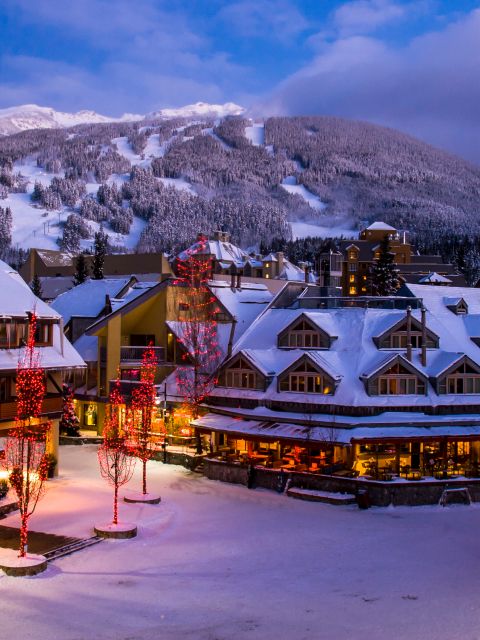
Whistler Blackcomb, Banff, and Sun Peaks ach make a strong family base, and the right pick depends on how big a resort you want to navigate. Whistler Blackcomb is the largest and most complete, with dedicated kids' ski schools, a pedestrianised village, and enough terrain to keep growing skiers busy for a full week. Banff offers a similar range across three nearby ski areas, with the added pull of natural hot springs and wildlife spotting for family days off the slopes. Sun Peaks is the most manageable of the three. Since it’s a ski-through village, most accommodation is ski-in ski-out, and its light, dry snow and quiet slopes make it a favourite with families who'd rather skip Whistler's bigger crowds.
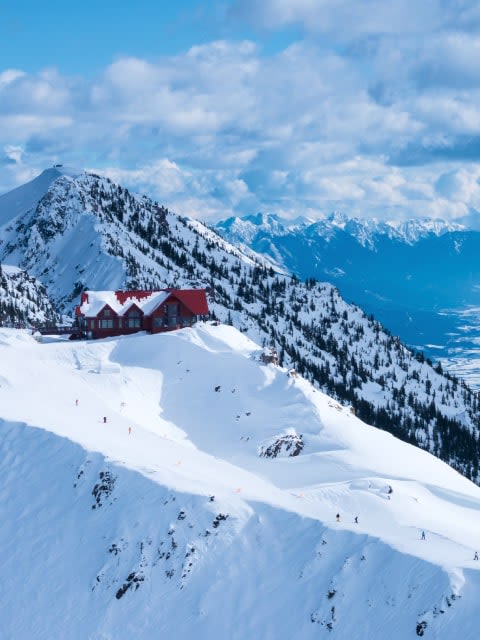
Kicking Horse, Fernie, and Revelstoke are three of Canada's most respected names among serious powder skiers. Kicking Horse is known for its steep chutes and alpine bowls. Fernie sees some of the most consistent snowfall in the Canadian Rockies, spread across five open bowls. Revelstoke goes further still with the longest vertical drop in North America, and heli- and cat-skiing available right from the base.
Cypress Mountain is Canada's clearest choice for snowboarding credentials. It hosted the halfpipe, snowboard cross, and parallel giant slalom events at the 2010 Winter Olympics, and that legacy shows in its terrain parks today, which range from beginner-friendly setups to large jumps and rail lines. The mountain has a strong variety of natural freeride terrain among the trees, with night riding available until 10pm for extra time on the hill.
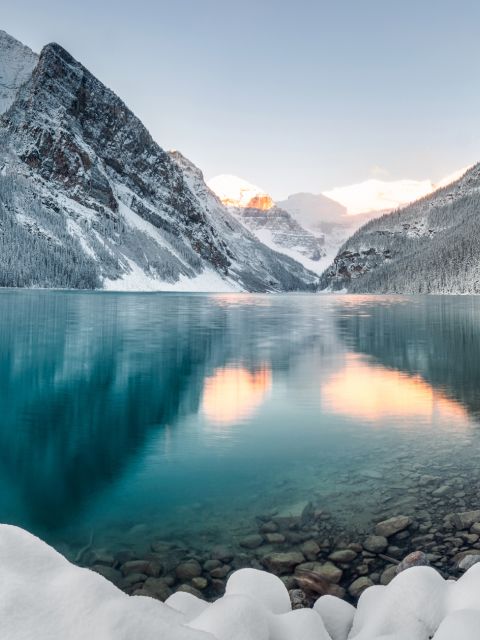
Lake Louise, Massif de Charlevoix, and Panorama each offer a different kind of romantic backdrop for a couple’s ski trip. Lake Louise pairs its skiing with one of the most photographed views in Canada, an emerald, glacier-fed lake overlooked by the historic Fairmont Chateau (itself a well-known honeymoon destination). Le Massif de Charlevoix, on the opposite side of the country, sends its runs down toward sweeping views of the St. Lawrence River. Panorama takes a quieter approach, with mountaintop dining experiences, slopeside hot pools, and a village small enough to feel like it's just the two of you.
Whistler Blackcomb has the biggest and busiest après-ski scene in Canada, with a pedestrianised village packed with bars and restaurants that stays lively well after the lifts close. Banff offers a similarly strong scene within its own town centre, where craft breweries and late-night spots line the main strip, backed by mountain views on nearly every corner and a town that stays busy well into the evening.
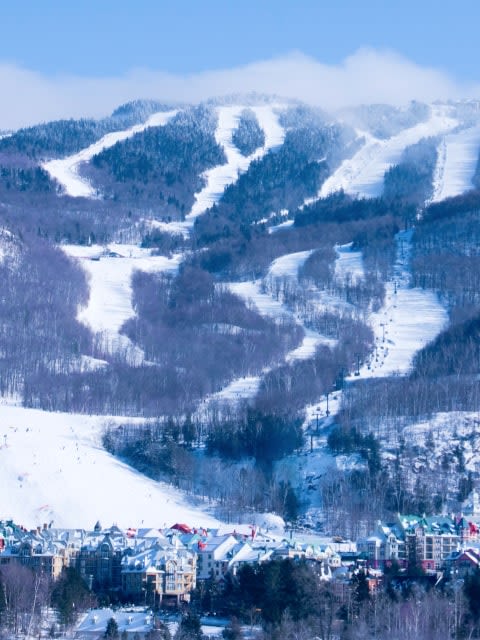
Blue Mountain and Mont Tremblant both work well for a group where not everyone plans to spend the whole trip on skis. Blue Mountain has Ontario's only mountain coaster and an indoor water park right at the base, plus ropes courses for an active day away from the slopes. Mont Tremblant goes further still, with its own family water park, a Nordic-style spa, and a casino, all within its pedestrian village.
Red Mountain and Jasper’s Marmot Basin both offer a quieter, more independent side of Canadian skiing. Red Mountain, in the old mining town of Rossland, has been skied since the 1890s and has kept a fiercely independent, community feel ever since, with legendary tree skiing throughout its five peaks. Marmot Basin sits inside Jasper National Park, a UNESCO World Heritage Site and one of the world's largest Dark Sky Preserves, with Canada's highest base elevation and regular wildlife sightings on the way up the access road.
Yes. Canada is home to the largest ski resort in North America, plentiful snowfall across both the Rockies and the BC interior, and a distinct ski culture with a long history behind it. The resorts are spread across four provinces, so there's real variety in scale and character, from big mountain terrain in the west to smaller, village-focused resorts in the east.
It varies by resort. Whistler and Lake Louise sit at the pricier end, comparable to top European destinations, while resorts like Fernie, Kicking Horse, and those in Ontario and Quebec tend to be more affordable. The exchange rate can also work in UK travellers' favour, making on-the-ground costs more manageable than they first appear.
January to March is generally the strongest window. January and February bring the deepest snow, while March offers longer days and slightly warmer temperatures. Some resorts, particularly the higher-altitude ones, stay open into April.
Western Canada, spanning British Columbia and Alberta, is home to the country's biggest mountains, heaviest snowfall, and longest lift-served vertical drops. Eastern Canada, in Ontario and Quebec, offers smaller mountains with their own resort villages, generally reached via a shorter flight from the UK.
Yes. Heli- and cat-skiing were both pioneered in Western Canada, and several resorts, including Revelstoke and Panorama, offer access to backcountry terrain by helicopter or snowcat for those who've exhausted the lift-served options.
It depends on your trip. A single-resort stay is usually easy without one, since most resorts are set up for walkable, ski-in ski-out access. If you're planning to combine several BC resorts along routes like the Powder Highway, a car (or transfers between resorts) makes a lot more sense.
Commencez à créer votre séjour au ski de rêve dès aujourd'hui avec notre guichet unique pour le ski - des centaines de stations, des combinaisons illimitées.




 4.9/5
4.9/5Je réserve habituellement moi-même les vols, les transferts, l'hôtel, la location du matériel de ski et les forfaits ski, mais cette année j'ai utilisé WeSki pour un séjour à Morzine. C'était tellement plus simple. Tout a parfaitement fonctionné - les transferts sont arrivés à l'heure et il y avait beaucoup de retours d'information tout au long du processus, ce qui vous donne confiance que les vacances se dérouleront sans problème.

Un service vraiment utile qui est beaucoup plus facile à utiliser que d'autres sites "tout compris". Il comble parfaitement le fossé entre une agence de voyage et la réservation du séjour par vous-même en ligne. J'utiliserai WeSki chaque fois que j'irai au ski à partir de maintenant.
Nous avons réservé un séjour au ski de dernière minute à Morzine via WeSki. Nous avions envisagé de réserver le séjour nous-mêmes, mais nous n'avons pas pu trouver un prix aussi avantageux que celui proposé par WeSki. L'entreprise a été super et nous n'avons rencontré aucun problème du début à la fin. Je passerai certainement de nouveau par eux pour réserver un autre week-end au ski.
Une expérience fluide du début à la fin. Je passais des heures à essayer d'organiser un week-end et j'ai réussi à le faire avec WeSki en quelques minutes et pour le même prix que si je l'avais réservé moi-même. Le vol, le transfert et l'hébergement étaient tous comme prévu et nous n'avons rencontré aucun problème.

Weski Europe BV (numéro d'enregistrement 87334100 à la chambre de commerce) est un membre enregistré de SGR. Vous pouvez vérifier cela sur www.sgr.nl/english. Les vacances répertoriées sur ce site web sont couvertes par la garantie de SGR, selon les termes du programme de garantie SGR. Sous la garantie SGR, les consommateurs verront la somme de leur voyage prépayée remboursée si leur contrepartie est incapable de remplir ses obligations contractuelles en raison d'une incapacité financière. Dans la mesure où l'accord comprend le transport et que la destination a déjà été atteinte, le voyage de retour sera organisé.