EN
EN
Dolomiti Superski is the largest ski pass network in the world, covering 12 ski valleys across the Italian Dolomites - a UNESCO World Heritage mountain range with some of the most dramatic scenery anywhere in the Alps. The area spans three Italian provinces (South Tyrol, Trentino, and Veneto) and connects 14 resorts through a shared pass. Skiing here is as much about the landscape as the terrain: towering limestone spires, wide-open plateaux, and mountain huts serving some of the best food you'll find on any ski slope.
The network covers 1,200 km of marked piste served by around 450 lifts, sitting between 1,000 m and 3,342 m on the Marmolada glacier. Twelve ski valleys are connected by a single pass, with the famous Sella Ronda circuit linking four of the central valleys. The season typically runs from late November to mid-April. Not all resorts are physically linked by lifts, but the Dolomiti Superski pass gives you access to all of them.
The resorts range from the glamour of Cortina d'Ampezzo to the Tyrolean charm of Val Gardena and the quiet villages of Val di Fiemme. Whether you want the famous Sella Ronda circuit, a week exploring a single valley, or the chance to ski a different area every day, this network has the range. Browse Dolomiti Superski ski deals on WeSki to start planning your trip.
| Country | Italy |
| Region | South Tyrol, Trentino, and Veneto |
| Total piste km | 1,200 km |
| Altitude | 1,000 m (valley floors) - 3,342 m (Marmolada glacier) |
| Linked resorts | 14 Cortina d'Ampezzo Val Gardena Alta Badia Arabba Kronplatz Campitello di Fassa Canazei Ortisei 3 Zinnen Dolomites Alpe di Siusi Carezza Civetta Val di Fiemme San Martino di Castrozza |
| Lifts | 450 |
| Runs | 1,200 km across 12 ski valleys |
| Season | Late November - mid-April (Marmolada glacier extends season) |
| Ski pass name | Dolomiti Superski pass |
| Nearest airports | Innsbruck (~1 hr 30 min to western resorts) Venice (~2 hr to eastern resorts) Verona (~2 hr 30 min) Bergamo (~3 hr) |
| Glacier skiing | Yes - Marmolada glacier (3,342 m), accessed from Arabba |
| WeSki services | Transfers: 12 of 14 resorts (see resort sections for details) Ski equipment hire: Arabba, Campitello di Fassa, Canazei, Cortina d'Ampezzo, Kronplatz, San Martino di Castrozza, Selva Gardena, and others No WeSki lessons currently available |
Cortina is the most famous resort in the Dolomites - a stylish town with a long history as a winter sports destination, having hosted the 1956 Winter Olympics and co-hosting the 2026 Games. The skiing is spread across several separate sectors (Tofana, Faloria-Cristallo, Lagazuoi-5 Torri), each with its own character. The setting beneath the Tofane peaks is spectacular. Cortina has excellent restaurants, a lively evening passeggiata, and a polished atmosphere. It's well connected to the Hidden Valley ski safari route through to Alta Badia.
Cortina d'Ampezzo ski deals
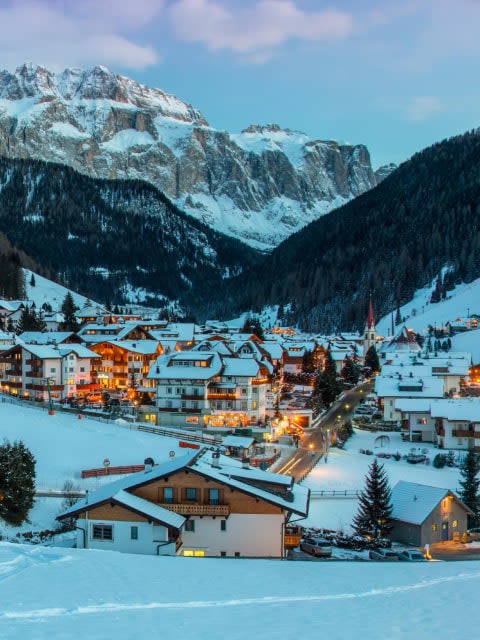
Val Gardena is one of the central valleys of the Sella Ronda circuit, with three villages - Selva, Santa Cristina, and Ortisei - each with a different feel. Selva is the highest and most ski-focused; Ortisei is the largest and most characterful. The valley sits beneath the Sassolungo massif and has direct access to the Sella Ronda in both directions. The skiing is excellent for intermediates, with long, well-groomed reds and blues. Val Gardena also hosts the annual Saslong World Cup downhill race.
Val Gardena ski deals
Alta Badia is the gastronomic heart of the Dolomites. The area includes the villages of Corvara, Colfosco, La Villa, San Cassiano, and Badia, and is home to several Michelin-starred mountain restaurants. The skiing is predominantly intermediate, with wide, immaculately groomed runs and the Gran Risa World Cup giant slalom course above La Villa. It's another central Sella Ronda valley, with easy links to Val Gardena and Arabba. The Ladin culture here gives the area a distinctive identity.
Alta Badia ski deals
Arabba is a small, quiet village at 1,602 m with the most serious terrain of the Sella Ronda resorts. It's the access point for the Marmolada glacier (3,342 m) - the highest point in the entire Dolomiti Superski area - and has steeper, more demanding skiing than the neighbouring valleys. The village itself is compact and unpretentious. It's an excellent base for strong intermediates and advanced skiers who want to combine Sella Ronda cruising with more challenging terrain.
Arabba ski deals
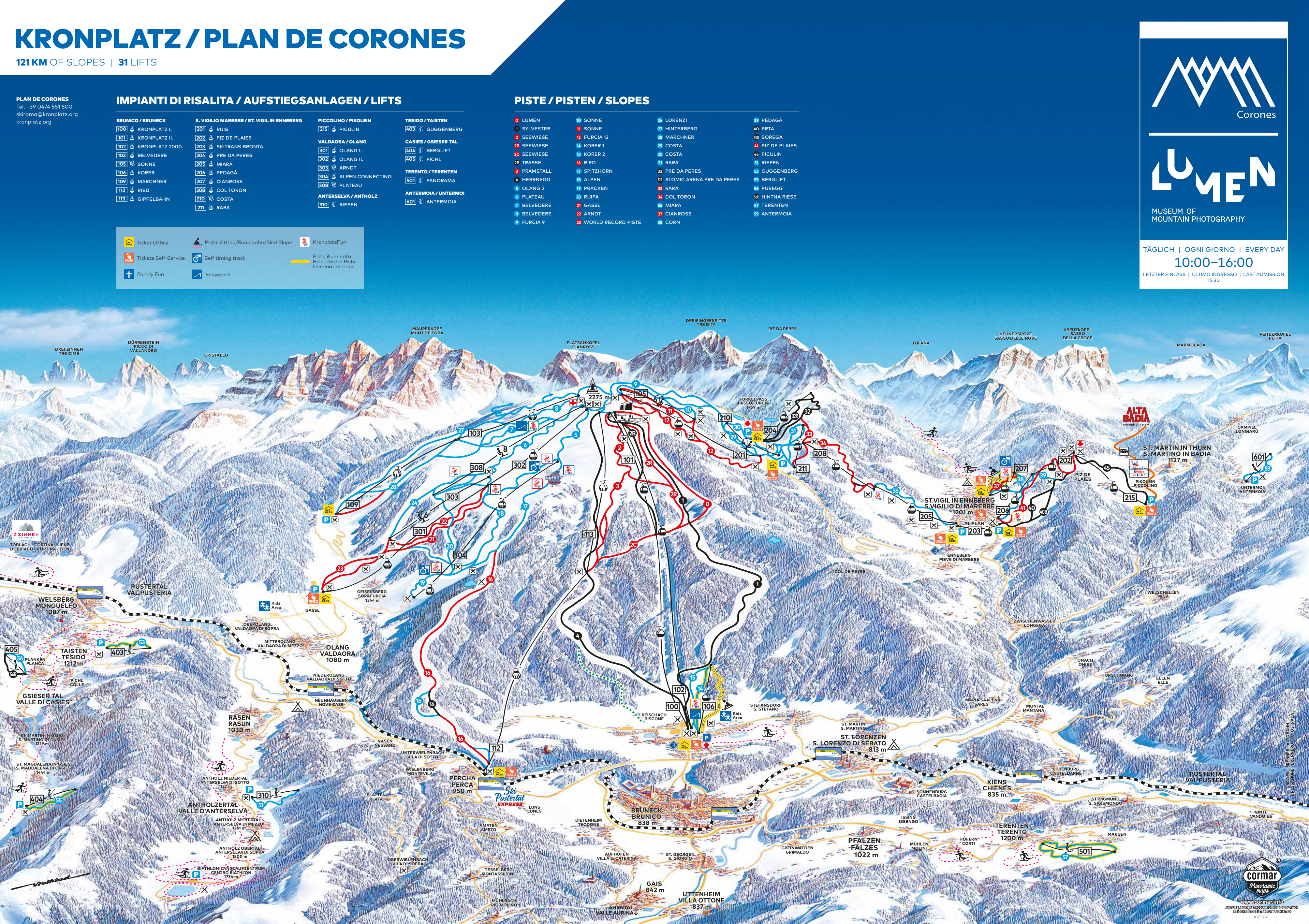
Kronplatz (Plan de Corones) is a single, broad mountain with runs radiating down all sides - a distinctive layout that makes navigation simple. The summit at 2,275 m has the Messner Mountain Museum and a Zaha Hadid-designed building, plus panoramic views of the surrounding Dolomites and the Austrian Alps. The skiing is predominantly intermediate, with wide, fast runs and excellent grooming. The town of Bruneck at the base is a proper Tyrolean market town with a medieval centre.
Kronplatz ski deals
Campitello di Fassa sits in the Val di Fassa and provides a gondola link up to the Col Rodella at 2,484 m, connecting directly to the Sella Ronda circuit. The village is traditional and quiet, with a handful of hotels and restaurants along the main street. From Col Rodella, you can ski into Val Gardena, Alta Badia, or across to Arabba. It's a convenient, low-key base for accessing the Sella Ronda without the higher prices of the more established resort villages.
Campitello di Fassa ski deals
Canazei is the largest town in the Val di Fassa, sitting at the foot of the Marmolada and linking into the Sella Ronda via the Belvedere gondola. It's livelier than Campitello, with a better selection of restaurants, bars, and shops. The Belvedere area above has a good mix of reds and blues, and from here you can access Arabba and the Marmolada glacier. The town has a sociable atmosphere and works well as a base for exploring the central Dolomites.
Canazei ski deals
Ortisei (St. Ulrich) is the main town in Val Gardena and the largest of the three valley villages. It has a beautiful pedestrianised centre, a strong woodcarving tradition, and a gondola up to the Alpe di Siusi and Seceda areas. It's slightly lower than Selva and a touch more town than resort, with good shopping and restaurants. The skiing above Ortisei links into the broader Val Gardena system and the Sella Ronda circuit.
3 Zinnen Dolomites (Drei Zinnen) is the easternmost major area in the Dolomiti Superski network, named after the iconic Tre Cime di Lavaredo peaks. The skiing links several small resorts including Innichen/San Candido and Sesto, and sits in the Val Pusteria. The runs are predominantly blue and red, with stunning views of the surrounding peaks. It's quieter and less well-known internationally than the Sella Ronda valleys, which means more space on the pistes.
Alpe di Siusi (Seiser Alm) is Europe's largest high-altitude alpine meadow, and the skiing here has a character all of its own. It's a wide, sunny plateau at around 1,850 m with gentle blues and stunning views of the Sassolungo and Sciliar massifs. The terrain is ideal for families and relaxed intermediates. It connects to the Val Gardena ski system and from there to the Sella Ronda. The cross-country skiing here is also excellent.
Alpe di Siusi ski deals
Carezza is a small, quiet ski area beneath the dramatic Latemar and Catinaccio/Rosengarten peaks. The skiing is compact - around 40 km of piste - but the setting is extraordinary, and the runs are well-groomed and uncrowded. It's not connected to the Sella Ronda circuit by lifts, but the Dolomiti Superski pass covers it. Carezza is a good choice for a peaceful day away from the busier valleys, or as a base for families who want a quieter setting.
Civetta is centred on the village of Alleghe, which sits on a lake beneath the imposing north face of Monte Civetta. The skiing links several small areas and has a good range of reds and blues, with the dramatic Civetta wall as a constant backdrop. It's one of the quieter areas in the Dolomiti Superski network and has a local, unhurried feel. A good option for skiers who want to explore beyond the Sella Ronda.
Civetta ski deals
Val di Fiemme is a wide valley in Trentino with skiing spread across the Alpe Cermis and other linked areas. The main resort of Cavalese is a pleasant market town, and the skiing suits families and intermediates well. The area is known for its cross-country skiing heritage - it regularly hosts World Cup Nordic events. Downhill terrain is mostly blues and reds with panoramic views. It's quieter and less tourist-focused than the Sella Ronda valleys.
Val di Fiemme ski deals
San Martino di Castrozza sits at 1,450 m beneath the Pale di San Martino - a dramatic wall of Dolomite peaks that's particularly stunning at sunset. The skiing is split between two main areas: the slopes above San Martino and the separate Rolle Pass area. The terrain is well-suited to intermediates, with some steeper sections off the Cima Rosetta cable car. The town has a genteel, old-fashioned atmosphere and good restaurants. It's one of the more southerly Dolomiti Superski resorts.
San Martino di Castrozza ski deals
The Dolomites are excellent for beginners thanks to the wide, well-groomed slopes and sunny conditions. Alpe di Siusi has some of the gentlest terrain in the network - a vast, sunny plateau with wide blues and very little steep ground. Alta Badia's Corvara and Colfosco areas have good nursery slopes separated from faster traffic. Kronplatz's broad summit means beginners have plenty of space. The grooming standards across the Dolomites are among the best in Europe, and the mountain huts provide a welcome break with proper meals, not just a sandwich.
WeSki does not currently have lessons available in the Dolomiti Superski area, but all resorts have local ski schools, many with English-speaking instructors.
WeSki tip: The Dolomites' famous mountain huts (rifugi) serve full meals on the slopes - pasta, local dishes, even wine. Build hut stops into your day: they're part of the experience, not just a pitstop. Many have sun terraces with views that are worth the visit on their own.
This is where the Dolomites truly excel. The Sella Ronda is the headline act - a 40 km circuit around the Sella massif linking Val Gardena, Alta Badia, Arabba, and the Val di Fassa, skiable in both directions in a single day. Beyond the circuit, every valley has excellent intermediate terrain: the long reds in Val Gardena, the immaculately groomed runs in Alta Badia, the wide boulevards on Kronplatz, and the quieter slopes in Val di Fiemme and 3 Zinnen. The Hidden Valley route from Lagazuoi down to Armentarola is a must-do - a gentle off-piste descent through a stunning canyon, ending with a horse-drawn sleigh ride back.
WeSki tip: Do the Sella Ronda clockwise first (orange direction). The runs are slightly more forgiving, and you'll finish in Val Gardena with the afternoon sun on the slopes. If you do it anti-clockwise (green direction) on another day, you'll see the same mountains from a completely different angle.
Arabba and the Marmolada glacier have the steepest marked terrain, with genuine black runs and a demanding descent from the Marmolada summit at 3,342 m. Val Gardena's Saslong World Cup course is open to the public and worth skiing for the speed and pitch. The off-piste potential is significant but different from the western Alps - the terrain is more technical and rocky, requiring local knowledge. The Lagazuoi-5 Torri area above Cortina has some excellent itinerary routes. A guide familiar with the Dolomite rock formations is strongly recommended.
WeSki tip: The Marmolada descent from 3,342 m to Malga Ciapela is 12 km and drops nearly 1,800 m of vertical - one of the longest runs in the Dolomites. It starts steep and icy at the top and opens out below. Go early for the best conditions and check glacier status before you set off.
The Dolomiti Superski pass covers all 1,200 km of piste and around 450 lifts across the entire network on a single ticket. Passes are available from one day up to the full season, with discounted rates for children, teens, and seniors. For shorter stays in a single valley, local valley passes are also available at a lower rate, with upgrade options. The pass includes the Sella Ronda circuit, the Marmolada glacier, and all 12 ski valleys.
You can add the lift pass directly to your WeSki booking, along with ski equipment hire at Arabba, Campitello di Fassa, Canazei, Cortina d'Ampezzo, Kronplatz, San Martino di Castrozza, and Selva Gardena among others - so everything's sorted before you arrive.
WeSki tip: If you're staying six days or more and basing yourself in the Sella Ronda area, the full Dolomiti Superski pass is worth it even if you don't visit every valley. Day trips to Cortina, Kronplatz, or 3 Zinnen make excellent changes of pace, and the pass saves you from buying separate tickets each time.
The access point depends on which resort you're heading to. For the western resorts (Val Gardena, Alta Badia, Kronplatz), Innsbruck is the closest airport at around 1 hour 30 minutes. For the eastern resorts (Cortina, 3 Zinnen), Venice Marco Polo is roughly 2 hours. Verona works well for the southern valleys (Val di Fassa, Val di Fiemme) at around 2 hours 30 minutes. Bergamo and Munich are also options. By train, Bolzano and Bressanone are useful rail hubs for the central valleys, with bus connections to most resorts.
WeSki has transfers to 12 of the 14 resorts in the network. Private transfers are available to all 12, with shared transfers to Alta Badia, Arabba, Cortina d'Ampezzo, Campitello di Fassa, Canazei, Ortisei, and Selva Val Gardena. Scheduled transfers run to Alta Badia, Cortina d'Ampezzo, Campitello di Fassa, Canazei, 3 Zinnen, and San Martino di Castrozza. Add them to your booking for a straightforward door-to-door trip.
The season runs from late November to mid-April. The Marmolada glacier at 3,342 m provides high-altitude skiing when conditions allow. Most of the skiing sits between 1,500 m and 2,500 m, and the Dolomites benefit from excellent snowmaking infrastructure - over 90% of runs are covered, which keeps conditions reliable even in low-snow years. January to mid-March typically sees the best natural snow, but the grooming and snowmaking mean the slopes are in good shape throughout the season.
The Italian school holidays in late December and throughout February are the busiest periods, particularly on the Sella Ronda circuit. If you've got flexibility, January and the first half of March are noticeably quieter. Early and late season both work well here thanks to the snowmaking and the sunny climate - the Dolomites get around 300 days of sunshine a year, so even in December and late March, conditions on the slopes are often bright and pleasant.
Yes. The Dolomites have wide, well-groomed slopes and excellent learning areas. Alpe di Siusi, Alta Badia (Corvara and Colfosco), and Kronplatz are particularly strong for beginners. Grooming standards are among the best in Europe. WeSki does not currently have lessons available, but all resorts have local ski schools, many with English-speaking instructors.
Dolomiti Superski covers 1,200 km of marked piste served by around 450 lifts across 12 ski valleys, ranging from 1,000 m to 3,342 m. Fourteen resorts are covered by a single pass. It is the largest ski pass network in the world.
The Sella Ronda is a 40 km ski circuit around the Sella massif, linking Val Gardena, Alta Badia, Arabba, and the Val di Fassa. It can be skied in either direction (clockwise - orange, or anti-clockwise - green) in a single day, with around 4 to 6 hours of skiing depending on pace and stops. It's predominantly blue and red terrain with stunning views throughout.
It depends on what you're looking for. Val Gardena (Selva) and Alta Badia (Corvara) are the most central for the Sella Ronda. Cortina d'Ampezzo has the most style and atmosphere. Arabba is the pick for advanced skiers and Marmolada access. Kronplatz suits intermediates who want a quieter setting. Campitello di Fassa and Canazei are well-positioned Sella Ronda bases. For peace and quiet, consider 3 Zinnen, Carezza, or San Martino di Castrozza.
The season typically runs from late November to mid-April. Over 90% of runs are covered by snowmaking, which keeps conditions reliable throughout the season. The Marmolada glacier at 3,342 m adds high-altitude terrain. The Dolomites also benefit from around 300 days of sunshine a year.
The best airport depends on your resort. Innsbruck is closest for western resorts (about 1 hr 30 min to Val Gardena or Kronplatz). Venice is best for Cortina and the eastern valleys (about 2 hr). Verona works for the southern valleys. WeSki has transfers to 12 of the 14 resorts, including private, shared, and scheduled options.
The Dolomiti Superski pass covers all 14 resorts and 12 valleys. The Sella Ronda circuit links four central valleys by lifts. Other resorts (Cortina, Kronplatz, 3 Zinnen, Carezza) are covered by the pass but require a drive between them. Free ski bus services connect some areas. Most visitors base themselves in one valley and take day trips to others.
Yes. Ski equipment hire is available through WeSki at Arabba, Campitello di Fassa, Canazei, Cortina d'Ampezzo, Kronplatz, San Martino di Castrozza, Selva Gardena, and several other locations. WeSki does not currently have lessons available in the Dolomiti Superski area. You can add equipment hire to your booking along with your lift pass and transfers.
Start building your dream ski trip today with our one-stop ski shop - hundreds of resorts, unlimited combinations.

 4.9/5
4.9/5I usually book flights, ground transportation, hotel, ski rental and lift tickets myself but this year used WeSki for a trip to Morzine. It was so much easier. Everything worked perfectly - ground transportation arrived on time and there was plenty of feedback throughout the whole process giving you confidence the vacation would go smoothly.

A really useful service that is so much easier to use than other 'all-inclusive' sites. It nicely bridges the gap between a travel agent and booking the trip yourself online. I'll use WeSki every time I go skiing from now on.
We booked a late minute skiing trip to Morzine through we ski. We looked at booking the trip ourselves but could get anywhere near the price quoted by we ski. The company was excellent and we had no problems at all from start to finish. I would definitely use them to book another weekend skiing trip.
Seamless experience from start to finish. I was spending ages trying to sort out a weekend break and managed to do it with we ski in minutes and for the same price as booking it all up yourself. Flight, transfers and accommodation was all as expected and faultless.