
EN
EN
 Stunning views
 Traditional charm
 Top facilitiesStunning viewsTraditional charmTop facilitiesStunning viewsTraditional charmTop facilitiesStunning viewsTraditional charmTop facilities
Civetta is one of the most striking corners of the Dolomites, in the Veneto region of northern Italy, a handful of small mountain villages set beneath the vast pale wall of Monte Civetta. The main village, Alleghe, sits on the shore of a lake formed by a landslide in 1771, with the mountain's rock face rising straight up above the water. That face, the northwest wall of Monte Civetta, is one of the largest in the Dolomites, and part of why this whole landscape holds UNESCO World Heritage status. These are working Veneto mountain communities with a quiet, lived-in feel, set in a landscape of raw, rugged peaks that climbers have prized for generations.
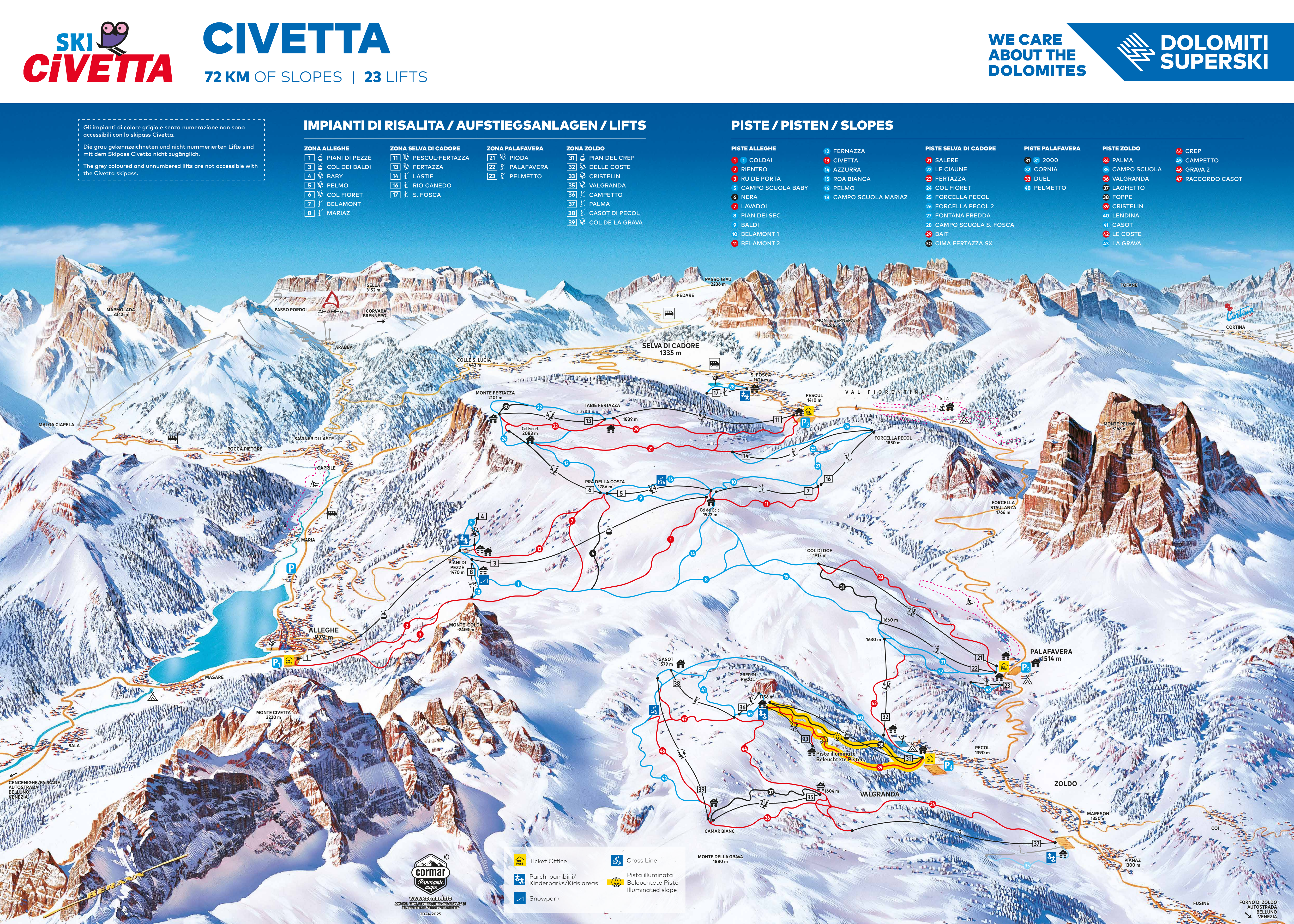
The skiing suits cruisers and intermediates especially well. Most of the runs sit below the treeline, wide and well groomed, winding down through the forest with the Civetta and Pelmo peaks filling the skyline. From the high point above Alleghe at around 2,100 metres, you can drop almost all the way down to the lake, a descent of more than a thousand metres through the trees. There are gentle nursery areas at the base of each village to get started on, and a few steeper pitches higher up for stronger skiers, though the heart of it is long, scenic cruising. Civetta holds snow well for its height, with heavy natural snowfall and snowmaking across nearly all of its pistes, so the season runs from late November into early April. The lifts link the villages along the mountain, so you can ski a circuit from one valley to the next over a day. Ski Civetta covers around 80 kilometres of piste on its own, and it's part of the wider Dolomiti Superski network, which connects twelve areas across the Dolomites for anyone wanting to range further.
Off the slopes, this is Veneto, a region that takes its food seriously. Mountain refuges and village restaurants serve hearty Dolomite cooking, from polenta and cured meats to casunziei, the crescent-shaped ravioli filled with beetroot or ricotta and dressed with butter. The valley has one claim worth knowing: Val di Zoldo is the home of Italy's ice cream makers, the families who carried gelato out across Europe from the late 1800s, and you'll still find superb artisan gelato in the villages today. The non-ski hours fill easily. You can go ice skating at Alleghe, join a guided snowshoe walk to a mountain hut for dinner under the stars, or head to Val di Zoldo for the floodlit evening slopes, and there are cross-country trails through the valleys. Add the Ladin culture of the Val Fiorentina villages, rooted in one of the Dolomites' old native languages, and Civetta adds up to a rounded winter holiday, not only a ski trip.
Check out Civetta ski deals to start planning your trip.
Civetta is one of the most striking corners of the Dolomites, in the Veneto region of northern Italy, a handful of small mountain villages set beneath the vast pale wall of Monte Civetta. The main village, Alleghe, sits on the shore of a lake formed by a landslide in 1771, with the mountain's rock face rising straight up above the water. That face, the northwest wall of Monte Civetta, is one of the largest in the Dolomites, and part of why this whole landscape holds UNESCO World Heritage status. These are working Veneto mountain communities with a quiet, lived-in feel, set in a landscape of raw, rugged peaks that climbers have prized for generations.
The skiing suits cruisers and intermediates especially well. Most of the runs sit below the treeline, wide and well groomed, winding down through the forest with the Civetta and Pelmo peaks filling the skyline. From the high point above Alleghe at around 2,100 metres, you can drop almost all the way down to the lake, a descent of more than a thousand metres through the trees. There are gentle nursery areas at the base of each village to get started on, and a few steeper pitches higher up for stronger skiers, though the heart of it is long, scenic cruising. Civetta holds snow well for its height, with heavy natural snowfall and snowmaking across nearly all of its pistes, so the season runs from late November into early April. The lifts link the villages along the mountain, so you can ski a circuit from one valley to the next over a day. Ski Civetta covers around 80 kilometres of piste on its own, and it's part of the wider Dolomiti Superski network, which connects twelve areas across the Dolomites for anyone wanting to range further.
Off the slopes, this is Veneto, a region that takes its food seriously. Mountain refuges and village restaurants serve hearty Dolomite cooking, from polenta and cured meats to casunziei, the crescent-shaped ravioli filled with beetroot or ricotta and dressed with butter. The valley has one claim worth knowing: Val di Zoldo is the home of Italy's ice cream makers, the families who carried gelato out across Europe from the late 1800s, and you'll still find superb artisan gelato in the villages today. The non-ski hours fill easily. You can go ice skating at Alleghe, join a guided snowshoe walk to a mountain hut for dinner under the stars, or head to Val di Zoldo for the floodlit evening slopes, and there are cross-country trails through the valleys. Add the Ladin culture of the Val Fiorentina villages, rooted in one of the Dolomites' old native languages, and Civetta adds up to a rounded winter holiday, not only a ski trip.
Check out Civetta ski deals to start planning your trip.
Civetta is, for the most part, a cruiser's mountain, made for long, relaxed runs you can ski at an easy, flowing pace, with plenty in between for skiers who want to push a bit harder. Its runs are long and largely tree-lined, rolling down through the forest at a steady, enjoyable gradient that lets you settle into a rhythm and cover ground. One thing that sets this mountain apart is its layout. Rather than lapping one slope all day, the pistes and lifts string along the mountain's flanks linking three village bases, Alleghe, Selva di Cadore, and Val di Zoldo. You can have a proper point-to-point journey, starting above one village in the morning, skiing across to another, and finding a different way back over the day. The scenery changes as you move from one valley to the next, and modern gondolas and chairlifts out of each base keep it flowing.
There's terrain for every level. Beginners have wide nursery areas at all three village bases and gentle blues to progress onto, with plenty of room to build confidence. Intermediates get the run of the mountain, with long red cruising runs through the trees that are fast, flowing, and approachable. Stronger skiers have a handful of steep black pitches and good tree skiing to seek out, along with off-piste lines for those with the experience to read them.
Civetta is an easy place to learn. Each of the village bases has its own nursery area, with gentle, wide slopes and simple lifts for your first days on snow. The learning areas at Palafavera, between Alleghe and Selva di Cadore, are among the gentlest and most sheltered of these. Beyond the nursery slopes, a large share of the mountain is graded blue, so there's plenty of forgiving terrain to move onto as your confidence grows. Each village has its own ski school, with group and private lessons in English, so it's easy to add some instruction wherever you're based.
When you're ready to leave the nursery area, the mountain’s wide blue runs make for a comfortable next step. Pian de Sec (above Alleghe) is about as gentle as a real run gets and a good first piste to build on, and the short Azzurra nearby works well as an easy warm-up. As you find your feet, wide, rolling blues like Lendina and La Grava give you room to open up your turns and cover more ground. The runs all the way down to the villages are graded red, so early on you can ride the lifts back to base and stay on the blue terrain higher up.
WeSki insider tip: La Grava and its neighbour Grava 2 run down opposite sides of the same wide slope, the left an easy blue, the right a steeper red. Learn your turns on the blue side, then cross to the red when you're ready. It's one of the most natural places on the mountain to step up from blue to red without ever changing piste.
Civetta is, at heart, an intermediate mountain, since most of the runs are long, rolling reds that wind down through the forest. With its well groomed and varied terrain, you can build speed, work on your carving, and link turn after turn without the gradient getting away from you. Coldai is a good example, a red run above Alleghe that twists through the trees and gradually steepens as you go. Over at Selva di Cadore, Salere is another great intermediate run that spans around four kilometres for a long, satisfying cruise, while the wide-open pistes around Col de la Grava give you room to open up and carve at speed.
The real appeal Civetta has for a confident intermediate is the freedom to roam. Because the lifts and pistes link three separate village bases, you can ski across the mountain over a day, starting above one village, working your way to another, and looping back by a different route. It turns a day's skiing into a tour of the whole area, with enough variety between the valleys to keep you busy for the best part of a week.
WeSki insider tip: Set aside a day to ski the full way over to Val di Zoldo and back. The Zoldo runs are some of the best cruising in the area, the long Valgranda red through the trees especially, and skiing out and looping home is the most satisfying way to take in the whole of Civetta in one go.
Civetta is best known for its cruising, but there's proper challenge here for stronger skiers, and the black runs are where to find it. On the Alleghe side, Nera is the steepest pitch, a short, sharp test off the top. The best of the steep skiing, though, is over on the Val di Zoldo side, around the Pian del Crep lift. Foppe is a sustained black that drops straight back to the chair, and Laghetto is a steep, narrow black through the trees, the most enjoyable run of the lot for a confident skier. There's good tree skiing here too, on the wooded slopes above Pescul and Pecol.
To be straight about it, Civetta won't fill a full week of steep skiing on its own. The blacks are limited in number, and this is a mountain for cruising more than for charging hard. For a bigger day out, though, the Marmolada is close by, the highest peak in the Dolomites, and the long glacier descent from its summit is one of the great runs in the range, well worth a day trip while you're in the area.
WeSki insider tip: For the steepest skiing in one place, base yourself around the Pian del Crep lift on the Val di Zoldo side. It tops a conical summit with pistes dropping off in every direction, the steepest right under the lift, so you can lap Foppe and Laghetto back to back without traversing the whole mountain to do it.
Snowboarding is well woven into life at Civetta. Alleghe even bills itself as an "unconventional" resort, and it backs that up with a busy freestyle and freeride scene that draws riders in for contests through the winter. For free riding, the mountain plays to a board's strengths: the long, tree-lined reds carry plenty of speed and flow, there are natural banks and rollers to work off, and the wooded slopes above Pescul and Pecol open up some good tree riding after fresh snow. Most of the lifts are gondolas and chairs, so you're spared the worst of the draglifts, though it's worth knowing that a few of the runs linking the valleys flatten out, carry your speed across those and you'll save yourself unstrapping to skate.
For freestyle, there's plenty to work with. The main setup is the Alleghe Central Park up at Piani di Pezze, with separate lines for different abilities, from a small training area through to bigger kickers and rails, plus a Big Air Bag for trying new tricks into a soft landing. A second park sits over in Val di Zoldo near Pecol, and there are a few boardercross courses dotted around, the Alleghe Boardercross runs banked turns and rollers down the Pelmo slope and is gentle enough for families. Regular contests run through the season, so there's usually something on if you like a bit of atmosphere.
Off-piste at Civetta covers a lot of ground, from easy tree skiing right off the lifts to serious ski touring on the surrounding peaks. The most accessible of it is the broad, wooded face between Col dei Baldi and Col Fioret, which holds good snow after a fall and gives some of the best tree skiing in the area: steep enough to keep moving, gentle enough to stay in control, and it feeds back onto the pistes rather than into thick forest below. Beyond that, the slopes between the marked runs keep their powder well after a storm, and there are open lines and gullies above the treeline for skiers with the experience to take them on.
The bigger draw, though, is ski touring. This is classic Dolomites terrain for it, and the peaks around the resort open up routes well beyond the lift network. One popular tour on Monte Civetta itself climbs past the Coldai refuge before dropping back down toward Alleghe, and the slopes around Monte Pelmo, the great peak across the valley, hold more touring lines again. It's the kind of skiing that rewards a few days and a sense of adventure. As anywhere off the marked runs, go with a local mountain guide who knows the snowpack and can read the day's avalanche risk, the resort's ski schools and the Alleghe alpine guides can set you up.
Civetta has five ski schools spread across the village bases, all part of Italy's national ski-school association, with close to 150 instructors between them. They run the full range of group and private lessons, for all ages and from first-timers up to experts, and while the schools are Italian, English-speaking instructors are available, worth requesting when you book so it's arranged in advance. Children are well looked after, with dedicated programmes and snow-garden camps at the nursery areas, and some schools take little ones from as young as three.
Beyond the standard lessons, there's some genuinely interesting specialist coaching on offer. Several of the schools have instructors who teach carving, telemark, and snowboarding, and there's freestyle coaching for riders looking to progress in the parks. For getting off the marked runs, the local mountain guides run freeride and ski-touring sessions, a good way to make your first turns in the backcountry safely, alongside someone who knows the snow. Keen skiers will also find schools offering video analysis and technique workshops to sharpen things up.
Civetta's freestyle setup centres on the Alleghe Central Park. It's built as a progression, with separate small, medium, and large lines, so you can start on gentle features and work up, across a spread of kickers at different sizes and a good run of rails, boxes, and jibs. Alongside it sits a Big Air Bag, a soft inflatable landing for trying new tricks before you take them onto snow. Newer freestylers have a smaller park of their own to learn in, with a couple of boxes, a rail, and an easy jump line.
Over in Val di Zoldo there's a second park near Pecol, set on a floodlit piste so you can keep riding into the evening, and a few boardercross courses are dotted around the area for racing the banks and rollers. Everything is shaped daily, and the parks host freestyle contests through the winter.
Civetta makes an easy, welcoming base for a family holiday. The villages are small and friendly, with warm, family-run Italian hospitality and good mountain food, and Alleghe's setting on the lake beneath Monte Civetta gives the whole trip a memorable backdrop. On the mountain, things are refreshingly straightforward for parents. Its slopes are wide, sunny, and tree-lined, the altitude is gentle, and the whole area is easy to get around, so a family can get going without much fuss. It all adds up to a calm, relaxed holiday, easy for children to settle into and easy for parents to enjoy.
For young children, the learning setup is good. Each base has gentle nursery slopes, and above Alleghe at Piani di Pezze there's Ally Farm, a dedicated children's snow park and ski kindergarten built to ease little ones into skiing. The ski schools take children from around age three, with programmes that turn the first days on snow into play. Once they're past the nursery slopes, there's plenty of easy blue terrain to grow into, though the long runs down to the villages are graded red, so younger children often ride the lifts back down and stay on the gentler slopes up top. Older children and stronger young skiers get more still: the connected village-to-village skiing gives them a real sense of adventure over a day, and the terrain parks, built with beginners and teenagers in mind, are a draw in their own right, with a family-friendly boardercross course to race through.
Off the slopes, there's plenty to round out the holiday. Alleghe has a modern ice rink right by the lake, open to everyone for skating, and the town is a stronghold of Italian ice hockey, so catching a match makes for a fun family evening. Easy, pushchair-friendly walks run around the lake, and there's snowshoeing in the woods for a gentle adventure on foot. Eating is comfortable and family-friendly, with mountain refuges and village restaurants serving hearty local cooking, and the valley's famous gelato is always a hit. The overall feel is relaxed and unhurried, a lakeside corner of the Dolomites where the evenings are easy and the pace is slow.
Civetta isn't only about the skiing. Between the lake, the forests, and the string of old Veneto villages, there's plenty to fill a rest day or keep non-skiers happy, from gentle wintry walks and a turn on the ice to a day out in a famous mountain town. Here are some of the best things to do, on the snow and off it.
Dining across the Civetta area is built on Veneto mountain tradition and the Ladin cooking of the Belluno Dolomites: hearty, honest food rooted in what the valleys produce, polenta, venison and other game, wild mushrooms, and local mountain cheeses. The scene runs on family-run trattorias down in the villages and rifugi up on the slopes, places where recipes are handed down rather than reinvented, and where a long lunch in the sun is part of the day.
WeSki insider tip: Order casunziei all'ampezzana, half-moon ravioli filled with beetroot, dressed in melted butter, poppy seeds, and smoked ricotta. They're the signature pasta of the Belluno and Cortina Dolomites, and the beetroot stains the plate a vivid purple-red.
Après-ski in Civetta is low-key and easygoing, built around a relaxed drink as the day winds down. In Alleghe, the afternoon tends to ease off on a sunny terrace or down by the lake, a glass of local wine or a Bombardino in hand, before things shift into the village bars. There's a decent spread of spots for a night out, for example, a wine bar that doubles as the town's social hub, a lively pub with live music most winter nights, and a place that pours its own beer. Selva di Cadore is quieter, with a bar or two embracing the easy rhythm of village life, while the on-mountain huts set out their terraces for a last drink before the ski down.
For a livelier night out, Cortina is about 40 minutes away by car or taxi, with its smarter bars and clubs. Most evenings here, though, settle into a long dinner and an early night.
Après-ski spots to know:
Accommodation around Civetta is mostly small and family-run, comfortable hotels, guesthouses and B&Bs, and self-catering apartments and chalets, rather than large resort complexes. The hotels tend to be personal places, often run by the same family for years, with warm service and a strong line in Veneto mountain cooking. Many offer half board, and the evening meal is usually one of the better parts of a stay. Across the villages the style is traditional and unpretentious: wood-panelled, cosy, and well looked after.
Most of the places to stay sit in one of three villages. Alleghe is the obvious base, set on the lake with the widest choice of hotels and apartments, the most going on in the evenings, and its gondola running up to the slopes from the edge of the village. Over in the sunny Val Fiorentina, Santa Fosca and neighbouring Selva di Cadore are quieter and more traditional, a short hop from the chairlifts on that side of the mountain. Pecol, the main village on the Val di Zoldo side, is quieter again, with its own gondola up to the slopes and easy reach of the Zoldo pistes and the floodlit evening skiing. None of the villages is far from a lift, and the ski bus links them through the day, so wherever you base yourself you can get onto the mountain easily and still reach the others.
The Ski Civetta pass is the one you'll want for a stay here. It covers every lift and piste across the linked villages of Alleghe, Selva di Cadore, Palafavera, and Val di Zoldo, so a single pass lets you ski the whole connected area, including the village-to-village circuit, switching freely from one valley to the next over the day. Day passes and multi-day passes are both available, with family and child rates too.
When you book your Civetta ski holiday through WeSki, we can help you find the day, multi-day, or family pass that best fits your trip.
You'll find rental shops in all the main villages, Alleghe, Selva di Cadore, and Val di Zoldo, several of them right by the lifts, so it's easy to pick up your gear close to where you're staying and skiing. They carry the full range of skis, snowboards, boots, and helmets, from beginner sets through to higher-performance kit, and the staff are happy to help you get the right fit. It's worth booking ahead over the Italian school holidays, especially if you need children's equipment.
Getting up to the slopes is easy wherever you stay. Each of the base villages has its own lift into the ski area, gondolas out of Alleghe and Pecol and chairlifts on the Val Fiorentina side, and most accommodation is a short walk or a quick ski-bus hop from the nearest one. Once you're up, the whole area connects on skis, so you can work your way across the lifts and pistes from one village's slopes to the next and back over the day, without coming down to drive.
Off the snow, the villages themselves are small and easily walked, with shops, bars, and restaurants close at hand wherever you're based. They do sit in three separate valleys, so by road they're more spread out, but a ski bus links the main villages and lift bases through the season, and the public Dolomitibus runs between them too. If you'd rather not drive, local taxis and private transfer services can be arranged. Parking at the lift bases is free.
A car is mainly useful for day trips further into the Dolomites, to Cortina or the other ski areas, on mountain roads where winter tyres are needed and chains are worth carrying. For the skiing itself, though, you can manage well without one: most days are spent on the Civetta slopes and evenings in the village, with the lifts and the ski bus covering nearly everything you'll need.
Civetta sits in the Agordino, the cluster of valleys below the Belluno Dolomites in Italy's Veneto region. For most visitors the handiest airport is Venice Marco Polo, around 170km away and roughly two and a half hours by road. Treviso is a little closer, at about 150km, and often the budget-airline choice, while Verona and Bergamo are also within reach to the south, and Innsbruck lies around 200km to the north over the Brenner Pass. From Venice or Treviso, the route heads north on the A27 motorway towards Belluno, then climbs into the Agordino on mountain roads for the final stretch up to the resort.
WeSki can arrange a private or shared door-to-door transfer to take you straight to your accommodation when you book a Civetta ski holiday.
Monte Civetta (3,220m) is one of the most recognisable peaks in the Dolomites. Its northwest wall is among the largest rock faces in the range, over 1,000m of vertical cliff running for several kilometres, and it's a legendary objective for climbers, with a long history of pioneering ascents. The ski area sits beneath this face, and the mountain stands over the skyline from almost every part of the slopes. The Dolomites are a UNESCO World Heritage Site, and Civetta is one of their landmark peaks.
Yes. There's a nursery area at each of the main village bases for your first days, and a good amount of easy terrain to progress onto, much of the mountain is graded blue, the easiest level in the European system (there are no "green" runs here simply because Italian resorts don't use that grade). The main thing to know is that the long runs down to the villages are red, so in the early days you'll often ride the lifts back down and stay on the gentler slopes higher up. The ski schools take beginners of all ages, including children from around three. It's a comfortable place to learn.
Ladin is an old Rhaeto-Romance language spoken in several valleys of the Dolomites, including the Val Fiorentina above Selva di Cadore. It descends from the Latin of the Roman era and predates both modern Italian and German in the area, and roughly 30,000 people still speak it as a first language. Its communities keep distinct traditions, food, and architecture, which add real cultural depth to this corner of the Dolomites.
It depends on your plans. The local Ski Civetta pass (around 80km across the linked villages) is plenty for several days. If you'd like to range further, the Dolomiti Superski pass opens the wider network of about 1,200km, including Arabba (a short drive away and the gateway to the famous Sellaronda circuit), the Marmolada, Cortina, Alta Badia, and Val Gardena. For a longer stay with an appetite for exploring, many skiers value the upgrade; for a few days, or if you're happy on the local slopes, the Ski Civetta pass is all you need. Worth knowing: if you already hold an Ikon Pass, it includes Dolomiti Superski days here.
They're quite different in feel. Cortina is a large, well-known resort town with extensive terrain, plenty of shops and restaurants, and a high profile as a co-host of the 2026 Winter Olympics. Civetta is smaller and more low-key, a handful of traditional mountain villages with a wilder, more rugged character. Both sit on the Dolomiti Superski network and are about 40 minutes apart by car, so you can ski one and visit the other. Civetta suits people who want scenery and a traditional, unhurried base; Cortina suits those after a bigger resort town with more going on.
Reasonably so. The top of the ski area sits at around 2,100m, moderate by Dolomite standards, but snowmaking covers close to all of the pistes, so cover stays dependable through the season even when natural snow is thin. The north-facing slopes hold snow best, and the southern Dolomites can get heavy falls from Adriatic weather systems, part of why the Belluno valleys are among the snowier corners of the range. The season usually runs from late November into early April, with January and February the most dependable months.
Lago di Alleghe is an alpine lake formed in 1771, when a huge rockfall from Monte Piz dammed the valley and flooded it. It sits right below Monte Civetta's wall, one of the most striking spots in the area, and the village of Alleghe lies on its shore as the main base for the ski area. In cold winters the lake freezes over, and there's a lakeside ice rink in the village for skating.
 4.9/5
4.9/5I usually book flights, transfers, hotel, ski rental and lift passes myself but this year used WeSki for a trip to Morzine. It was so much easier. Everything worked perfectly - transfers arrived on time and there was plenty of feedback throughout the whole process giving you confidence the holiday would go smoothly.

A really useful service that is so much easier to use than other 'all-inclusive' sites. It nicely bridges the gap between a travel agent and booking the trip yourself online. I will use WeSki every time I go skiing from now on.
We booked a late minute skiing trip to Morzine through we ski. We looked at booking the trip ourselves but could get anywhere near the price quoted by we ski. The company was excellent and we had no problems at all from start to finish. I would definitely use them to book another weekend skiing trip.
Seamless experience from start to finish. I was spending ages trying to sort out a weekend break and managed to do it with we ski in minutes and for the same price as booking it all up yourself. Flight, transfer and accommodation was all as expected and faultless.

WeSki is a trading name operated by Wetrip Weski Ltd (BR021500). All the flights and flight-inclusive holidays on this website are financially protected by the ATOL scheme. When you pay you will be supplied with an ATOL Certificate. Please ask for it and check to ensure that everything you booked (flights, hotels and other services) is listed on it. Please see our booking conditions for further information or for more information about financial protection and the ATOL Certificate go to: www.caa.co.uk.
Package holidays that do not include travel by air are financially protected via ABTOT.
For the latest travel advice from the Foreign & Commonwealth Office visit www.gov.uk/foreign-travel-advice.