EN
EN
Val Thorens and Val d'Isère are two of the biggest names in French skiing, and they sit only around 35 km apart as the crow flies in the Tarentaise. They do not share a lift pass or a ski area, though. Val Thorens is the highest resort in the Three Valleys, at the top of the Belleville valley. Val d'Isère sits at the head of the Isère valley and shares its slopes with Tignes. By road they are around 95 km apart, and nothing links them on skis. So this is a choice between two mountains as much as two villages: a vast, high, treeless circuit on one side, and a smaller, steeper area with an old village at its heart on the other. This guide compares passes, terrain, snow, villages, après, families, experts and getting there, so you can pick the week that fits how you ski.
Choose Val Thorens for: the largest lift-linked ski area in the world from the door, a village at 2,300 m where almost every bed is close to a piste, wide and open intermediate terrain, a young and lively après scene, and self-catered apartments that make it easy to house groups.
Choose Val d'Isère for: steep pistes and serious off-piste close to the lifts, a real village centre with centuries of history, a broader dining scene, tree-lined runs for stormy days, and the Grande Motte glacier above Tignes on the same pass.


| Feature | Val Thorens | Val d'Isère |
|---|---|---|
| Country | France (Savoie) | France (Savoie) |
| Ski area | Three Valleys - 600 km of pistes (around 150 km on the local pass) | Tignes - Val d'Isère - 300 km of pistes (around 150 km on the local pass) |
| Village altitude | 2,300 m | 1,850 m |
| Highest lift | 3,230 m (Pointe du Bouchet, Orelle side) | 3,456 m (Grande Motte, in Tignes) |
| Season | Roughly late November to early May | Roughly late November to early May |
| Best for | Mileage, intermediates, doorstep skiing | Steeps, off-piste, village life |
| Village character | Purpose-built, car-free, above the treeline | Historic Savoyard village with outlying hamlets |
| Nearest airport | Chambéry (~1 hr 45 min); Geneva (~2 hr 45 min) | Chambéry (~1 hr 45 min); Geneva (~3 hr) |
Start here, because it is the point most comparisons skip: Val Thorens and Val d'Isère are not linked, and no standard lift pass covers both. Each sits in its own ski area, and each gives you a choice between a local pass and the full area. In Val Thorens, the Val Thorens - Orelle pass covers around 150 km - the resort's own bowl plus the slopes that drop to Orelle in the Maurienne valley. Step up to the full Three Valleys pass and you add Les Menuires, St Martin de Belleville, Méribel, La Tania, Courchevel and Brides-les-Bains, 600 km in all, with a Belleville valley pass sitting in between. In Val d'Isère, a local pass covers the home side - Bellevarde, Solaise and Le Fornet - while the full Tignes - Val d'Isère pass adds Tignes and the Grande Motte glacier for 300 km. Local-pass rules can change between seasons, so check what is on sale for your dates. The practical difference is shape. Val Thorens sits at the far end of the Three Valleys, so the full pass doubles your options, but Courchevel is a full-day round trip with an eye on the last lifts home. Tignes - Val d'Isère is more compact, and its far corners are closer to home.
Who it suits: if covering as much ground as possible is the point of the week, Val Thorens on the full Three Valleys pass; if you would rather know one ski area well, Val d'Isère's is big enough for a week and easier to get around.
Val Thorens skis as one huge, high bowl ringed by peaks, entirely above the treeline. Wide blues and reds fall back towards the village from almost every side, so you can lap for hours without planning the way home, and the slopes catch the sun at different times of day. The Cime Caron, at around 3,200 m, gives the big panorama and a long, sustained black back down, and the links to Les Menuires and Méribel run out from the top of the bowl. It is flattering, high-mileage skiing, built for intermediates who want variety. Val d'Isère is steeper and more varied. Bellevarde holds the Face, a wide World Cup downhill, alongside long reds; Solaise is gentler at the top; and Le Fornet and the Pissaillas glacier sit at the head of the valley. The lower runs at La Daille and Le Fornet wind through larch woods, which Val Thorens has none of. Grades read differently too: a Val d'Isère red tends to ask more than a Three Valleys red.
Who it suits: for wide, high cruising and endless variety, Val Thorens; for pitch and more varied terrain on a smaller canvas, Val d'Isère.
Both are among the more snow-sure resorts in the Alps, and both run roughly from late November to early May. Val Thorens has the edge on altitude. The village sits at 2,300 m and almost all of its skiing is above 2,000 m, so the runs home stay wintry at the very start and end of the season, and there is no low-lying piste to turn to slush. Val d'Isère's village sits 450 m lower, at 1,850 m, and its home runs finish at village level, where they lean on snowmaking in a lean year and soften by afternoon in spring. Higher up the picture evens out: much of Val d'Isère's skiing faces north and holds its snow well, and the Pissaillas glacier and the Grande Motte above Tignes lift the ceiling of the area. Altitude has a cost, though. With no trees, Val Thorens loses all contrast when cloud sits on the bowl, and its top lifts are exposed to the wind. Val d'Isère's wooded runs keep you skiing on those days.
Who it suits: for an early-season or late-spring trip, Val Thorens; for a midwinter week when storms are part of the deal, Val d'Isère's trees are worth having.
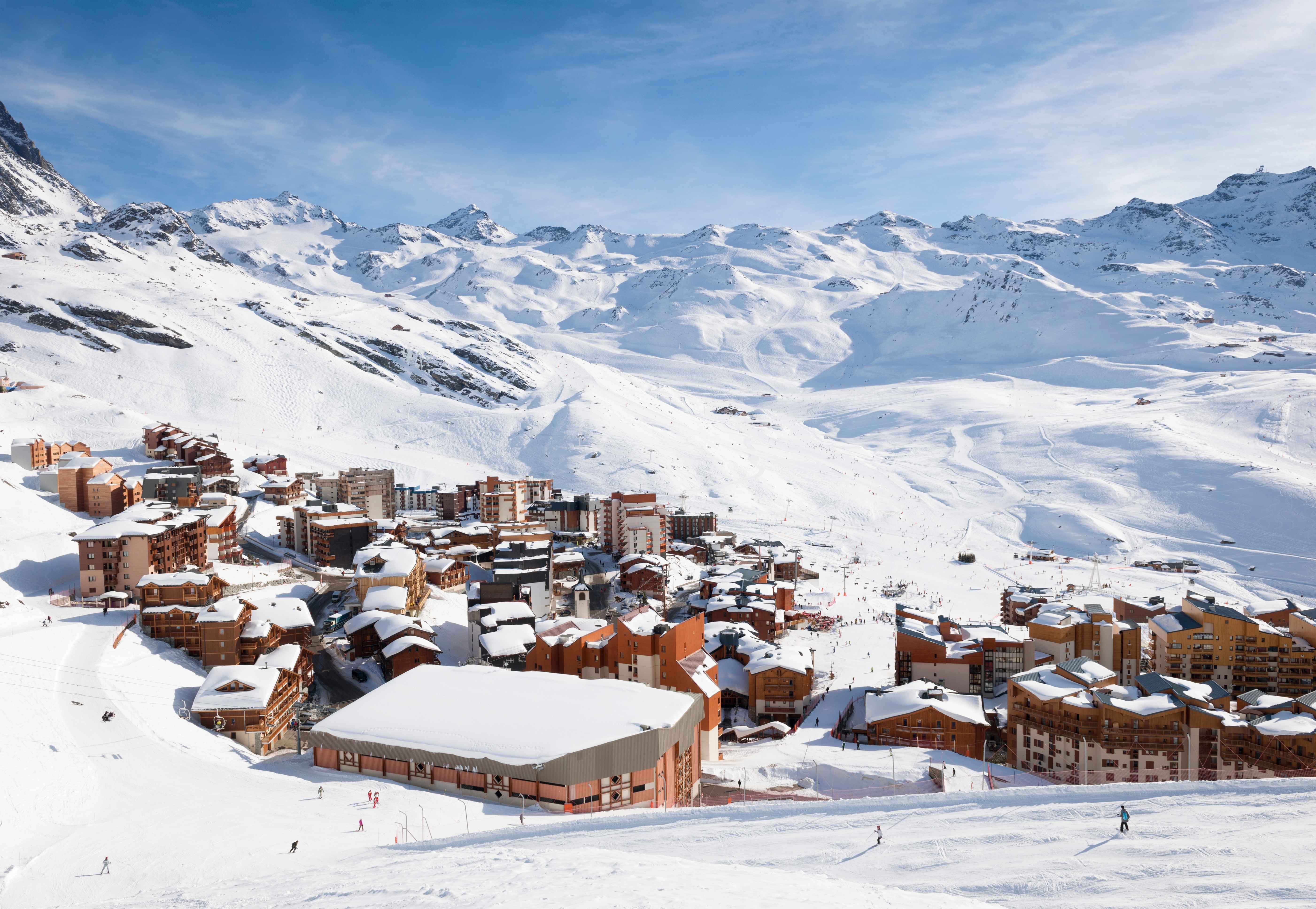
Val Thorens was built from scratch from the early 1970s, and it shows in the convenience. The centre is compact and traffic-free - cars go into the car parks on arrival and stay there all week - and nearly every building sits on or beside a piste, so most stays are ski-in/ski-out or close to it. Wood and stone cladding has softened the look over the years. Most accommodation is self-catered apartments, alongside a growing number of upmarket hotels. Evenings are short walks and sharp air: at 2,300 m, nights are cold. Val d'Isère has a real village at its heart, with a baroque church, stone and timber buildings and streets that predate ski tourism. It stretches along the valley floor, with La Daille at one end and Le Fornet at the other, linked by a free bus. Catered chalets and hotels make up much of the stock, and fewer beds are right on the snow, so expect a short walk or bus ride to the lifts from many of them.
Who it suits: for doorstep skiing and a resort built around the slopes, Val Thorens; for a village with history and life beyond skiing, Val d'Isère.
Both resorts have a La Folie Douce on the mountain above town, and both are famous for their afternoons. The crowd is what separates them. Val Thorens skews young and international, with student weeks and big groups, and because the centre is so compact, bars and late-night clubs are only a few minutes' walk from most beds. Val d'Isère's après is just as well known but spread across a wider age range: the terrace at La Daille in the afternoon, busy bars in the village, Dick's Tea Bar as the late-night landmark, and quieter wine bars for anyone who would rather talk than dance. Dining is where Val d'Isère pulls ahead. Its restaurants run from hearty Savoyard places to Michelin-starred tables, with enough range to eat out every night of the week. Val Thorens has a handful of high-end hotel restaurants, but the everyday choice leans casual.
Who it suits: for young groups after big nights close to bed, Val Thorens; for mixed ages who want après followed by a proper dinner, Val d'Isère.
Val Thorens makes the first days easy for most beginners. Nursery slopes sit in the heart of the resort, the gentle greens and blues at the bottom of the bowl lead straight back to the village, and short distances mean little carrying of skis. The catch is the altitude: at 2,300 m it is colder and windier than most resorts, which small children feel first, and some people sleep badly on the first night or two. Val d'Isère has strong ski schools, snow gardens in the village and dedicated beginner zones, including a gentle area at the top of Solaise reached by lift. Beyond those zones the mountain steepens quickly, and the runs back into the village are demanding, so many newer skiers ride the lift down at the end of the day. Val d'Isère tends to suit families whose children already ski confidently, and who will make use of the evenings in the village.
Who it suits: for first-timers and young children, Val Thorens; for families with confident older children, Val d'Isère.
Val d'Isère is one of the great expert resorts in France. The Face de Bellevarde puts a race-grade black on the doorstep, and the couloirs and open faces around Le Fornet, the Pissaillas glacier and La Daille put serious off-piste close to the lifts, best taken with a guide. Tignes, on the same pass, adds the Grande Motte and a big freestyle park. Val Thorens is less famous among strong skiers but far from tame: the blacks off the Cime Caron are long and steep, the off-piste valley of the Lac du Lou is a classic guided descent, and the whole Three Valleys - the steeps of Mont Vallon above Méribel and the Courchevel couloirs among them - is within reach on the full pass. Val Thorens has a good park close to the village; Val d'Isère's sits on Bellevarde. Put simply, Val d'Isère concentrates its challenge close to home, while Val Thorens spreads it across a far larger area.
Who it suits: for steeps and off-piste close to the village, Val d'Isère; for strong skiers who value mileage and variety, Val Thorens.
Both resorts are reached up the Tarentaise valley, on the same road as far as Moûtiers. There they split: Val Thorens climbs 37 km of hairpins up the Belleville valley, while the road to Val d'Isère carries on past Bourg-Saint-Maurice and up beyond the turning for Tignes. From Chambéry both take around 1 hour 45 minutes; from Geneva, the most common gateway for UK flights, Val Thorens is slightly closer at around 2 hours 45 minutes against 3 hours for Val d'Isère, with Lyon an option for both. By rail, Val Thorens is served from Moûtiers-Salins-Brides-les-Bains and Val d'Isère from Bourg-Saint-Maurice, each followed by around 45 minutes to an hour by bus or taxi. In winter the road over the Col de l'Iseran is closed, so Val d'Isère is the end of the line. Between the two resorts it is around 95 km and 1 hour 40 minutes by car via Moûtiers, with no direct bus - a day trip is possible with a car, but not something to plan a week around.
Who it suits: for a slightly shorter transfer, Val Thorens; in practice, the journey is close enough that it should not decide the choice.
WeSki insider tip: when cloud settles on Val Thorens, do not wait it out in the bowl. Ski down the Belleville valley towards St Martin, or across to Méribel, where the lower runs wind through trees and the contrast comes back. Based in Val d'Isère, the same trick works at La Daille and Le Fornet.
These are two separate ski areas, so the choice decides which mountain you ski all week, not only where you sleep. Three questions usually settle it.
How far do you want to roam? If the appeal is a different valley every day, Val Thorens and the 600 km of the Three Valleys are hard to beat. If you would rather learn one area well and spend less time on lifts getting home, Tignes - Val d'Isère is big enough and easier to get around.
Who is the least confident skier in the group, and who is the most? A first-timer has an easier week in Val Thorens, with nursery slopes in the village and gentle runs home. A group of strong skiers after steeps and off-piste close to the lifts will find more of it in Val d'Isère.
What happens if the weather turns? For an early-season or late-spring trip, Val Thorens' altitude is the safer booking. In midwinter, when storms come through, Val d'Isère's tree-lined runs keep you skiing while a treeless bowl goes white.
If all three come out level, choose by the evening - a compact resort built for skiing and late nights, or an old village where the day carries on into dinner.
No - and it is a common assumption, given how close they look on a map. Val Thorens is part of the Three Valleys, and Val d'Isère is part of Tignes - Val d'Isère. The two ski areas are not linked by lift, and no standard lift pass covers both. By road they are around 95 km apart, roughly 1 hour 40 minutes by car via Moûtiers, so a day trip from one to the other is possible with a car but takes a full day.
Val Thorens, for most first-timers. Its nursery slopes sit in the middle of the resort, the gentle runs at the bottom of the bowl lead straight back to the village, and almost everything is close to a piste. Val d'Isère has excellent ski schools and good beginner zones, but the mountain steepens quickly beyond them and the runs home are demanding, so newer skiers often take the lift down at the end of the day.
Both are among the most snow-sure resorts in the Alps. Val Thorens has the edge on altitude: the village sits at 2,300 m and almost all of its skiing is above 2,000 m, which helps most at the start and end of the season. Val d'Isère's village is lower, but its upper slopes face largely north and the glaciers above it raise the ceiling. In stormy weather, Val d'Isère's tree-lined runs give better visibility than Val Thorens' open bowl.
Broadly, a week in Val d'Isère tends to feel more upmarket, with more catered chalets, polished hotels and a deeper restaurant scene. Val Thorens leans towards self-catered apartments close to the pistes, which suits groups who want flexibility, though it has smart hotels too. The passes are separate, so compare the local and full-area options for each resort - the right one depends on how much of the ski area you plan to use.
For young children, Val Thorens usually has the edge on day-to-day ease: a compact, car-free centre, nursery slopes in the resort and short walks to the snow. The trade-off is the cold at 2,300 m. Val d'Isère suits families whose children already ski confidently, with steeper terrain to grow into and a village with more to do in the evenings, though its runs home are demanding for less experienced skiers.
Both are big après resorts, each with a La Folie Douce on the mountain, so it comes down to the crowd. Val Thorens skews younger, and its compact centre puts bars and late-night clubs a few minutes from most beds. Val d'Isère draws a wider age range, with lively bars, quieter wine bars and a stronger dining scene, so the evening is as likely to end with a long dinner as a late night.