
EN
EN
 Traditional charm
 Stunning views
 Off-slope activities
 Hidden gemTraditional charmStunning viewsOff-slope activitiesHidden gemTraditional charmStunning viewsOff-slope activitiesHidden gemTraditional charmStunning viewsOff-slope activitiesHidden gem
San Candido (Innichen in German) is a beautifully preserved medieval town at 1,175m in the Puster Valley of South Tyrol, the Italian Dolomites' easternmost valley and one of its most scenic. The town's Collegiate Church, founded in the 8th century, is one of the most important Romanesque buildings in the eastern Alps, and the cobbled centre with its painted facades, independent shops, and bakeries has a distinctly Tyrolean elegance. South Tyrol's dual Italian-Austrian identity is felt strongly here - German is the first language, the architecture is Alpine-Austrian, and the food blends Italian refinement with Tyrolean heartiness. San Candido is part of the 3 Peaks Dolomites (Drei Zinnen / Tre Cime) ski area, named after the iconic Tre Cime di Lavaredo - the three rock towers that are the most photographed peaks in the Italian Dolomites and a UNESCO World Heritage landmark.
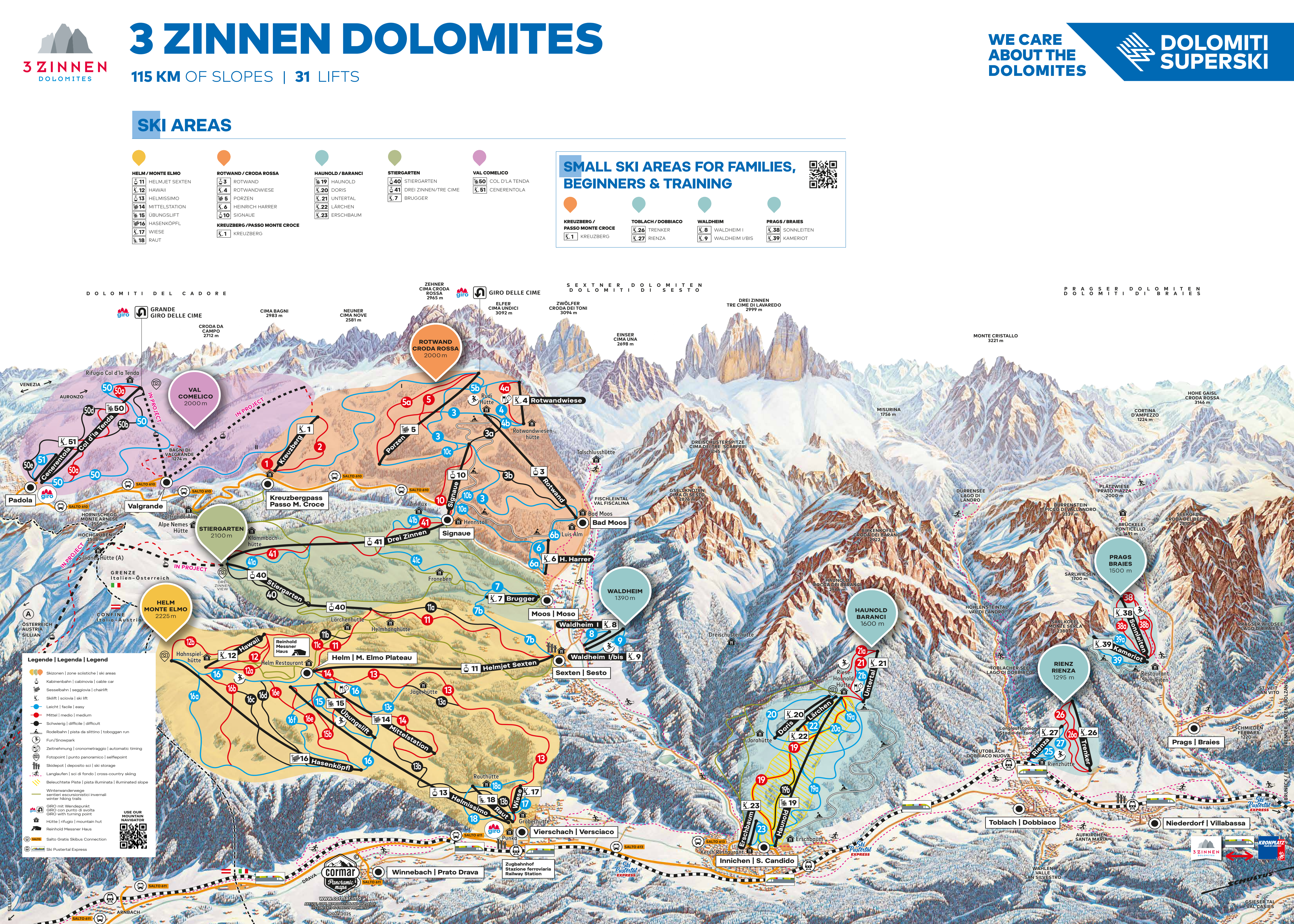
The 3 Peaks Dolomites ski area covers 115km of pistes across 82 runs, served by 31 lifts including six gondolas and a high-speed six-seater chair. The summit reaches 2,300m with a 1,170m vertical drop. The terrain is weighted towards gentler skiing, with nearly half the runs graded for beginners and a further 37% intermediate - making this one of the most accessible ski areas in the Dolomites. The longest run stretches 4.7km, and the season runs from late November through mid-April. The Dolomiti Superski pass provides access to the broader 1,200km network across the Dolomites.
What sets San Candido apart is the combination of a proper, historically significant town with a substantial, family-friendly ski area and the most dramatic mountain scenery in the Alps. The Tre Cime di Lavaredo, visible from the upper slopes, are a defining Dolomite landmark. The town has genuine year-round life, excellent restaurants, a thriving Christmas market, and an extraordinary 255km of cross-country skiing trails that make the Puster Valley one of Europe's premier Nordic skiing destinations. Check out San Candido ski deals to start planning your trip.
San Candido (Innichen in German) is a beautifully preserved medieval town at 1,175m in the Puster Valley of South Tyrol, the Italian Dolomites' easternmost valley and one of its most scenic. The town's Collegiate Church, founded in the 8th century, is one of the most important Romanesque buildings in the eastern Alps, and the cobbled centre with its painted facades, independent shops, and bakeries has a distinctly Tyrolean elegance. South Tyrol's dual Italian-Austrian identity is felt strongly here - German is the first language, the architecture is Alpine-Austrian, and the food blends Italian refinement with Tyrolean heartiness. San Candido is part of the 3 Peaks Dolomites (Drei Zinnen / Tre Cime) ski area, named after the iconic Tre Cime di Lavaredo - the three rock towers that are the most photographed peaks in the Italian Dolomites and a UNESCO World Heritage landmark.
The 3 Peaks Dolomites ski area covers 115km of pistes across 82 runs, served by 31 lifts including six gondolas and a high-speed six-seater chair. The summit reaches 2,300m with a 1,170m vertical drop. The terrain is weighted towards gentler skiing, with nearly half the runs graded for beginners and a further 37% intermediate - making this one of the most accessible ski areas in the Dolomites. The longest run stretches 4.7km, and the season runs from late November through mid-April. The Dolomiti Superski pass provides access to the broader 1,200km network across the Dolomites.
What sets San Candido apart is the combination of a proper, historically significant town with a substantial, family-friendly ski area and the most dramatic mountain scenery in the Alps. The Tre Cime di Lavaredo, visible from the upper slopes, are a defining Dolomite landmark. The town has genuine year-round life, excellent restaurants, a thriving Christmas market, and an extraordinary 255km of cross-country skiing trails that make the Puster Valley one of Europe's premier Nordic skiing destinations. Check out San Candido ski deals to start planning your trip.
The 3 Peaks Dolomites ski area connects several sectors spread across the mountains above the Puster Valley, with San Candido, Sesto (Sexten), and Versciaco (Vierschach) as the main base villages. The skiing spans both sides of the valley, with gondolas launching from the valley floor into terrain that mixes open, sunny meadows with larch-lined runs and dramatic Dolomite rock faces. The views are exceptional - the pale rock towers and pinnacles of the Sesto Dolomites provide a backdrop that no other ski area in the world can match.
With 115km and 82 runs, the local ski area has genuine substance. The lift system is modern and efficient - six gondolas handle the main vertical from the valley, and the high-speed chairs keep the upper mountain moving well. The terrain's beginner-to-intermediate focus makes this a cruiser's paradise: wide, well-groomed runs with consistent gradients and the kind of scenery that makes you stop mid-piste to stare. The Dolomiti Superski pass adds access to over 1,200km across the wider Dolomites, though most visitors find the local area and its views compelling enough for a full week.
San Candido and the 3 Peaks Dolomites area is one of the best places in the Dolomites to learn to ski. Nearly half the runs - 39 of 82 - are graded for beginners, providing an exceptional amount of gentle terrain. The nursery areas at the valley bases are well-equipped with conveyor carpets and easy lifts, and the gondolas whisk you to altitude where further gentle slopes await. The wide, sunny pistes and reliable grooming create ideal learning conditions.
The progression from nursery slopes to longer blue runs is smooth throughout the area. The runs are wide enough that you never feel hemmed in by faster skiers, and the views of the Dolomite peaks provide a stunning reward from the very first days. The ski schools across the area are experienced with children and beginners, English-speaking instructors are readily available, and the overall atmosphere is relaxed and family-oriented. For a first ski holiday in the Dolomites, San Candido is hard to beat.
WeSki insider tip: The Haunold (Monte Baranci) area directly above San Candido has the gentlest terrain and the best-equipped nursery zone. It's also the most sheltered in poor weather. Start here for the first few days, then venture to the wider 3 Peaks sectors as confidence builds.
Intermediates have a strong selection, with 30 runs covering flowing blues and engaging reds across the connected sectors. The runs from the Stiergarten and Helm (Elmo) areas provide long, varied descents with panoramic Dolomite views and enough gradient to stay interesting. The 4.7km longest run gives a satisfying sustained descent, and the efficient gondola system means you can cover a lot of ground in a day.
The Dolomiti Superski pass opens up dramatically more terrain for intermediates wanting variety. The wider 1,200km network includes resorts like Cortina d'Ampezzo, Alta Badia, and Val Gardena - all accessible as day trips by car or ski bus. The Sellaronda circuit, the famous ski tour around the Sella massif, is one of the great intermediate skiing experiences in the world and is reachable from San Candido with a morning's drive to the starting point.
WeSki insider tip: The Helm (Elmo) sector faces south and catches the sun beautifully through the middle of the day. The long red runs here have sweeping views across to Austria and the Lienz Dolomites - some of the finest panoramic intermediate skiing in South Tyrol.
The 3 Peaks area has 13 runs graded advanced or expert, making up about 16% of the terrain. The reds are properly pitched in places, particularly on the steeper Stiergarten and Rotwand sectors, and the handful of blacks provide genuine challenge when moguled or left ungroomed. The north-facing slopes hold firm, cold snow, and the steeper terrain above the treeline has enough exposure and gradient to demand confident technique.
For a week of dedicated steep skiing, the local area will feel limited. But the Dolomiti Superski pass changes the equation entirely. The steeper terrain at Cortina (particularly the Olimpia delle Tofane), Val Gardena's Saslong World Cup run, and the challenging itinerary routes across the Sella group are all accessible as day trips. San Candido provides a peaceful, well-priced base from which to explore the broader Dolomites, returning each evening to a proper town rather than a resort village.
WeSki insider tip: For the steepest local skiing, head to the Rotwand sector - the black and harder red runs there are the most sustained on the mountain and stay quiet while the majority of skiers cruise the sunnier blues elsewhere.
The wide, well-groomed terrain suits snowboarding well, particularly for beginner and intermediate riders. The gondola-heavy lift system means minimal surface-lift issues. The natural terrain has gentle rollers and features suited to a relaxed riding style, and the views from the board are as spectacular as from skis. Advanced freeriders may find the gentle terrain profile limiting, though the steeper sectors and off-piste options above the treeline add some variety.
Off-piste is limited by the area's generally gentle topography, but the terrain above the treeline has some skiable bowls and gullies that hold snow after storms. The larch forests between runs provide accessible tree skiing when conditions allow. For serious off-piste ambitions, the wider Dolomites - particularly the Marmolada glacier area and the itinerary routes around the Sella group - provide more challenging options accessible on the Dolomiti Superski pass. A guide is recommended for off-piste exploration.
Several ski schools operate across the 3 Peaks area, running group and private lessons for all ages. English-speaking instructors are readily available - South Tyrol's trilingual population (German, Italian, English) makes communication straightforward. Children's programmes start from around age three, and the extensive beginner terrain makes the area an exceptionally effective place for ski instruction. The ski schools' reputation for quality and patience with beginners is strong.
The 3 Peaks area has a terrain park with features for beginner and intermediate freestyle riders, maintained through the season. For more advanced freestyle facilities, the wider Dolomiti Superski network provides parks at several larger resorts accessible on the same pass.
San Candido is one of the most naturally family-friendly ski destinations in the Dolomites. The vast amount of beginner and intermediate terrain, the safe and beautiful medieval town, the efficient lift system, and the Dolomite scenery create an environment where families can relax and enjoy the mountains without any of the logistical stress of bigger, more complex resorts. The atmosphere is warm, welcoming, and geared towards families in the best South Tyrolean tradition.
Younger children have extensive nursery terrain and well-run ski school programmes, with the Haunold area providing a particularly gentle, sheltered environment. The toboggan run from Haunold back to San Candido is a family highlight - a 3km descent through the forest that children adore. Older children and teenagers can explore the full 115km of the 3 Peaks area, with the Dolomiti Superski pass opening up even more ambitious day trips. The cross-country skiing (255km of trails) provides an alternative activity for active families.
For parents, San Candido's town character is the clincher. This is a proper, historic community with independent shops, excellent bakeries, superb restaurants, a swimming pool, and the kind of civilised Tyrolean atmosphere that makes evenings as enjoyable as the skiing. Hotels are often family-run with genuine warmth, and half-board rates include South Tyrolean cooking that's a highlight in itself. The Christmas market (if visiting in December) adds a magical dimension that children remember for years.
San Candido's medieval town centre, the Puster Valley's cultural richness, and the proximity to the Tre Cime di Lavaredo give rest days and non-skiers genuine depth and variety.
The Puster Valley and surrounding Dolomite landscape provide an outstanding range of winter activities:
San Candido's historic character and the Puster Valley's cultural depth provide excellent off-slope options.
Dining in San Candido showcases South Tyrol's extraordinary culinary identity - a fusion of Italian and Austrian traditions that produces some of the most distinctive mountain food in Europe. Canederli (bread dumplings served in broth or with butter and cheese), Schlutzkrapfen (spinach-and-ricotta half-moon ravioli), speck (Tyrolean cured ham), Kaiserschmarrn (shredded pancake), and apple strudel share menus with Italian pasta, risotto, and espresso. The quality is consistently high, and the town has enough restaurants to keep you exploring all week.
WeSki insider tip: Order Schlutzkrapfen - South Tyrol's signature half-moon shaped ravioli, filled with spinach and ricotta, tossed in sage butter with Parmesan. They're the dish that most perfectly captures the Italian-Austrian fusion that defines this region's cooking. Follow with a slice of apfelstrudel (apple strudel) and an espresso - the Alps and the Mediterranean on one menu.
Après-ski in San Candido has the comfortable, civilised rhythm of a South Tyrolean town rather than a ski resort. The end of the ski day means a Glühwein or an aperitivo at a mountain Hütte as the sun drops behind the Dolomite towers, followed by a walk through the medieval town centre to dinner. The atmosphere is warm, sociable, and unhurried - Italian conviviality meets Tyrolean cosiness in a combination that's hard to improve on.
The evening scene revolves around food. The town's restaurants and Gaststätten fill up for long dinners, and the hotel bars provide comfortable spots for a nightcap. Nightlife is quiet - a few bars stay open, and some hotels host live music evenings - but most visitors are here for the quality of the daytime experience and the culinary pleasures of the evening rather than the party. The Christmas market in December adds an extra layer of atmospheric evening charm.
Après-ski spots to know:
Accommodation in San Candido is predominantly hotel-based, with the South Tyrolean tradition of family-run Gasthofe and wellness hotels providing the backbone. Many properties have been in the same families for generations and combine genuine warmth with impressive facilities - spa areas, pools, saunas, and half-board dining with South Tyrolean cooking are standard at even three-star properties. Self-catering apartments and holiday homes are also available.
The town is compact and walkable, with the gondola base, town centre, shops, and restaurants all within easy reach. Properties near the Haunold gondola provide the most direct ski access. The half-board hotel model is particularly strong here - the quality of the evening cooking makes it genuinely worthwhile, and the rates represent excellent value compared to the more famous Dolomite resorts. Booking ahead for Christmas, New Year, and Italian school holidays is essential.
The 3 Peaks Dolomites pass covers all 31 lifts and the full 115km local ski area. For access to the wider Dolomites, the Dolomiti Superski pass covers over 1,200km of pistes across 12 linked areas - one of the largest ski pass domains in the world. Free beginner lifts at the base areas reduce costs for families with new skiers. Check for family and multi-day pass options when booking your San Candido ski holiday package through WeSki to find the best fit for your trip.
Rental shops in the town and at the gondola bases carry a full range of downhill, cross-country, and snowboard equipment. The South Tyrolean shops provide attentive, multilingual service. Nordic equipment rental is a particular strength given the 255km trail network. Booking ahead during peak holiday weeks is wise, particularly for children's equipment.
The town is compact and walkable. The Haunold gondola is a short walk from the centre, and the other 3 Peaks sectors are connected by a free ski bus that runs regularly through the season. The ski bus also connects to Sesto and Versciaco for accessing additional lifts and terrain.
A car is useful for day trips to Cortina d'Ampezzo, Lienz in Austria, or other Dolomiti Superski resorts. San Candido also has a train station on the Puster Valley line, with connections to Fortezza (on the Brenner line) and into Austria via Lienz. The train is a practical and scenic alternative for reaching the town. Parking is available in town and at the gondola bases.
San Candido is in the eastern Puster Valley of South Tyrol, near the Austrian border. The nearest airports are Innsbruck (around 130km, roughly 90 minutes by car), Venice Marco Polo (around 200km), and Bolzano (no scheduled flights, but about 110km by road). The Brenner motorway from Innsbruck connects to the Puster Valley road, making road access straightforward. San Candido has a train station with connections from Fortezza (Brenner line) and from Lienz in Austria.
WeSki has car rentals from the airport as well as private transfers to San Candido. Add them to your San Candido ski holiday package for seamless door-to-door travel.
It's one of the best family ski destinations in the Dolomites. Nearly half the runs are beginner-graded, the town is beautiful and safe, the ski schools are excellent and multilingual, and the off-slope activities - tobogganing, swimming pool, cross-country skiing, horse-drawn sleighs - keep every age group entertained. The South Tyrolean half-board hotel tradition means excellent family-friendly meals are included. The Christmas market adds extra magic for December visits.
The Tre Cime (Drei Zinnen in German) are three iconic rock towers rising to 2,999m, recognised as a UNESCO World Heritage Site within the Dolomites. They're the most photographed peaks in the Dolomites and visible from the upper slopes of the ski area. In winter, they're accessible on snowshoe excursions for closer views. The 3 Peaks Dolomites ski area takes its name from these landmarks.
Outstanding - 255km of groomed Nordic trails make the Puster Valley one of the largest cross-country skiing networks in the Alps. Trails range from gentle valley loops to longer, more demanding routes through the Dolomite landscape. The network includes Olympic-calibre tracks and is a genuine attraction in its own right. For Nordic enthusiasts, the cross-country skiing here rivals the downhill as the main reason to visit.
If you're staying for a week and want to explore beyond the local 115km, the Dolomiti Superski pass (covering 1,200km+ across 12 areas) is excellent value and opens up some of the finest skiing in the Alps. Cortina d'Ampezzo, Alta Badia, Val Gardena, and the Sellaronda circuit are all accessible as day trips. For shorter stays or families focused on the local area, the 3 Peaks Dolomites pass is sufficient.
The summit at 2,300m and north-facing slopes provide good reliability from late November through mid-April. Extensive snowmaking covers the majority of the ski area. The Puster Valley's position in the eastern Dolomites means it catches snowfall from both northern and southern weather systems. January to March is the most consistently reliable period. The lower town at 1,175m relies more on snowmaking for the return runs.
The local 3 Peaks area has limited advanced terrain (16% of runs). For a full week of challenging skiing, the Dolomiti Superski pass is essential - it opens up significantly steeper terrain at Cortina, Val Gardena, and elsewhere. San Candido works well for advanced skiers as an affordable, characterful base for exploring the wider Dolomites, returning each evening to a proper town rather than a purpose-built resort.
Yes - San Candido is trilingual. German is the primary language (South Tyrol is an autonomous, predominantly German-speaking region of Italy), Italian is the second language, and English is widely spoken in hotels, restaurants, ski schools, and shops. Communication is effortless for English-speaking visitors, making it one of the easiest Italian ski destinations to navigate.
Very easily. The Austrian border is about 8km away, and the town of Lienz in East Tyrol is roughly 40 minutes by car. There's also a direct train connection. Lienz has a charming old centre, a castle, and excellent Austrian cafés. The cross-border proximity adds an easy day-trip option and underlines the area's dual Austrian-Italian character.
 4.9/5
4.9/5I usually book flights, transfers, hotel, ski rental and lift passes myself but this year used WeSki for a trip to Morzine. It was so much easier. Everything worked perfectly - transfers arrived on time and there was plenty of feedback throughout the whole process giving you confidence the holiday would go smoothly.

A really useful service that is so much easier to use than other 'all-inclusive' sites. It nicely bridges the gap between a travel agent and booking the trip yourself online. I will use WeSki every time I go skiing from now on.
We booked a late minute skiing trip to Morzine through we ski. We looked at booking the trip ourselves but could get anywhere near the price quoted by we ski. The company was excellent and we had no problems at all from start to finish. I would definitely use them to book another weekend skiing trip.
Seamless experience from start to finish. I was spending ages trying to sort out a weekend break and managed to do it with we ski in minutes and for the same price as booking it all up yourself. Flight, transfer and accommodation was all as expected and faultless.

WeSki is a trading name operated by Wetrip Weski Ltd (BR021500). All the flights and flight-inclusive holidays on this website are financially protected by the ATOL scheme. When you pay you will be supplied with an ATOL Certificate. Please ask for it and check to ensure that everything you booked (flights, hotels and other services) is listed on it. Please see our booking conditions for further information or for more information about financial protection and the ATOL Certificate go to: www.caa.co.uk.
Package holidays that do not include travel by air are financially protected via ABTOT.
For the latest travel advice from the Foreign & Commonwealth Office visit www.gov.uk/foreign-travel-advice.