
EN
EN
 Stunning views
 Off-piste skiing
 Hidden gemStunning viewsOff-piste skiingHidden gemStunning viewsOff-piste skiingHidden gemStunning viewsOff-piste skiingHidden gem
Mitsumata is the gateway to Kagura, a mountain in Japan known for its deep, dry powder and a season that runs late into spring. It sits in Niigata, on Japan's snowy northwest coast, in a region so buried by storms off the Sea of Japan that the Japanese simply call it snow country. The bullet train from Tokyo reaches it by burrowing through a long mountain tunnel and out into a white, muffled world of deep drifts and steep-roofed villages. From the small village at the base, a big ropeway carries you up into a much larger mountain, with gentle, tree-lined runs low down, and high, open powder fields and well-known backcountry terrain up top.
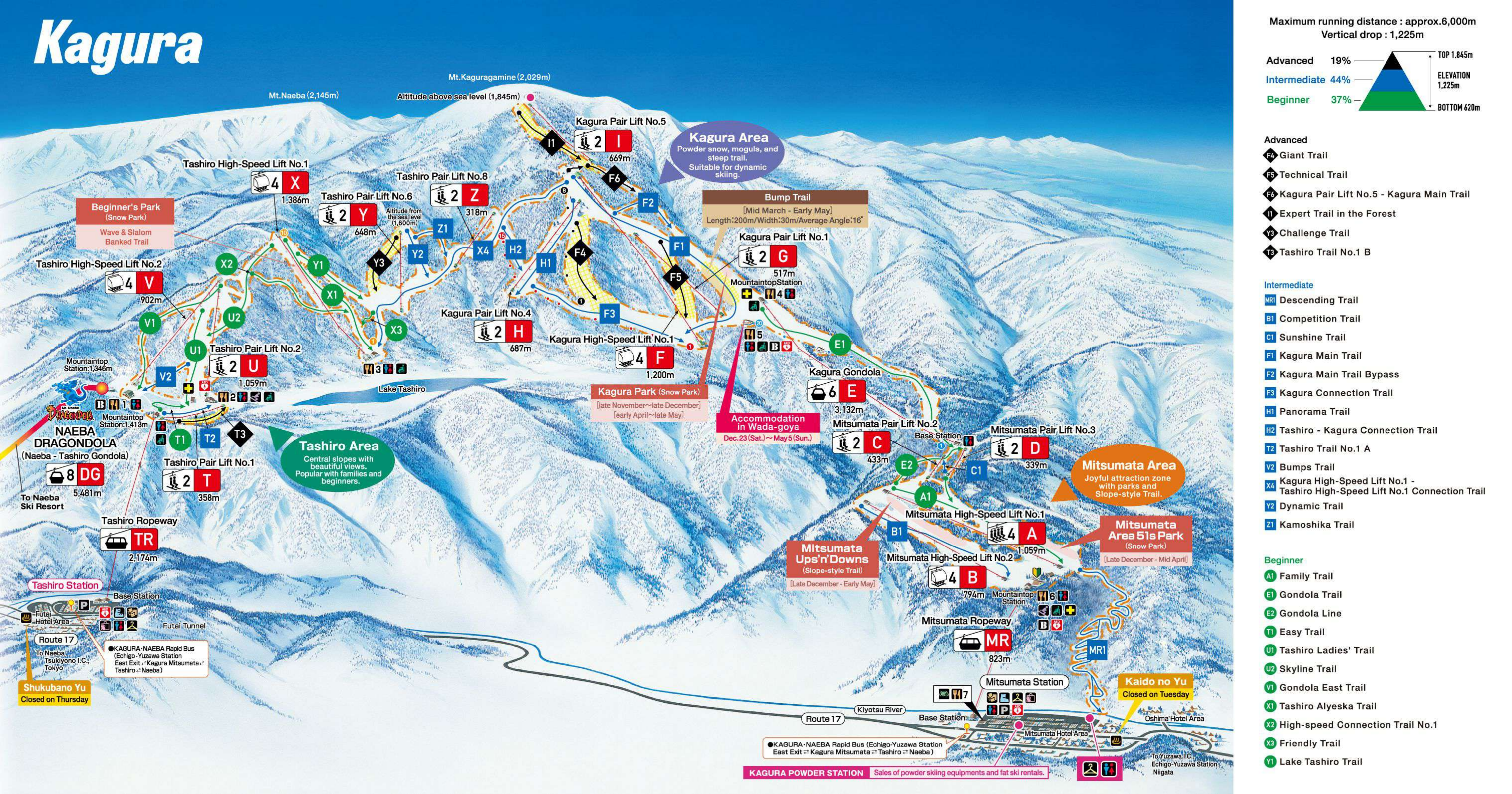
The mountain is really three linked areas stacked up the hillside, and it's set up so there's something for every level. You start at the Mitsumata base, low among the trees, where gentle, wide runs make an easy place for beginners and families to get going. Head up, and the skiing grows with you, with long intermediate pistes across the middle of the mountain, then steeper, ungroomed runs and glades higher up on the Kagura slopes for strong skiers and boarders. All told, there are around thirty runs, climbing from the base at about 620m to a summit near 1,845m, so well over a kilometre of vertical. Up high, you’ll find the skiing the mountain is famous for, deep, light powder and some of the best lift-accessed backcountry in Japan, held in good condition by the altitude deep into spring.
Staying in Mitsumata is a peaceful, snowy affair. The village is a small, quiet base at the foot of the ropeway, with a handful of lodges, pensions, and restaurants, and some of the places to stay have their own hot-spring baths to soak in after a day on the snow. It's a restful spot, with snow play and snowshoeing on the doorstep and little to pull you away from the skiing. When you want a bit more, Echigo-Yuzawa is a short ride away, one of Japan's classic onsen (hot-spring) towns and the setting of the Nobel-winning novel Snow Country. There you can wander between bathhouses, eat wonderful Niigata food, and dive into the local sake culture, most memorably at the station's sake hall, where you can taste your way along a wall of local brews from vending machines, or even soak in a sake-infused bath.
Check out Mitsumata ski deals to start planning your trip.
Mitsumata is the gateway to Kagura, a mountain in Japan known for its deep, dry powder and a season that runs late into spring. It sits in Niigata, on Japan's snowy northwest coast, in a region so buried by storms off the Sea of Japan that the Japanese simply call it snow country. The bullet train from Tokyo reaches it by burrowing through a long mountain tunnel and out into a white, muffled world of deep drifts and steep-roofed villages. From the small village at the base, a big ropeway carries you up into a much larger mountain, with gentle, tree-lined runs low down, and high, open powder fields and well-known backcountry terrain up top.
The mountain is really three linked areas stacked up the hillside, and it's set up so there's something for every level. You start at the Mitsumata base, low among the trees, where gentle, wide runs make an easy place for beginners and families to get going. Head up, and the skiing grows with you, with long intermediate pistes across the middle of the mountain, then steeper, ungroomed runs and glades higher up on the Kagura slopes for strong skiers and boarders. All told, there are around thirty runs, climbing from the base at about 620m to a summit near 1,845m, so well over a kilometre of vertical. Up high, you’ll find the skiing the mountain is famous for, deep, light powder and some of the best lift-accessed backcountry in Japan, held in good condition by the altitude deep into spring.
Staying in Mitsumata is a peaceful, snowy affair. The village is a small, quiet base at the foot of the ropeway, with a handful of lodges, pensions, and restaurants, and some of the places to stay have their own hot-spring baths to soak in after a day on the snow. It's a restful spot, with snow play and snowshoeing on the doorstep and little to pull you away from the skiing. When you want a bit more, Echigo-Yuzawa is a short ride away, one of Japan's classic onsen (hot-spring) towns and the setting of the Nobel-winning novel Snow Country. There you can wander between bathhouses, eat wonderful Niigata food, and dive into the local sake culture, most memorably at the station's sake hall, where you can taste your way along a wall of local brews from vending machines, or even soak in a sake-infused bath.
Check out Mitsumata ski deals to start planning your trip.
The skiing at Mitsumata builds as you climb. The lower Mitsumata slopes, right by the village, are gentle, wide, and tree-lined, an easy place for beginners and families to get going or to warm up first thing. Ride the ropeway and gondola higher and the mountain grows into the Kagura area, where long intermediate pistes give way to open powder fields, steep pitches, moguls, and the lift-accessed backcountry that draws powder-seekers from across Japan. Off to one side, the Tashiro area adds more gentle, scenic cruising above a frozen lake, along with some good tree skiing. It's a mountain that suits beginners and intermediates especially well, with plenty of mellow terrain to grow on, while stronger skiers and boarders head up top for the powder, the trees, and the steeper lines.
Getting around takes a little planning, as the mountain is big and spread out. You ride up from the village on the Mitsumata ropeway, a large cable car that carries over a hundred people at a time, and from the top a mix of gondola, fast quads, and older two-person chairs fans out across the three areas. The Kagura area sits in the middle and acts as the hub, linking Mitsumata with Tashiro, which you reach on a connecting traverse. It's a functional network rather than a slick, modern one, some of the chairs are slow, and crossing between the far ends of the mountain takes time and a bit of route-planning, but it opens up a lot of varied terrain once you know your way around.
Important for international visitors: One thing worth knowing if you've only skied in Europe or North America is that Japan grades its runs a little differently. Green is the easiest, for beginners, red is intermediate, and black is advanced. The one to watch is red, which here means an intermediate run rather than the harder grade it signals in Europe, and there's no blue at all. Gradings can also feel gentler and less consistent than you might be used to, so it's worth easing into the system on your first day.
The Mitsumata base area is a good place to learn. Wide, gentle slopes fan out near the foot of the ropeway, groomed daily and set apart from the busier runs higher up, so beginners have plenty of soft, forgiving snow and room to practise at their own pace. The main beginner run is the Family Course, an easygoing slope of just over a kilometre that runs down from the top of the ropeway, gentle enough to build confidence on but long enough to feel like a proper descent.
When you're ready to move on, the wide Kagura Main course is an ideal next step, a long, rolling run reached by the gondola from Mitsumata, mostly cruisy with the odd steeper pitch to stretch you. The trees along the way keep visibility good on snowy days and give a sheltered, reassuring feel as your confidence grows.
WeSki insider tip: Once you're comfortable, make the trip over to the Tashiro area for the Alyeska Course. It's one of the gentlest runs on the whole mountain, but it comes with sweeping views over a frozen lake and the peaks beyond, and because most beginners stay on the Mitsumata side, it's a quiet, scenic run that few first-timers ever find.
Intermediates are well looked after here, and the local pass covers all three areas, so there's a lot of ground to roam. Start with the forested cruisers that drop from the top of the Mitsumata ropeway, wide, well-groomed runs with a steady, comfortable pitch. The one to aim for, though, is the Kagura Main course, reached by the gondola up into the Kagura area, a long, wide run of around a kilometre and a half that rolls down the mountain with the odd steeper pitch to keep it interesting. Over in the Tashiro area, the Kamoshika course winds a long, scenic line through the mountains, a good change of pace and usually quieter.
The real step up comes in the Kagura area itself, all of it on the local pass. The runs linking Kagura down to Tashiro and Mitsumata are longer, steeper, and more varied than anything lower down, with sustained pitches through mixed forest and open slopes. Better still, you can string them together into one of the area's great intermediate descents, top to bottom from the Kagura-Tashiro area right down to the Mitsumata base, over a kilometre of vertical through constantly changing terrain. On a snowy day, the soft, untracked snow at the edges of the groomers makes a gentle place to try your first turns off the piste.
WeSki insider tip: Kagura is famous for its tree skiing, and the well-spaced glades right beside the groomed runs are a perfect place to try it. Once you're comfortable on the Kagura pistes, dip a few turns into the trees along the edge, staying close to the run, and you'll get a taste of the soft, sheltered powder skiing Japan is known for, without straying into anything serious.
High up, the Kagura area is where the mountain shows its serious side. Above the treeline the slopes open into wide bowls, steep faces, and pitches that pile up with snow, and the runs off the ridgeline stay steep and demanding the whole way down. The Rinkan Expert Course, threading steeply through the forest from the highest point on the mountain, is the one to test yourself on, and there's a dedicated mogul run, the Technical Course, that bumps up in spring. After a big snowfall, this is some of the best lift-served powder skiing on Honshu, deep and reliable, and often still quiet a day or two after a storm.
For experts, though, the real draw is the backcountry off the top of Kagura. Marked gates lead out beyond the resort boundary into a huge expanse of untracked terrain, volcanic gullies, open faces, and long powder runs into the mountains, all reached from the top of the lifts on the standard local pass. It's serious ground, so you sign out through a permit gate and, unless you truly know the area, go with a guide, since finding the best lines and getting safely back out takes local knowledge, and the avalanche risk is real. Happily, the resort is well set up for visitors, with English-language permit forms and English-speaking guides on hand.
WeSki insider tip: Kagura's backcountry is some of the most accessible in Japan for English-speaking visitors, so it's worth planning for rather than leaving to chance. Sort out a guide before your trip, or on a rest day, and get familiar with the permit-gate system early. Do that, and you can move quickly when the terrain is at its best, rather than scrambling to organise it on the morning you most want to be out there.
Snowboarding is well established at Mitsumata, and there's plenty here to enjoy on a board. Up on the Kagura slopes the deep, light powder and long, ungroomed tree runs are the real draw, some of the best freeriding in the country. Most of the main runs are steep and true, so you can hold your speed easily. The one thing to watch is the flat sections, since the traverses between the three areas and parts of Tashiro can mean some skating or unstrapping, though they open up a lot of terrain and are worth it. Down low, the gentle Mitsumata slopes suit beginners well.
For many skiers, the off-piste is the whole reason to come to Kagura. What makes it special is how accessible it is, a system of marked gates opens onto the terrain beyond the groomed runs, so you can reach genuine backcountry straight from the lifts rather than earning every turn on foot. The gates open according to the day's avalanche conditions and snowpack, and the terrain runs the full range, from well-spaced tree runs across the mid-mountain to the steep, open bowls and chutes off the Kagura summit. It's serious ground, though, and conditions can turn quickly, so it's well worth heading out with one of the guides based in nearby Echigo-Yuzawa, both to stay safe and to be shown the lines you'd never find alone.
The resort ski school runs group and private lessons for all levels from its base at Mitsumata. English-speaking instructors are limited at the resort school itself, but several international ski schools in the Yuzawa area offer private lessons in English, so it's worth booking ahead, especially for weekends and Japanese holidays. Given that Kagura is all about the powder, the most rewarding option for many visitors is a powder or off-piste clinic, a chance to get comfortable in the deep snow and start linking turns through the trees with an instructor alongside. Stronger skiers can go a step further with a private backcountry guide, the surest way to unlock the terrain beyond the gates safely.
The main terrain park is the Area51s Park, on the Mitsumata slopes at the base of the mountain. It has a spread of jumps, kickers, rails, and boxes to session, with the features arranged so you can start on the smaller ones and work your way up as your confidence grows. There are a couple more parks higher up across the wider area, including a dedicated beginners' park over in Tashiro, so wherever you're skiing there's somewhere to practise. The features are built and maintained through the main season.
Mitsumata makes an easy, low-key base for a family ski trip. The small mountain village keeps everything close at hand, with a range of places to stay, from simple lodges to family-run pensions, many within easy reach of the slopes, so days are simple to organise with children in tow. There's a gentle sense of fun to the place, too. You’ll ride a big ropeway up from the village to reach the slopes, which children tend to love, and there's a snow-play area down at the base where little ones can sledge and play before they're ready to ski. It's small, quiet, and easy to get around, which takes a lot of the stress out of a family trip.
On the mountain, the gentle Mitsumata slopes are the perfect place for anyone learning, with wide, tree-lined runs and an enclosed kids' area that make a reassuring spot for children. The ski school takes in children for lessons, though it's worth knowing there's no drop-off childcare here, so young, non-skiing children will need a parent on hand. For families whose children already ski confidently, the mountain opens right up, with longer runs and more variety higher in the Kagura area, where the gentle tree runs give a real sense of adventure on a snowy day. Mitsumata suits families with a bit of skiing between them slightly better than complete first-timers, but there's enough gentle terrain to learn on all the same.
Beyond the slopes, there's plenty to round out the trip at Mitsumata. Back at the base, children can sledge in the snow-play area or head out on a family snowshoe walk, and an afternoon or a full day down in Echigo-Yuzawa town, a short ride away, makes a great outing, with hot-spring baths to soak in and street food to graze on, plus there’s the lively station and sake hall for a parent’s-only night out. With Tokyo little more than an hour away by bullet train, a day trip to the capital is easily done too. In the evenings, the Mitsumata lodges serve simple, homely Japanese food, curry rice, ramen, and udon that children usually take to happily, and Echigo-Yuzawa has a wider spread of restaurants if you'd like more choice.
Mitsumata is a quiet, snowy base, so much of what you'll do off the slopes centres on the mountain and the nearby town of Echigo-Yuzawa, a short shuttle away. This is a part of Japan built around simple, restorative pleasures, such as long soaks in natural hot springs, wonderful local food, and Niigata's celebrated sake, all wrapped up in a town with real history and character. There's plenty on the snow too, from guided backcountry touring to gentle snowshoe walks. Here are some of the best things to do around Mitsumata and Echigo-Yuzawa.
Eating around Mitsumata is a homely, satisfying affair. The village lodges and mountain restaurants serve the warming Japanese food that hits the spot after a day in deep snow, curry rice, ramen, udon, katsu, and steaming bowls of noodles, much of it built on Niigata's two great sources of pride, its rice, some of the best in Japan, and the sake made from it. For more variety and a proper night out, Echigo-Yuzawa is a short ride away, with everything from tiny ramen counters and famous soba shops to izakaya and the refined multi-course dinners served at its traditional inns.
WeSki insider tip: After a big powder day, treat yourself to a bowl of steaming Niigata ramen and a flask of hot local sake down in Echigo-Yuzawa. There are few better ways to thaw out after hours in the deep snow, and Niigata does ramen and sake as well as anywhere in Japan.
Evenings in Mitsumata revolve around the onsen. The village is small and geared to the skiing, so once the lifts stop, the ritual is a beer at your lodge or the base followed by a long soak in a hot-spring bath to ease tired legs. If your lodge doesn't have its own bath, there's a footbath and an onsen by the base at the roadside station.
For a livelier evening, Echigo-Yuzawa is about twenty minutes away, reachable by local bus during the day or by taxi after dark, with some lodges running their own shuttles. The town is where the sake and the bars are. A good place to start is the Ponshukan hall at the station, where tokens let you taste your way through more than a hundred Niigata sakes, a reminder that this is one of Japan's great sake regions. After that, the izakaya and small bars around the station make for a warm, easygoing night, with local regulars, Tokyo weekenders, and powder-chasers from further afield all winding down together.
Après-ski spots to know:
Staying in Mitsumata means a small, welcoming cluster of pensions, lodges, and minshuku (family-run Japanese guesthouses) close to the ropeway base. These are modest, homely places rather than big hotels, and that's the appeal, most are family-run, with just a handful of rooms, a warm welcome, and good value for money. Rooms are often traditional Japanese in style, with tatami-mat floors and futon bedding, and many places offer half-board with home-cooked Japanese dinners and breakfasts, the easy, cosy way to eat here. Some have their own hot-spring baths to soak in at the end of the day, which is worth looking out for when you book.
What you gain by staying up here is the mountain on your doorstep. You're right by the ropeway, so you can be among the first up on a fresh snowfall, a real advantage when the powder and the upper Kagura terrain are the whole point. It's a peaceful, snowy base too, quiet in the evenings and geared entirely around the skiing, with your hosts often happy to point you towards the day's best snow.
The local lift pass covers all three linked areas, Kagura, Mitsumata, and Tashiro, on a single ticket, giving you the ropeways, gondola, and chairlifts across the whole of the local mountain and its roughly 30km of pistes. Day and multi-day passes are available, with a multi-day ticket the sensible choice for a stay of three days or more.
Check for multi-day pass options when booking your Mitsumata ski holiday package through WeSki to find the best fit for your trip.
There are rental shops at the Mitsumata base stocking skis, snowboards, boots, and helmets, so it's easy to sort your gear right where you're staying. Given how good the powder gets up on the Kagura slopes, it's well worth asking for fat skis or a powder board, and the base has a dedicated powder-rental shop that specialises in exactly that. For anyone heading into the backcountry, the Kagura powder station rents avalanche safety equipment and can arrange guides too. Booking online in advance helps make sure you get the right setup for your first morning, and there are more rental shops down in Echigo-Yuzawa if you'd rather pick up gear in town.
Mitsumata village is tiny, small enough to walk end to end in a few minutes, with the ropeway, lodges, and rental shops all clustered together. Getting onto the snow is easy, since you just walk to the base and ride the big Mitsumata ropeway up to the slopes. From there, the three areas, Mitsumata, Kagura, and Tashiro, all link up on skis through the lift system, so you don't need any transport once you're on the mountain.
For heading into Echigo-Yuzawa, a shuttle bus runs between the Mitsumata base and the town through the ski season, taking about twenty minutes. It runs a handful of times a day, and less often in the evenings, so it's worth checking the return times if you're going in for dinner and an onsen. Taxis are an easy alternative for the short ten-minute hop, and some lodges run their own shuttles too. If you're hiring a car, there's parking at the base, and it's about a ten-minute drive down to the town.
Mitsumata is reached through Tokyo, whose two international airports, Narita (NRT) and Haneda (HND), are served by direct flights from cities across the world. From the airports to Mitsumata is roughly 250km via Narita, or a little less, around 210km, via the more central Haneda. The easiest way to cover the distance is by train. From Tokyo, the Joetsu Shinkansen (bullet train) reaches Echigo-Yuzawa in about seventy-five to ninety minutes, and from there it's a short bus or taxi ride up to the Mitsumata base.
WeSki has private transfers to Mitsumata. Add them to your Mitsumata ski holiday package for seamless door-to-door travel. WeSki also provides car rental from the airport if you'd prefer flexibility on the ground.
They're three connected areas that make up one linked mountain, all on a single lift pass. Mitsumata is the base area, with gentle slopes and the main ropeway up. Tashiro is a mid-mountain zone with a mix of intermediate and advanced terrain and good tree skiing. Kagura is the highest area, reaching about 1,845m, with above-treeline bowls, steep chutes, and the best of the powder. Most people ride up from Mitsumata and work their way through all three areas across the day.
It gets a lot of snow, in similar volumes to the big Hokkaido resorts, though the character is a little different, Niigata's snow tends to be heavier and denser than Hokkaido's famously dry powder. Higher up on the Kagura slopes the snow is lighter and drier, and there's so much of it that deep days come round often through the winter. The big draw over Hokkaido is how easy it is to reach, a couple of hours from Tokyo by train rather than a domestic flight.
The Mitsumata base area has gentle, well-groomed slopes that suit beginners, compact, generally quiet, and set apart from the tougher runs higher up. That said, the mountain's real strength is its intermediate, advanced, and powder terrain up top, so while beginners are looked after, it plays best to stronger skiers. A mixed-ability group works nicely here, with beginners on the Mitsumata slopes and stronger skiers heading up to Kagura.
It's one of the longest in mainland Japan. The Kagura area usually opens in late November and stays open into late May, and in some years spring skiing on the top slopes runs into early June. The altitude, the shaded north-facing terrain, and the sheer amount of snow mean the upper mountain holds its cover long after lower resorts have closed. Late-season skiing here is popular with Japanese skiers and can be excellent, with settled spring snow and sunshine.
Yes. Kagura has a well-established system of backcountry gates that open according to avalanche conditions, giving access to steep, untracked terrain beyond the resort boundary. Guided tours run through operators based in Echigo-Yuzawa and are strongly recommended, especially on a first visit. Full avalanche safety equipment (a transceiver, probe, and shovel) is essential, and conditions in the Niigata mountains can change quickly.
It comes down to what you want from the trip. Staying in Mitsumata puts you right by the ropeway, which is ideal if early starts and powder days are the priority, and it's where WeSki's accommodation is. Echigo-Yuzawa, about twenty minutes away, is a larger onsen town with more restaurants, bathhouses, and evening life, and the shuttle links the two through the ski season. In short, Mitsumata for a powder-focused trip close to the lifts, and Echigo-Yuzawa if you'd rather be based in the town.
Take the Joetsu Shinkansen from Tokyo Station to Echigo-Yuzawa (about 75 to 90 minutes), then a shuttle bus or taxi to the Mitsumata base (roughly 20 minutes). The whole trip comes in at around two hours, which makes it one of the easiest serious powder mountains in Japan to reach. Trains run through the day, so even a short trip from Tokyo is practical.
 4.9/5
4.9/5I usually book flights, transfers, hotel, ski rental and lift passes myself but this year used WeSki for a trip to Morzine. It was so much easier. Everything worked perfectly - transfers arrived on time and there was plenty of feedback throughout the whole process giving you confidence the holiday would go smoothly.

A really useful service that is so much easier to use than other 'all-inclusive' sites. It nicely bridges the gap between a travel agent and booking the trip yourself online. I will use WeSki every time I go skiing from now on.
We booked a late minute skiing trip to Morzine through we ski. We looked at booking the trip ourselves but could get anywhere near the price quoted by we ski. The company was excellent and we had no problems at all from start to finish. I would definitely use them to book another weekend skiing trip.
Seamless experience from start to finish. I was spending ages trying to sort out a weekend break and managed to do it with we ski in minutes and for the same price as booking it all up yourself. Flight, transfer and accommodation was all as expected and faultless.

WeSki is a trading name operated by WeTrip Ltd. All the flights and flight-inclusive holidays on this website are financially protected by the ATOL scheme. When you pay you will be supplied with an ATOL Certificate. Please ask for it and check to ensure that everything you booked (flights, hotels and other services) is listed on it. Please see our booking conditions for further information or for more information about financial protection and the ATOL Certificate go to: www.caa.co.uk.
Package holidays that do not include travel by air are financially protected via ABTOT.
For the latest travel advice from the Foreign & Commonwealth Office visit www.gov.uk/foreign-travel-advice.