EN
EN
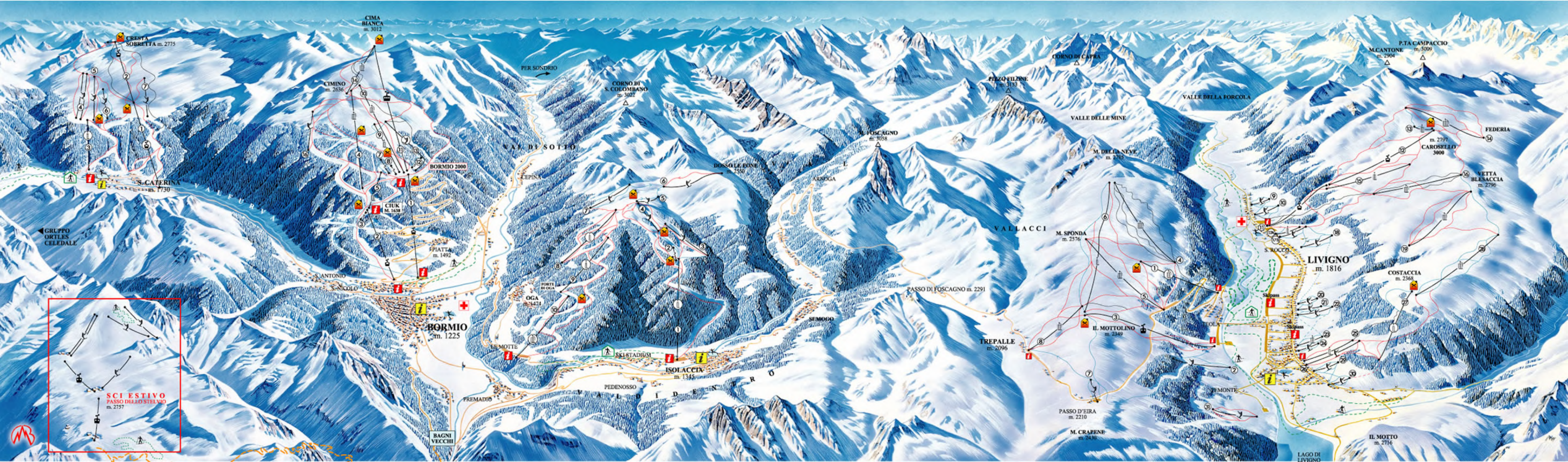
Alta Valtellina is a ski area in the upper Valtellina valley of Lombardy, in the far north-east corner of the Italian Alps, close to the Swiss border and the Stelvio Pass. It links Bormio and Santa Caterina Valfurva - two resorts with serious alpine pedigree. Bormio has hosted World Championship and World Cup races for decades, and both Bormio and Santa Caterina are co-hosting alpine skiing events at the 2026 Milan-Cortina Winter Olympics. The area sits at the foot of the Ortles-Cevedale group, the highest mountains in the eastern Alps, and has a distinctive character: ancient thermal-spa town, demanding World Cup terrain, and a remote, end-of-the-valley location that keeps the crowds away.
The two resorts have a combined 110 km of piste served by 19 lifts, sitting between 1,225 m and 3,012 m at Cima Bianca above Bormio. There are 39 runs: 4 green, 10 blue, 14 red, and 11 black. The terrain skews noticeably towards intermediate and advanced. The season runs from late November to mid-April. Both resorts share the Alta Valtellina Skipass, though they are separate ski areas not connected by lifts.
Bormio is the main resort - a historic spa town with a lively centre and one of the greatest vertical drops of any ski area in the Alps. Santa Caterina Valfurva is a smaller, quieter village further up the valley with its own ski area and a 2026 Olympic venue. Between them, you get demanding skiing, thermal baths, and an Italian mountain-town atmosphere that feels a long way from the mainstream ski circuit. Browse Alta Valtellina ski deals on WeSki to start planning your trip.
Bormio is one of Italy's most historic ski towns, sitting at 1,225 m at the foot of the Stelvio Pass. The town has been a thermal-spa destination since Roman times - the Bagni di Bormio and Bormio Terme complexes are fed by natural hot springs and are a defining part of the experience. The centre is atmospheric: narrow streets, medieval towers, good restaurants, and a proper Italian community feel. The skiing above is concentrated on a single mountain face that drops from Cima Bianca (3,012 m) to the valley floor - a vertical drop of nearly 1,800 m, making it one of the greatest continuous descents in the Alps. The Stelvio World Cup downhill course, which will host the 2026 Olympic men's downhill, is a demanding, sustained run with genuine World Championship pedigree. The terrain is predominantly red and black, with long, steep descents through the forest.
Santa Caterina Valfurva is a small, traditional village at 1,738 m in the Valfurva valley, about 12 km from Bormio. It has a quiet, local character - a handful of hotels, a church, and a genuinely mountain-community atmosphere. The ski area is compact (around 35 km of piste) but well-designed, with the terrain rising to 2,725 m and a good mix of reds and blues. Santa Caterina has its own World Cup and Olympic heritage - it hosts the Coppa del Mondo di Deborah Compagnoni (named after the local triple Olympic champion) and will be a venue for the 2026 Olympic alpine events. The village sits at the entrance to the Stelvio National Park, and the surrounding peaks of the Ortles-Cevedale group provide a dramatic backdrop.
Santa Caterina Valfurva ski deals
This is an area that leans towards intermediate and advanced terrain, so beginners should choose their sector carefully. Santa Caterina has the gentler slopes, with a nursery area near the village and some manageable blues higher up. In Bormio, the lower slopes near Bormio 2000 (the mid-station) have a beginners' area, but the mountain gets steep quickly above and below. The green-run count is low (just 4 across the area), so complete first-timers may find the progression limited compared to purpose-built beginner destinations.
WeSki does not currently have lessons or ski equipment hire available in the Alta Valtellina area. Both resorts have local ski schools with English-speaking instructors, and rental shops are available in Bormio and Santa Caterina.
WeSki tip: If you're a beginner, base yourself at Santa Caterina rather than Bormio. The terrain is gentler, the slopes are quieter, and the progression from nursery to blues feels more natural. Once you're confident, you can day-trip to Bormio for the bigger mountain, but Santa Caterina is the more comfortable starting point.
The 10 blues and 14 reds give intermediates good range, particularly at Bormio. The long reds from Cima Bianca (3,012 m) back towards the town have enormous vertical and varied terrain - you can ski nearly 1,800 m of continuous descent, which takes a good 20 minutes without stopping. The runs through the forest on the lower mountain are sheltered and well-groomed. Santa Caterina has shorter, more consistent reds with a calmer atmosphere. Confident intermediates should try the upper section of the Stelvio course - the lower part is genuinely steep, but the top section is a manageable red with outstanding views.
WeSki tip: The descent from Cima Bianca (3,012 m) to Bormio (1,225 m) is one of the longest continuous runs in Italy - nearly 1,800 m of vertical. It takes about 20 minutes non-stop, so pace yourself. The upper section above the treeline is wide and open; the lower section through the forest is narrower and steeper. It's a run that rewards stamina.
The 11 blacks and the Stelvio World Cup course make Bormio a serious advanced-skier destination. The Stelvio downhill - the same course that will host the 2026 Olympic men's downhill - is open to the public and demands respect: sustained steep pitches, compressions, and a finish straight that arrives at speed. The upper mountain above 2,500 m has open, above-treeline terrain with freeride potential after fresh snow. The proximity to the Ortles-Cevedale group (the Ortles reaches 3,905 m) means there's significant backcountry and ski-touring potential in the wider area, though it's committing, high-altitude terrain that requires a guide and full mountain equipment.
WeSki tip: The Stelvio World Cup course is open to the public and worth skiing for the experience - it's genuinely steep and gives you an appreciation for what the racers do at 130 km/h. The San Colombano section is the steepest part. Ski it when it's freshly groomed for a controlled descent, and don't be embarrassed about taking it slowly - everyone does on the first run.
The Alta Valtellina Skipass covers both Bormio and Santa Caterina Valfurva on a single ticket. Passes are available from one day up to the full season, with discounted rates for children, teens, and seniors. Individual resort passes are also available. The Alta Valtellina pass also includes Livigno's ski area (a separate resort about 35 km away, covered separately on WeSki), which adds substantial additional terrain if you're willing to drive.
WeSki does not currently have ski equipment hire available in the Alta Valtellina area, but rental shops are widely available in both Bormio and Santa Caterina.
WeSki tip: The Alta Valtellina pass includes Livigno, which is a duty-free zone with its own extensive ski area. Livigno is about 35 km from Bormio via the Foscagno Pass (open in winter). A day trip there adds 115 km of additional terrain plus duty-free shopping. It's a very different resort from Bormio - wide, modern, and sunny - and the contrast makes a good change of pace.
Bormio sits in a remote corner of northern Lombardy, and the journey is part of the character. Bergamo is the closest practical airport, about 2 hours 30 minutes' drive via the Valtellina valley road. Milan Malpensa is around 3 hours. Innsbruck is roughly 2 hours 30 minutes via the Resia Pass (when open) or around 3 hours 30 minutes via the motorway through the Brenner and Merano. The Stelvio Pass, one of the highest and most famous road passes in Europe, connects to the South Tyrol but is closed in winter. By train, the nearest station is Tirano on the Bernina Express line from St Moritz, with a bus connection to Bormio (about 1 hour). Santa Caterina is about 12 km further up the valley from Bormio.
WeSki has private transfers to both Bormio and Santa Caterina Valfurva. Add them to your booking for a straightforward door-to-door trip.
The season runs from late November to mid-April. Bormio's terrain reaches 3,012 m, which keeps the upper slopes in good condition, and the north-facing lower mountain retains snow well through the trees. Snowmaking covers key runs. Santa Caterina sits at 1,738 m with terrain to 2,725 m, giving it reliable altitude snow. January to mid-March typically sees the most consistent conditions across both areas.
Italian school holidays in late December and throughout February are the busiest periods, though the remote location means Alta Valtellina stays quieter than the more accessible Italian resorts even at peak. If you've got flexibility, early January and the first half of March are calm. The 2026 Winter Olympics will bring significant attention to both resorts - check for any schedule impacts if you're visiting during the Games period. Late season brings spring conditions on the lower slopes while the upper mountain holds up well.
It's better suited to intermediates and above. Santa Caterina has gentler terrain and is the more comfortable choice for beginners. Bormio's mountain is steep and the green-run count is low. WeSki does not currently have lessons or ski equipment hire available, but both resorts have local ski schools and rental shops.
Bormio and Santa Caterina Valfurva have a combined 110 km of piste served by 19 lifts, ranging from 1,225 m to 3,012 m. There are 39 runs: 4 green, 10 blue, 14 red, and 11 black. The two resorts share the Alta Valtellina Skipass but are not connected by lifts. The pass also includes Livigno's ski area.
Bormio is a historic spa town at 1,225 m with thermal baths, a lively centre, and one of the steepest ski mountains in the Alps (3,012 m summit, 1,800 m vertical drop, World Cup downhill course). Santa Caterina is a smaller, quieter village at 1,738 m with gentler terrain and a calmer atmosphere. Bormio suits confident skiers who want big terrain and town life; Santa Caterina suits families and intermediates.
Bormio has been a thermal-spa destination since Roman times. The town has several thermal complexes, including the Bagni di Bormio (historic baths in a mountain setting) and Bormio Terme (a modern wellness centre). The hot springs are fed by natural geothermal water and range from indoor pools to outdoor baths with mountain views. They're a popular après-ski activity and a defining part of the Bormio experience.
Yes. Both Bormio and Santa Caterina Valfurva are co-hosting alpine skiing events at the 2026 Milan-Cortina Winter Olympics. The Stelvio course in Bormio will host the men's downhill and super-G. Santa Caterina will host other alpine events. The infrastructure investment for the Games is upgrading lifts and facilities at both resorts.
The season runs from late November to mid-April. Bormio's terrain reaches 3,012 m, keeping upper-slope conditions reliable. Snowmaking covers key runs at both resorts. January to mid-March sees the most consistent conditions. The nearby Stelvio glacier (separate from the ski area) provides summer skiing from June to November.
Fly to Bergamo (about 2 hr 30 min drive) or Milan Malpensa (3 hr). The area is in a remote corner of northern Lombardy, so the journey is longer than for most Italian resorts. By train, Tirano on the Bernina Express line connects to Bormio by bus (about 1 hr). WeSki has private transfers to both Bormio and Santa Caterina Valfurva.
No. Bormio and Santa Caterina Valfurva are separate ski areas about 12 km apart, sharing the Alta Valtellina Skipass. You'll need to drive between them. The pass also includes Livigno, about 35 km from Bormio via the Foscagno Pass.
Yes. The Alta Valtellina Skipass includes Livigno's ski area (115 km of piste), about 35 km from Bormio via the Foscagno Pass. Livigno is also a duty-free zone. It's a worthwhile day trip for additional terrain and a very different skiing experience - wide, sunny, and modern.
Start building your dream ski trip today with our one-stop ski shop - hundreds of resorts, unlimited combinations.
 4.9/5
4.9/5I usually book flights, transfers, hotel, ski rental and lift passes myself but this year used WeSki for a trip to Morzine. It was so much easier. Everything worked perfectly - transfers arrived on time and there was plenty of feedback throughout the whole process giving you confidence the holiday would go smoothly.

A really useful service that is so much easier to use than other 'all-inclusive' sites. It nicely bridges the gap between a travel agent and booking the trip yourself online. I will use WeSki every time I go skiing from now on.
We booked a late minute skiing trip to Morzine through we ski. We looked at booking the trip ourselves but could get anywhere near the price quoted by we ski. The company was excellent and we had no problems at all from start to finish. I would definitely use them to book another weekend skiing trip.
Seamless experience from start to finish. I was spending ages trying to sort out a weekend break and managed to do it with we ski in minutes and for the same price as booking it all up yourself. Flight, transfer and accommodation was all as expected and faultless.

WeSki is a trading name operated by WeTrip Ltd. All the flights and flight-inclusive holidays on this website are financially protected by the ATOL scheme. When you pay you will be supplied with an ATOL Certificate. Please ask for it and check to ensure that everything you booked (flights, hotels and other services) is listed on it. Please see our booking conditions for further information or for more information about financial protection and the ATOL Certificate go to: www.caa.co.uk.
Package holidays that do not include travel by air are financially protected via ABTOT.
For the latest travel advice from the Foreign & Commonwealth Office visit www.gov.uk/foreign-travel-advice.