
EN
EN
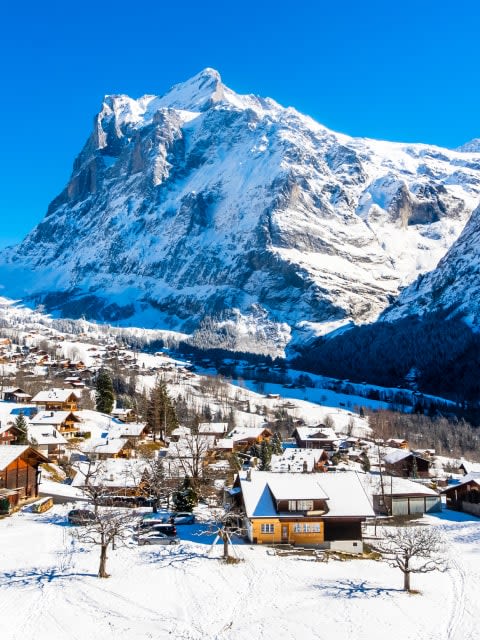
Jungfrau Ski Region spreads across two deep Alpine valleys in Switzerland’s Bernese Oberland, where the slopes look straight out at a wall of glaciers and snow-covered peaks rising to over 4,000m. At the centre of that view stand three famous neighbouring peaks, the Eiger, the Mönch, and the Jungfrau, whose names are often translated as the Ogre, the Monk, and the Maiden. Its 211km of pistes are split between three ski areas on a single pass, with the highest runs starting at 2,970m. Grindelwald and Wengen, the two main resorts, are linked by the region’s largest ski area, which spreads across the mountain between their two valleys. Grindelwald also has a second ski area of its own on the opposite side of its valley. The third ski area, Mürren-Schilthorn, sits across the valley from Wengen and is reached by train and cable car rather than by lift.
The skiing ranges from wide, open slopes high on the mountain to long runs that drop through the forest back to the valley. Beginners have plenty of wide, easy runs in both main resorts, so there’s space to practise without feeling rushed. Intermediates can spend days on long red and blue runs, from open pistes up high to tree-lined reds that wind all the way down to Grindelwald. Advanced skiers will find steep black runs in all three ski areas, including the World Cup downhill course above Wengen, the longest on the circuit, which opens to the public after its January race. The steepest skiing is in Mürren-Schilthorn, where black runs drop straight from its high summit, and the off-piste terrain around it is a favourite with freeriders.
Life here moves by mountain railway, with cogwheel trains climbing from the valley villages to the slopes, and Wengen and Mürren are closed to cars altogether. Grindelwald is the region’s largest resort, a mountain town lined with shops, hotels, and restaurants beneath towering rock faces. Wengen is a smaller village set on a high terrace, with views straight down the valley. Food leans towards hearty Swiss mountain cooking, from rösti and cheese fondue in mountain restaurants to more refined dining in the villages. Après-ski here is relaxed and sociable, starting at bars around the high lift stations and at cosy huts along the long runs home. In the villages, it moves on to hotel bars with live music, and Grindelwald has the most choice for a later night. Off the slopes, the choice runs from 50km of sledging runs, to a zip line that flies above the slopes and a train that tunnels up through the mountain to Europe’s highest railway station, at 3,454m.
| Country | Switzerland |
| Region | Bernese Oberland |
| Total piste km | 206 km |
| Altitude | 944 m (Grindelwald) - 2,970 m (Schilthorn summit) |
| Linked resorts | 3 Grindelwald Wengen Mürren-Schilthorn |
| Lifts | 44 |
| Runs | 102 (14 green, 35 blue, 38 red, 15 black) |
| Season | Mid-November - mid-April |
| Ski pass name | Jungfrau Ski Region pass |
| Nearest airports | Bern (~1 hr 30 min) Zurich (~2 hr 30 min) Basel (~2 hr 30 min) Geneva (~3 hr) |
| Glacier skiing | No (though the Jungfraujoch at 3,454 m is accessible as a sightseeing excursion) |
| WeSki services | Lessons: Grindelwald, Wengen Transfers: all 3 resorts (private and shared to Wengen; private to Grindelwald and Mürren-Schilthorn) Ski equipment hire: Grindelwald, Wengen |
Grindelwald has two ski areas on opposite sides of its valley, each with its own character. A gondola from the village centre climbs to First, the resort’s own ski area, where sunny, south-facing slopes hold long, easy cruising runs and a snow park. From the lift terminal at the lower end of the village, two gondolas lead up into the region’s largest ski area, which Grindelwald shares with Wengen. Beginners can start at Bodmi, a practice area on a sunny slope just above the village centre, with magic carpets and the ski school close by. Intermediates can spend days on the long red and blue runs that sweep down from the high slopes towards the valley, some through the forest, along with the wide cruising runs on First. The runs from First back to the village are red, so newer skiers will want to take the gondola down. Advanced skiers have black runs beneath the glaciers and a 6km descent from the top of First all the way back to the village, which drops more than 1,100m and ranks among the toughest runs in the region. After fresh snow, there’s freeride terrain on both sides of the valley.
The Eiger’s north face rises straight above Grindelwald, and as one of the most famous climbs in the Alps, it has made the village a base for mountaineers for generations. It’s the region’s largest resort and the only one you can drive into, with shops, hotels, and restaurants lining the main street and chalets scattered across the hillsides on either side. Accommodation ranges from grand historic hotels to family-run guesthouses, chalets, and apartments. It’s worth choosing where to stay with the skiing in mind, as the centre puts you close to the gondola up to First, while the lower end of the village is closest to the main lift terminal.
Days off the skis are easy to fill, with zip lines above the slopes included in the ski pass, long sledging runs down to the village, winter walks, and a sports centre with an indoor pool, ice rink, and curling. Grindelwald’s food scene covers everything from mountain huts serving platters of cured meats and local alpine cheese to fine dining. In the village, traditional restaurants serving Swiss classics sit alongside international kitchens, and several restaurants recognised by the Gault&Millau and Michelin guides build their menus around local, seasonal produce. Après-ski starts on the slopes and carries on in the village, where hotel bars host live music and a tipi bar brings DJs to the centre, keeping the evenings lively well after dark.
Wengen has two ways up to the slopes from the village centre, and both are part of the experience. A cogwheel train climbs through the forest to the high slopes where the region’s largest ski area spreads out, and a cable car rises to the open slopes on the far side of the mountain. Both are open to walkers too, so non-skiers can ride up for winter walks and wide views across the mountains. Beginners can start on the Figeller nursery slope in the middle of the village, which is a snow-covered field with magic carpets and short drag lifts. A short train ride up the mountain, there are more gentle learning slopes, along with an easy blue run beside the railway that makes a natural next step. Intermediates can spend their days on long, groomed red and blue runs, from broad, rolling pistes with steady gradients high on the mountain to runs that wind down through the trees. Advanced skiers have steep, technical black runs that start beneath the glaciers. Once its January race is over, the World Cup downhill course opens to the public too, so you can follow the racers’ line all the way down.
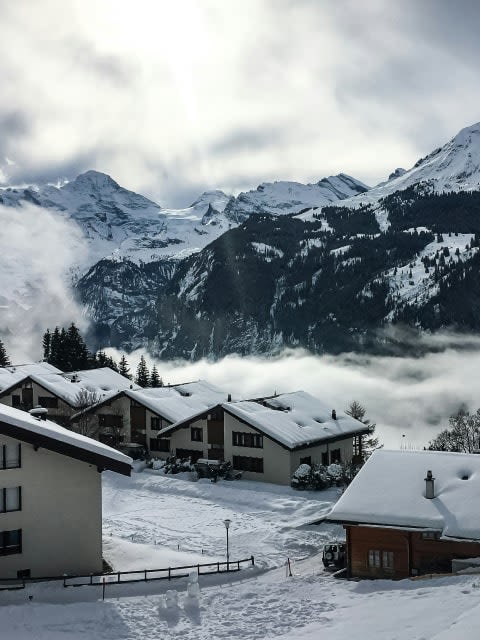
Wengen sits on a sloping shelf nearly 500m above the valley floor, with views straight down the valley and across to the mountains. There are no cars, so visitors will arrive by train and get around on foot. The compact centre has a short main street of shops and hotels, with a large ice rink and the nursery slope right at its heart. Accommodation ranges from grand historic hotels to chalets and apartments, and most are within walking distance of both the station and the cable car.
Days off the skis can be as active or as easy as you like, from skating and curling on the village ice rink to toboggan runs, snowshoeing, and more than 20km of winter walking trails. Most of Wengen’s restaurants are inside its hotels and open to everyone, serving everything from raclette and fondue to refined menus recognised by the Gault&Millau and Michelin guides. For a meal worth planning your day around, the Hotel Jungfrau Wengernalp is a historic, family-run hotel up on the mountain, reached only by the railway and known for its fine dining and a terrace facing the peaks. Après-ski begins at a snow bar in the village centre, then moves on to cosy hotel bars, some with live piano, and a few later bars where you can dance into the night.
Learning to ski in Jungfrau Ski Region comes with a view, as many of the easiest runs sit high on the mountain, facing the north faces of the Eiger, Mönch, and Jungfrau. Whichever resort you choose, you’ll find dedicated learning areas with magic carpets and gentle practice lifts, along with ski schools offering group and private lessons for adults and children. Once you’re comfortable on the nursery slopes, you can head up to the wide, gentle blue runs high on the mountain between Grindelwald and Wengen. Some of these carry on all the way down to the valley, so you can finish the day with a long, easy descent rather than another lap of the nursery slope.
In Grindelwald, beginners can start at Bodmi, a practice area just above the village centre. There’s also a ski school area at the top of the gondola from the lower lift terminal, close to the easy blue runs up there. Once you’ve moved on from the nursery slopes, run 22 is a good one to try, following the railway on a long, gentle descent all the way down to the lower end of the village. Up on First, the resort’s own ski area, beginners can enjoy the blue runs high on the mountain, but the runs back to the village are red, so most will ride the gondola down instead. In Wengen, the Figeller nursery slope sits right in the middle of the village, with more learning slopes a short train ride up the mountain. Once you’re ready, run 36 is particularly worth trying, as it stays blue all the way from the top of the mountain railway back down to the village. From the top of Wengen’s cable car, you also have run 2, which is another gentle blue, marked as a slow slope on the piste map.
Jungfrau Ski Region suits intermediates who like long runs and big views, with red and blue pistes that start high on the mountain and carry on all the way down to the valley. Grindelwald’s two ski areas each have their own feel. In the larger area that Grindelwald shares with Wengen, the runs are broad and rolling, with steady gradients across the open slopes up high and tree-lined reds lower down. One run worth trying there is run 3, which starts at the top of the cable cars and drops around 1,300m through the forest to the lower end of Grindelwald. Across the valley on First, the slopes face south, with long, wide cruising runs that are easy to settle into.
For many intermediates, a highlight of the trip to Jungfrau is a day on Mürren-Schilthorn, the region’s third ski area. Because it sits on the other side of the valley, you reach it by train and cable car rather than on skis, using the same pass. The skiing there starts higher than anywhere else in the region, so the open, treeless slopes up top tend to hold good snow. Below the high cable car station, you can follow sections of the Inferno, the world’s largest amateur ski race, on blue and red runs. Lower down, long runs wind through the pine forest, with views straight across the valley to the Eiger, Mönch, and Jungfrau.
Advanced skiers will find steep, demanding black runs in all three of Jungfrau’s ski areas, with the toughest terrain on Mürren-Schilthorn, the region’s highest ski area. Its black runs start right at the top, where the Schilthorn run drops straight from the summit along the opening stretch of the Inferno, the world’s largest amateur ski race. Just below, you’ll find the Direttissima, a run that starts at the cable car’s mid-station and is the steepest in the region. More black runs carry on lower down towards the village of Mürren, so strong skiers can spend a whole day on steep terrain here.
In the larger area that Grindelwald and Wengen share, the steepest runs start beneath the glaciers, and this is also home to the Lauberhorn, the World Cup downhill course above Wengen. Racers take it on each January, and once the race is over, the course opens to the public, with its famous sections manageable at a controlled speed. Another great run for strong skiers is the First–Bort–Grindelwald descent across the valley on First, which runs for 6km from the top all the way back to the village and ranks among the hardest in the region.
Strong skiers who like to venture beyond the marked runs will find plenty to explore, with large freeride areas on Mürren-Schilthorn and First and steep lines on the lower slopes of the Eiger. Much of this terrain is steep and avalanche-prone, so we recommend skiing it with a mountain guide for the safest experience and, of course, to find the best snow. For a big day out, try the Inferno course, which runs from below the Schilthorn summit all the way down to the valley floor, dropping more than 2,000m when there’s enough snow to ski it to the bottom. It’s worth setting off early (the open, exposed slopes up top give way to forest lower down, and conditions can change a lot on the way).
Jungfrau Ski Region has plenty for snowboarders, from long, groomed runs for carving to deep freeride terrain and a freestyle scene centred on First. First has long been at the heart of the region’s snowboard and freeski culture, with sunny, open slopes that suit riders of every level and a large freeride area up high for anyone who wants to go further with a guide. In the larger area between Grindelwald and Wengen, the wide, rolling runs are ideal for carving, and you can ride the mountain railway back up between runs instead of using drag lifts. Across the valley, the steep slopes and big off-piste terrain of Mürren-Schilthorn draw strong freeriders.
For days spent on jumps and rails, the region’s two snow parks cover every level. On First, the Snowpark Grindelwald-First has two parks of different difficulty, from easy features for beginners to big kickers for experienced riders, along with a 130m halfpipe and a ski cross course. Over on Mürren-Schilthorn, the Pända Snowpark has jibs, rails, and boxes, plus a kicker line for every level.
One ski pass covers the whole of Jungfrau Ski Region, so whichever resort you stay in, you can ski all three ski areas, including Mürren-Schilthorn across the valley. The Jungfrau Ski Region pass covers all 211km of pistes and every lift in Grindelwald-Wengen, First, and Mürren-Schilthorn, along with the mountain trains and cable cars that link them. It also includes the train from Interlaken into the mountains, the local buses around Grindelwald and Lauterbrunnen, and the zip lines on First. That matters here more than in most ski areas, since getting around the region relies on trains and cable cars as much as on chairlifts.
Because the same pass covers everything, it suits every kind of ski holiday here, from beginners who’ll spend most of their time close to their own village to strong skiers planning a day on the steep slopes of Mürren-Schilthorn. Non-skiers in your group can use a separate winter hiking and sledging pass instead, which covers the region’s trains, cable cars, and buses, so they can ride up to the slopes for winter walks and sledging.
Jungfrau Ski Region is within reach of four international airports. Zurich is the closest, around 150km from Grindelwald, followed by Basel at around 175km, Geneva at around 230km, and Milan Malpensa at around 310km. From each airport, you can travel on by hire car or by private or shared transfer. Grindelwald is the only one of the region’s resorts you can drive into. For car-free Wengen, the road ends in the valley below at Lauterbrunnen, where a mountain railway runs the last stretch up to the village. If you’d rather travel by train, Switzerland’s rail network connects all four airports with Interlaken, where trains continue into the mountains.
Once you arrive, you won’t need a car to get around. Mountain trains, cable cars, and gondolas link the villages with the slopes and with each other, and they’re all included in the ski pass, along with the local buses around Grindelwald and Lauterbrunnen. In Grindelwald, ski buses connect the village centre with the lift stations, while compact, car-free Wengen is easy to get around on foot. A day on Mürren-Schilthorn is a short train and cable car ride across the valley.
Jungfrau Ski Region has a long winter season. It starts in late November, when the high slopes between Grindelwald and Wengen open first, and runs until late April, with skiing carrying on up high after the lower areas have closed. The whole region is typically open from mid-December to the end of March, which is the most reliable window if you want to ski every area on the pass. January to mid-March usually brings the best snow. The slopes high on the mountain hold it best through the season, while snowmaking covers key runs lower down.
When you go also affects how busy the slopes and lifts feel. The busiest weeks are Christmas and New Year, the February school holidays across Europe, Easter, and Lauberhorn race week in Wengen. For quieter slopes, the weeks after New Year and March are good choices, and March in particular pairs reliable snow with longer days.
If you’d like to plan your trip around something special, two of skiing’s best-known races take place here each January. In mid-January, the Lauberhorn World Cup races bring tens of thousands of fans to Wengen to watch the world’s best racers on the longest downhill course on the circuit, and the village has a festive atmosphere all week. Later in the month, Mürren hosts the Inferno, the world’s largest amateur ski race, with more than a thousand skiers racing from below the Schilthorn summit towards the valley and spectators welcome along the course.
Grindelwald and Wengen are linked, sharing the region’s largest ski area, so you can ski from one village’s slopes to the other’s. Mürren-Schilthorn sits across the valley with no lift link, but the same pass covers it, along with the train and cable car journey to get there via Lauterbrunnen. Grindelwald’s own ski area, First, is also separate and reached by gondola from the village.
Choose Grindelwald if you want the most choice, with two ski areas on your doorstep, the region’s widest range of restaurants and bars, and the option to arrive by car. Choose Wengen if you’d rather stay in a compact, car-free village with a nursery slope in the centre and an easy blue run home from the high slopes. Both share the same main ski area.
Yes, once the January race is over, the Lauberhorn downhill course above Wengen opens to the public, so you can follow the same line as the World Cup racers. It’s best suited to strong skiers who are comfortable on steep black terrain, though its famous sections are manageable at a controlled speed. The course is closed to the public around race week while it’s prepared for racing.
At the top of the Schilthorn, at 2,970m, you’ll find Piz Gloria, a revolving restaurant that featured in the James Bond film On Her Majesty’s Secret Service. It turns a full circle while you eat, with views across a long chain of snow-covered peaks. Non-skiers can ride the cable car up too, so it’s an easy outing for the whole group.
Both work well for families, in different ways. Grindelwald has Bodmi, a practice area in the village with magic carpets and a ski school, plus a sports centre with an indoor pool and ice rink for days off the slopes. Wengen’s car-free streets are easy to explore with children, and its nursery slope sits right in the centre of the village.
Yes, non-skiers can easily get up onto the mountain here, since trains and cable cars run between the villages and the slopes, and a winter hiking and sledging pass covers them. That makes it easy to meet up with skiers at a mountain restaurant, walk the prepared winter trails, ride a sledge run down, or take the railway up to the Jungfraujoch.
There’s still plenty to do. The runs through the forest above the villages tend to have better visibility than the open slopes up high, and beginners can keep practising at Bodmi in Grindelwald. Off the slopes, Grindelwald’s sports centre has an indoor pool and ice rink, and Wengen has covered curling, so a cloudy day doesn’t have to mean a lost one.
Start building your dream ski trip today with our one-stop ski shop - hundreds of resorts, unlimited combinations.



 4.9/5
I usually book flights, transfers, hotel, ski rental and lift passes myself but this year used WeSki for a trip to Morzine. It was so much easier. Everything worked perfectly - transfers arrived on time and there was plenty of feedback throughout the whole process giving you confidence the holiday would go smoothly.

A really useful service that is so much easier to use than other 'all-inclusive' sites. It nicely bridges the gap between a travel agent and booking the trip yourself online. I will use WeSki every time I go skiing from now on.
We booked a late minute skiing trip to Morzine through we ski. We looked at booking the trip ourselves but could get anywhere near the price quoted by we ski. The company was excellent and we had no problems at all from start to finish. I would definitely use them to book another weekend skiing trip.
Seamless experience from start to finish. I was spending ages trying to sort out a weekend break and managed to do it with we ski in minutes and for the same price as booking it all up yourself. Flight, transfer and accommodation was all as expected and faultless.

WeSki is a trading name operated by Wetrip Weski Ltd (BR021500). All the flights and flight-inclusive holidays on this website are financially protected by the ATOL scheme. When you pay you will be supplied with an ATOL Certificate. Please ask for it and check to ensure that everything you booked (flights, hotels and other services) is listed on it. Please see our booking conditions for further information or for more information about financial protection and the ATOL Certificate go to: www.caa.co.uk.
Package holidays that do not include travel by air are financially protected via ABTOT.
For the latest travel advice from the Foreign & Commonwealth Office visit www.gov.uk/foreign-travel-advice.