
EN
EN
 Snow-sure resort
 Stunning views
 Top facilitiesSnow-sure resortStunning viewsTop facilitiesSnow-sure resortStunning viewsTop facilitiesSnow-sure resortStunning viewsTop facilities
Skiing in Arizona is a delightful surprise. High on the San Francisco Peaks, a short drive north of Flagstaff, Arizona Snowbowl is a proper mountain resort with its summit at 3,505m. The Peaks are the eroded remains of an ancient volcano, and their upper slopes hold snow from late autumn well into spring, with forested runs below and wide Southwestern views in every direction. Skiing here dates back to 1938, making Snowbowl one of the oldest ski areas in the United States.
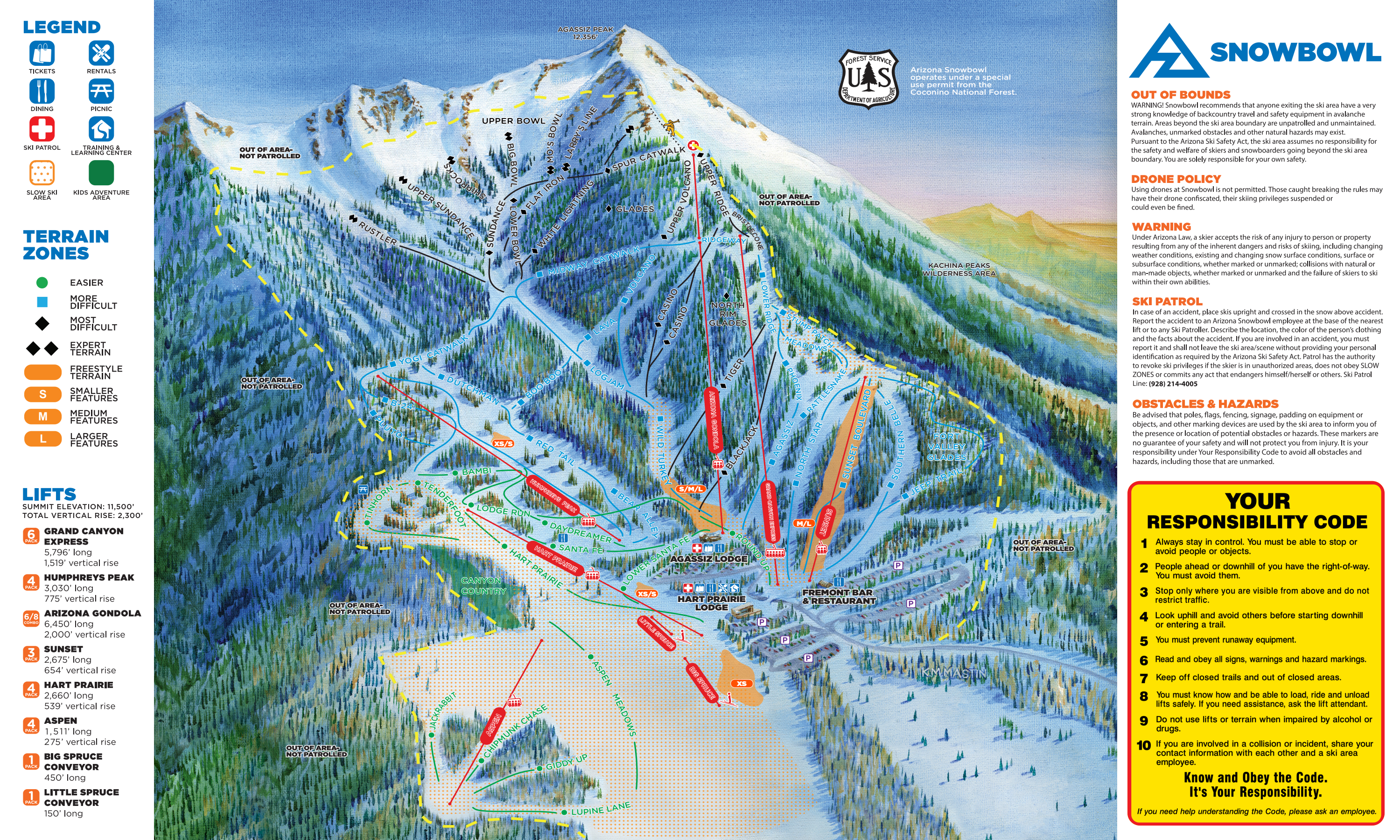
The skiing covers 777 acres of varied terrain, with a vertical drop of 700m and a longest run of 3.2km. There's a lot here for beginners and intermediates: Snowbowl has the largest learning area in the Southwest, 50 acres of gentle, open meadow at Hart Prairie, along with a good spread of blue cruisers winding down through the forest. Stronger skiers have plenty to test themselves on too, with steep black runs and the hike-to Upper Bowl up top for anyone after something wilder. The high elevation and a serious snowmaking system keep the season long, usually running from mid-November well into May, the longest in Arizona.
Off the slopes, Snowbowl has day lodges at the base serving hot food and drinks, a handful of terrain parks for freestylers, and rental shops on site. There's more to do in the snow nearby, too, with tubing at the Flagstaff Snow Park and cross-country skiing and snowshoeing on the groomed trails of the Arizona Nordic Village. Flagstaff itself is a lively university town, with independent restaurants, a strong craft-beer scene, and historic Route 66 running through the centre. And with the Grand Canyon only about 90 minutes away, a day trip to one of the world's great natural wonders is easily done on a ski holiday here.
Check out Arizona Snowbowl ski deals to start planning your trip.
Skiing in Arizona is a delightful surprise. High on the San Francisco Peaks, a short drive north of Flagstaff, Arizona Snowbowl is a proper mountain resort with its summit at 3,505m. The Peaks are the eroded remains of an ancient volcano, and their upper slopes hold snow from late autumn well into spring, with forested runs below and wide Southwestern views in every direction. Skiing here dates back to 1938, making Snowbowl one of the oldest ski areas in the United States.
The skiing covers 777 acres of varied terrain, with a vertical drop of 700m and a longest run of 3.2km. There's a lot here for beginners and intermediates: Snowbowl has the largest learning area in the Southwest, 50 acres of gentle, open meadow at Hart Prairie, along with a good spread of blue cruisers winding down through the forest. Stronger skiers have plenty to test themselves on too, with steep black runs and the hike-to Upper Bowl up top for anyone after something wilder. The high elevation and a serious snowmaking system keep the season long, usually running from mid-November well into May, the longest in Arizona.
Off the slopes, Snowbowl has day lodges at the base serving hot food and drinks, a handful of terrain parks for freestylers, and rental shops on site. There's more to do in the snow nearby, too, with tubing at the Flagstaff Snow Park and cross-country skiing and snowshoeing on the groomed trails of the Arizona Nordic Village. Flagstaff itself is a lively university town, with independent restaurants, a strong craft-beer scene, and historic Route 66 running through the centre. And with the Grand Canyon only about 90 minutes away, a day trip to one of the world's great natural wonders is easily done on a ski holiday here.
Check out Arizona Snowbowl ski deals to start planning your trip.
Arizona Snowbowl is shaped by two things: altitude and light. At over 3,500m the air is thin and the high-desert sun is powerful, filling the slopes with a bright, sharp mountain light. It can be deceptively strong, so pack high-factor sunscreen and good goggles even on overcast days, when the altitude and glare off the snow can catch out visitors. On a clear day, the views from the upper mountain stretch across the Painted Desert, the red rocks of Sedona, and hundreds of miles of high plateau, an extraordinary backdrop for a day's skiing. The mountain falls away down the old volcanic slopes in a natural progression, from open, wind-blown bowls up high to sheltered, tree-lined trails lower down.
Getting around is quick and modern. A high-speed six-person chair that's the longest in the state, carries skiers up to the upper mountain, part of an eight-lift system spread across the 777 acres. As for the runs, there's plenty of variety. Up top, the terrain is open and exposed, with steeper black pitches and a short hike to the Upper Bowl for the mountain's most challenging skiing. Lower down, well-groomed blue cruisers wind through the pine forest, while beginners get the wide, gentle meadow of Hart Prairie, the largest learning area in the Southwest. It's a compact mountain, but one with a real spread of terrain for every level.
Important for international visitors: the North American trail rating system differs from European colour codes. Green circles mark beginner runs (similar to European greens and easy blues). Blue squares cover intermediates, though they span a wider range than European blues, and some can feel quite demanding. Black diamonds indicate advanced terrain, and double black diamonds are expert-only, with steep pitches and exposure. There's no direct equivalent to European red runs, so blue squares deserve respect until you've found your level.
Beginners get a well-designed learning area at the base of the mountain, with green-circle runs (the North American equivalent of European greens and easy blues) served by their own lifts. You'll start out on the gentle, wide-open terrain of Hart Prairie, set apart from the faster traffic, then progress smoothly onto proper green runs as your confidence grows. Several of these longer greens wind down into the Ponderosa pine forest on the lower mountain, giving you your first taste of skiing through the trees and dappled sunlight, and the feel of a real mountain setting.
The runs are wide and forgiving, and the area's typically sunny weather often means good visibility, a real help when you're still working on your turns. It's a friendly, encouraging place to learn, where landing your first linked turns feels like a real achievement. One thing to be aware of is the altitude: at nearly 2,800m, even the base sits high, so you may feel the elevation more than usual, take your first day steady and give your body time to adjust.
WeSki insider tip: Make Hart Prairie your base for those first few days. The beginner area has its own lodge and lifts, so you can keep lessons, breaks, and lunch all in one low-key spot on gentle, open terrain, rather than heading over to the main-mountain base while you're still finding your feet.
Intermediates have the widest choice of terrain at Snowbowl. The main chairs serve a satisfying network of groomed runs winding through the conifer forest, with enough pitch and variety to keep things interesting. Bear in mind that US blue squares cover a broader range than European blues, so you'll find everything from gentle cruisers to runs with steeper sections that test your technique. Those tree-lined trails have real character, and the views opening up between the pines add something to every descent.
The Arizona Gondola opens up the upper mountain, where long runs carry you from above the treeline all the way back down through the forest, the shift from open alpine terrain up top to sheltered woodland below making each descent feel like a proper journey. Snowbowl rewards a bit of ambition, too. When you fancy stepping up, point yourself at one of the easier black diamonds, several are groomed top to bottom, so it's the steep pitch that challenges you rather than the snow underneath.
WeSki insider tip: For long, uninterrupted blue cruising, lap the Grand Canyon Express. Unlike the gondola, it tops out below the steepest summit terrain, so you can rack up run after run of groomers without straying onto anything too advanced, and from the top, the catwalk feeds you straight onto Logjam, one of the mountain's most enjoyable blues.
The upper mountain is where experienced skiers come into their own. Black and double-black runs drop off the volcanic ridgeline with sustained steeps, natural mogul fields, and exposed, wind-affected pitches that build up challenging snow, and named runs like Casino and Volcano put precise line choice and strong technique to the test. There isn't a vast amount of expert terrain, but what's here is concentrated and properly demanding.
Down on the lower mountain, tree skiing adds another dimension, with gladed runs winding through the mixed conifer forest, full of natural features, variable snow, and a different challenge from the open terrain up top. These sheltered lines hold snow well after a storm for some of the best powder skiing on the hill. Sitting above 3,500m helps, too: the snow generally stays in good condition, and the free-draining volcanic ground keeps the base from going icy. For strong skiers willing to read the mountain and ride out the altitude, there's plenty here to get stuck into.
WeSki insider tip:For the steepest terrain and expert lines, take the Arizona Gondola, not the Grand Canyon Express. It climbs higher up the mountain than any other lift, reaching the most challenging black-diamond pitches and the access point for the hike-to Upper Bowl, Snowbowl's most demanding terrain.
Snowbowl is a welcoming mountain for snowboarders, with a loyal local following and the easygoing energy of the college ski town down the road in Flagstaff. Riders are well served by the terrain, with tree runs and natural hits to play on through the forested lower mountain, and open powder fields and bowls up high for big, sweeping freeride turns. The high-desert setting makes the riding here distinctive, too: long spells of sunshine soften the snow into playful, spring-like conditions, while the altitude keeps it cold and dry up top after a storm.
It's a compact mountain, too, so you can mix park laps with freeriding and tree runs without burning time on long traverses. For freestyle, there are three terrain parks with a clear progression, from beginner-friendly boxes and small jumps up to bigger kickers and more advanced rails, so there's plenty to session whatever your level.
Snowbowl sits on the slopes of an old volcano, and that volcanic landscape throws up some unusual terrain features, bowls, gullies, and natural rollers that give the off-piste skiing real character. Within the resort boundary, the main off-piste is in the gladed areas between the marked trails, with tree runs through Ponderosa pine and mixed conifer that hold their snow well after a storm. Higher up, the exposed upper-mountain terrain takes on wind-affected features and variable snow, rewarding experienced skiers who can read the conditions.
Beyond the boundary, the San Francisco Peaks and the surrounding Coconino National Forest open up proper backcountry touring. This is serious terrain, though: avalanche awareness, the right safety equipment, and a look at the regional avalanche forecast are all essential before heading out, and going with a guide or someone who knows the area is the safest way to explore it.
The Arizona Snowbowl ski and snowboard school runs group lessons and private tuition for all abilities, from first-timers to experienced skiers fine-tuning their technique. Private lessons are the most flexible option, available in sessions from one to six hours and tailored to whatever you'd like to work on, be that freestyle and park skills or the mountain's steeper, more challenging terrain. Lessons are booked online in advance, multi-day packages are available, and the school has a good reputation for patient, encouraging instruction.
The terrain parks here run a natural progression, so there's somewhere to session whatever your level. Beginners can find their feet in the Hart Prairie Start Park, with small and friendly features, before stepping up to the Red Tail park as their skills improve. Sunset Terrain Park is where more advanced features live, with larger jumps, rails, and boxes that the crew rebuilds and shapes through the season, and there's a dedicated rail garden for anyone who'd rather focus on jibbing. Snowbowl's park crew takes pride in the setup, and the freestyle community here is active and welcoming, with an atmosphere that encourages progression without pressure.
Arizona Snowbowl is a great choice for families, with a laid-back, unpretentious atmosphere and a friendly feel making it an easy place to bring children of any age. The base area is compact and easy to get around, everything runs from a single base with no shuttle buses or complicated logistics, and the mountain's manageable size makes it easier to keep the family together through the day. Bear in mind that the altitude can tire the whole family early on, little ones most of all, so an easy first day and a few breaks go a long way.
For younger and less-experienced children, it's a gentle place to learn. The wide, open meadow of Hart Prairie is the largest learning area in the Southwest, with conveyor lifts and a beginner zone set well away from the main-mountain traffic. Group lessons take children from age four, through programmes like SkiWee and Mini Rider for the youngest skiers and snowboarders up to Mountain Kids for older ones. There's no on-site nursery or daycare, though, so ski school is the best way to keep young children happily occupied on the snow.
Older children, teenagers, and more confident young skiers have plenty to get into, with a good spread of blue runs and a handful of easier blacks to grow on. The Sunset lift, just by the Hart Prairie Lodge, is a particular favourite for mixed-ability families: you can all ride up together and then pick your own way down, with blue runs like North Star and Southern Belle from the top. Teens are often drawn to the terrain parks, too, where the features build from first tricks up to more confident jumps and rails.
Off the slopes, there's plenty to round out a family trip. Base lodges serve hot food through the day, and the wider Flagstaff area adds more snow fun nearby with activities like tubing, snowshoeing, cross-country skiing, and snowman-building. Flagstaff itself is an easy, family-friendly base, with a historic Route 66 downtown and a good choice of relaxed restaurants. Some of America's most famous landscapes are within reach, the Grand Canyon about 90 minutes away and the red rocks of Sedona around an hour south, so a day exploring is there if you want it.
Set high on the San Francisco Peaks in the Coconino National Forest, Arizona Snowbowl sits in a landscape that lends itself to all sorts of winter activities beyond the downhill. There's snowshoeing and cross-country skiing through the Ponderosa pines, backcountry touring on the Peaks for the well-equipped, and tubing and snow play for families nearby. Off the mountain, Flagstaff adds its own appeal as a lively college town, and some of the most celebrated landscapes in the country, the Grand Canyon, Sedona's red rocks, and ancient Native American heritage sites, are all within day-trip reach.
On the mountain itself, dining is casual and convenient. The two base lodges, Hart Prairie and Agassiz, serve hot food, warming drinks, and a beer at the end of the day, enough to refuel between runs without heading off the snow for long.
Flagstaff has an excellent and varied dining scene. Years of ambitious local chefs have given the town a reputation as one of Arizona's strongest food towns, and the Southwestern influence runs right through the cooking, with local farms, ranches, and foraged ingredients shaping seasonal menus. Here are some restaurants to check out in Flagstaff:
WeSki insider tip: Seek out the green chile. Roasted Hatch green chillies are a Southwestern staple, and in Flagstaff they turn up in everything from burgers to breakfast burritos, smoky, anywhere from mild to hot, and worth ordering wherever you spot them on a menu.
Après at the mountain itself is a low-key affair. Most people wind down with a beer on the deck at one of the base lodges, boots loosened, taking in the views before heading back into town. It's relaxed and unhurried rather than a big party scene, an easy end to the day in keeping with Snowbowl's laid-back feel.
Flagstaff is where the evening picks up. The historic downtown along Route 66 has a cluster of breweries, cocktail bars, and restaurants within easy walking distance of one another. Its brewery scene is a real point of pride, Flagstaff carries the title of Arizona's Craft Brew City, and creative cocktail bars and live-music spots round things out, so there's plenty to fill an evening once the lifts stop.
Après-ski spots to know:
There's no slopeside accommodation at Arizona Snowbowl. It's a day-ski area on national forest land, so visitors base themselves in Flagstaff, around 25 minutes' drive from the base area. Flagstaff has a wide range of places to stay, from historic downtown hotels and boutique properties to modern chains, classic motels, and holiday rentals. Decades as a stop on Route 66 have left the town with plenty of vintage motor lodges and characterful older buildings alongside the newer options, so there's something to suit most tastes and group sizes.
The hotels and rental properties along Milton Road and the Route 66 corridor are well placed, with easy access north to the mountain and out towards the Grand Canyon and Sedona. Flagstaff is a proper year-round city with supermarkets, shops, and services, so self-catering in a rental is straightforward. Most visitors get around by car, which also makes the day trips easy, but you don't strictly need one to reach the slopes: over the winter holidays and at weekends through the season, the free Mountain Express shuttle runs from downtown Flagstaff up to the base area.
Arizona Snowbowl lift tickets cover all eight lifts, the full trail network, and the terrain parks, with the Arizona Gondola included as standard. Day tickets and multi-day options are available. Snowbowl is owned by Mountain Capital Partners and sits on the Power Pass, the company's multi-resort season pass, so Power Pass holders have their access included, though for a single trip, day or multi-day tickets are usually the simplest choice.
Check for multi-day pass options when booking your Arizona Snowbowl ski holiday through WeSki to find the best fit for your trip.
Snowbowl's rental shop at the base lodge provides ski and snowboard packages for all ages and levels, including performance and demo options for more experienced skiers. The staff are experienced at fitting visitors from all backgrounds. Booking online in advance saves time, particularly on busy weekends when the Phoenix crowd arrives. Several independent ski shops in Flagstaff also offer rental equipment, which can be convenient for fitting the evening before your first day on the mountain.
Snowbowl is an easy mountain to find your way around. There are two base areas a short distance apart, Hart Prairie (with the beginner terrain and the rental shop) and Agassiz (with the gondola and the steeper terrain), each with its own parking, so you can pull into whichever suits your day. Lifts, lodges, and parking sit close together at each base, and once you're on the hill the terrain is all interconnected, so there's no need for shuttle buses or tricky navigation. You park, walk to the lifts, and ski.
Getting to and from the resort is easiest by car. Snowbowl Road runs about 11km up from Highway 180, north of Flagstaff, to the base, paved and maintained through winter but slow during and after storms, so allow extra time after heavy snow. In the heaviest conditions, chains or 4WD may be needed, and a park-and-ride shuttle runs up from Fort Valley Lodge lower down. You don't have to drive, though: the free Mountain Express shuttle links downtown Flagstaff with the base over the winter holidays and at weekends through the season. Around town, Flagstaff's downtown is walkable, and the Mountain Line bus network covers the wider city, handy for reaching restaurants and bars without a car.
Arizona Snowbowl sits on the San Francisco Peaks, about 11km north of Flagstaff. For international visitors, the gateway is Phoenix Sky Harbor International Airport, around 240km (150 miles) south. British Airways and American Airlines both fly direct from London Heathrow to Phoenix, with plenty of connecting options via US hubs as well.
From Phoenix, it's roughly a two-hour drive north to Flagstaff on Interstate 17, climbing from the Sonoran desert up into high pine forest along the way. Hire cars are available at the airport, or Groome Transportation runs a scheduled shuttle from Phoenix Sky Harbor to Flagstaff if you'd rather not drive. From Flagstaff, it's a short hop up to the base by car or, on weekends and over the holidays, the free Mountain Express shuttle.
WeSki offers car rentals from the airport as well as private transfers to Arizona Snowbowl. Add them to your Arizona Snowbowl ski holiday package for seamless door-to-door travel.
North American resorts use a different system from Europe. Green circles mark beginner runs, similar to European greens and easy blues. Blue squares cover intermediate terrain, but they span a wider range than European blues, some are gentle cruisers, others are quite a bit more demanding. Black diamonds are advanced, with steep, challenging pitches, and double black diamonds are expert-only, often with very steep terrain, moguls, or rocky sections. There's no direct equivalent to European red runs, so confident intermediates should expect some blue squares to feel testing.
Yes. Arizona Snowbowl is a fully fledged ski resort high on the San Francisco Peaks, with a base at 2,804m and a summit at 3,505m, high-alpine elevations that help hold the snow. It gets solid natural snowfall backed by extensive snowmaking, and the season runs from around late November well into spring, one of the longest in the Southwest. With 777 acres of terrain and runs for every level, it's a real mountain in its own right.
Snowbowl holds its own among the Southwest's ski areas. It has the largest vertical drop in Arizona at around 700m, 777 acres of varied terrain from the wide beginner meadows of Hart Prairie to the steep upper-mountain bowls, and one of the region's longest seasons. Recent lift upgrades, the Arizona Gondola and the Grand Canyon Express, have modernised access to the top of the mountain. What really sets a trip here apart is the setting, with the Grand Canyon, Sedona, and a town like Flagstaff all within easy reach of the slopes.
The San Francisco Peaks pull consistent snowfall from Pacific storms through the winter, and the high summit (3,505m) helps keep the snow in good shape. Snowmaking covers a good portion of the trail network, so conditions stay reliable through drier spells. The high-desert sun softens the snow through the day, especially on south-facing slopes, while the cold, dry air up high means fresh snowfall often skis light and powdery. The season is a long one, too, regularly running well into spring.
Yes, and it's one of the big draws of a trip here. The Grand Canyon's South Rim is about 90 minutes' drive from Flagstaff, so a day trip is easily done, you could ski in the morning and be standing on the rim by early afternoon. Winter is a wonderful time to see it, with crisp, clear air and the chance of snow dusting the rim, a very different scene from summer.
It might. The base sits at 2,804m and the summit at 3,505m, high enough that some visitors, especially those coming from sea level, feel the effects, things like shortness of breath, a mild headache, or tiredness. Staying well hydrated, going easy on alcohol for the first day, and taking it steady early on all help, and most people adjust within a day or two. If you're flying into Phoenix (around 340m), spending a night in Flagstaff (about 2,100m) before heading up to the mountain gives your body a chance to acclimatise.
Yes. A compact, easy-to-navigate base, gently graded beginner terrain at Hart Prairie, and structured children's programmes all make it an easy place to bring a family. Older children and teenagers have plenty of blue runs and terrain parks to grow into, and because everything sits close together at the base, it's easy to keep the family together through the day. Off the slopes, there's tubing and snow play nearby, the relaxed dining of Flagstaff, and, if you fancy a day away from the skiing, easy day trips to the Grand Canyon and Sedona.
 4.9/5
4.9/5I usually book flights, transfers, hotel, ski rental and lift passes myself but this year used WeSki for a trip to Morzine. It was so much easier. Everything worked perfectly - transfers arrived on time and there was plenty of feedback throughout the whole process giving you confidence the holiday would go smoothly.

A really useful service that is so much easier to use than other 'all-inclusive' sites. It nicely bridges the gap between a travel agent and booking the trip yourself online. I will use WeSki every time I go skiing from now on.
We booked a late minute skiing trip to Morzine through we ski. We looked at booking the trip ourselves but could get anywhere near the price quoted by we ski. The company was excellent and we had no problems at all from start to finish. I would definitely use them to book another weekend skiing trip.
Seamless experience from start to finish. I was spending ages trying to sort out a weekend break and managed to do it with we ski in minutes and for the same price as booking it all up yourself. Flight, transfer and accommodation was all as expected and faultless.

WeSki is a trading name operated by WeTrip Ltd. All the flights and flight-inclusive holidays on this website are financially protected by the ATOL scheme. When you pay you will be supplied with an ATOL Certificate. Please ask for it and check to ensure that everything you booked (flights, hotels and other services) is listed on it. Please see our booking conditions for further information or for more information about financial protection and the ATOL Certificate go to: www.caa.co.uk.
Package holidays that do not include travel by air are financially protected via ABTOT.
For the latest travel advice from the Foreign & Commonwealth Office visit www.gov.uk/foreign-travel-advice.