
EN
EN
 Snow-sure resort
 Top facilities
 Off-piste skiingSnow-sure resortTop facilitiesOff-piste skiingSnow-sure resortTop facilitiesOff-piste skiingSnow-sure resortTop facilitiesOff-piste skiing
Mammoth Mountain is California's flagship ski resort and one of the largest in the United States. Founded by Dave McCoy in the 1950s after he noticed the mountain held more snow than anywhere else in the region, it's grown from a single rope tow into a 3,500-acre resort with over 150 runs, 25 lifts, and a season that typically stretches from November through to June, one of the longest in the United States. The town of Mammoth Lakes sits at 2,424m (7,953ft), surrounded by the Inyo National Forest, with hot springs, volcanic craters, and the dramatic granite landscape of the Eastern Sierra as your backdrop. Its season typically stretches from November through to June, one of the longest in the United States.
The mountain's vast volcanic peak rises to 3,369m (11,053ft) and receives an average of 10 metres of snowfall every season. A 945m (3,100ft) vertical drop gives you serious serious scale, with above-treeline alpine bowls and exposed ridgelines at the summit giving way to extensive tree skiing mid-mountain and wide, gentle groomers near the base. Beginners have dedicated terrain across the lower mountain, intermediates can cruise for days across the broad mid-section, and advanced skiers and experts have steep chutes, mogul fields, and backcountry-style descents off the summit. Eight terrain parks and three halfpipes, including one of the world's only SuperDuper 22ft pipes, make Mammoth an internationally renowned freestyle destination where Olympic and X Games athletes come to train.
Beyond skiing, Mammoth Lakes is a proper mountain town with a laid-back Californian energy. The Village at Mammoth connects to the slopes by gondola, with restaurants, bars, and shops, while the wider town has a growing dining scene ranging from tiki bars and craft breweries to fine dining. Natural hot springs are scattered across the surrounding landscape, and soaking in a pool with views of the Sierra crest after a day on the mountain is one of those experiences you'll want to repeat every evening. Yosemite National Park is just over an hour's drive away for a rest-day trip that adds a whole other dimension to the week.
Mammoth Mountain is California's flagship ski resort and one of the largest in the United States. Founded by Dave McCoy in the 1950s after he noticed the mountain held more snow than anywhere else in the region, it's grown from a single rope tow into a 3,500-acre resort with over 150 runs, 25 lifts, and a season that typically stretches from November through to June, one of the longest in the United States. The town of Mammoth Lakes sits at 2,424m (7,953ft), surrounded by the Inyo National Forest, with hot springs, volcanic craters, and the dramatic granite landscape of the Eastern Sierra as your backdrop. Its season typically stretches from November through to June, one of the longest in the United States.
The mountain's vast volcanic peak rises to 3,369m (11,053ft) and receives an average of 10 metres of snowfall every season. A 945m (3,100ft) vertical drop gives you serious serious scale, with above-treeline alpine bowls and exposed ridgelines at the summit giving way to extensive tree skiing mid-mountain and wide, gentle groomers near the base. Beginners have dedicated terrain across the lower mountain, intermediates can cruise for days across the broad mid-section, and advanced skiers and experts have steep chutes, mogul fields, and backcountry-style descents off the summit. Eight terrain parks and three halfpipes, including one of the world's only SuperDuper 22ft pipes, make Mammoth an internationally renowned freestyle destination where Olympic and X Games athletes come to train.
Beyond skiing, Mammoth Lakes is a proper mountain town with a laid-back Californian energy. The Village at Mammoth connects to the slopes by gondola, with restaurants, bars, and shops, while the wider town has a growing dining scene ranging from tiki bars and craft breweries to fine dining. Natural hot springs are scattered across the surrounding landscape, and soaking in a pool with views of the Sierra crest after a day on the mountain is one of those experiences you'll want to repeat every evening. Yosemite National Park is just over an hour's drive away for a rest-day trip that adds a whole other dimension to the week.
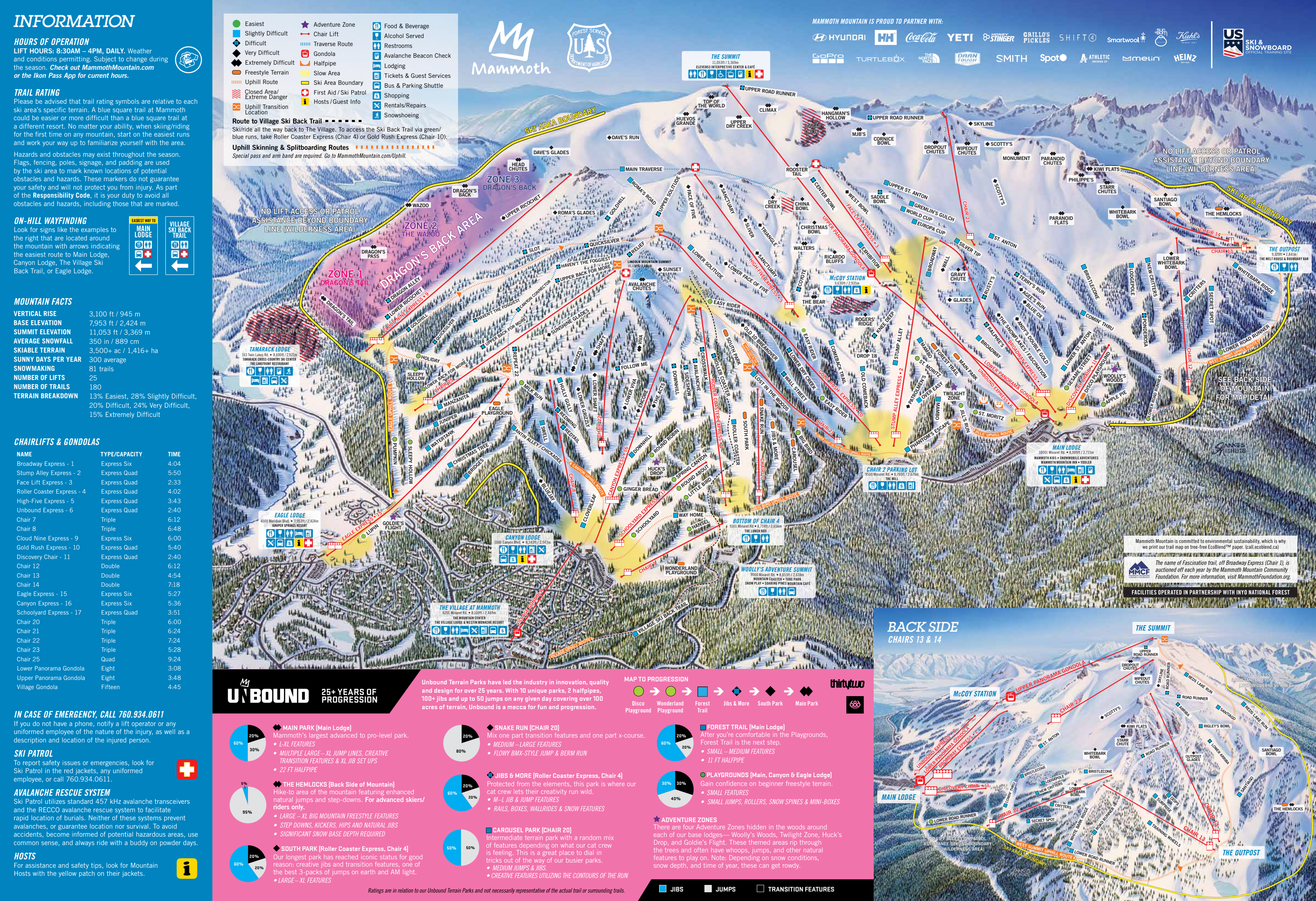
Whether you're skiing or snowboarding, you can expect a big-mountain experience at Mammoth. The resort is spread across multiple peaks and valleys, with terrain dropping from its exposed, treeless summit at 3,369m. From there, pistes wind down through alpine bowls, into well-spaced forest, and on to the groomed runs around its four base areas: Main Lodge, Canyon Lodge, Eagle Lodge, and The Village. A lift system of three gondolas, two high-speed six-packs, and nine high-speed quads keep things moving across the terrain.
The mountain is predominantly north-facing, which keeps snow in excellent condition. Sierra's famous snowpack is deep and stable, and while California's snow can occasionally lean heavier than Rocky Mountain powder, Mammoth's elevation keeps it light and skiable for most of the season. On top of natural conditions, the grooming at Mammoth is exceptional (Dave McCoy pioneered modern grooming standards here), with a fleet of over 30 snowcats grooming the pistes nightly to make sure the snow surface is consistently smooth.
A note about trail ratings for UK visitors: North American resorts use a different trail rating system from Europe. Green circles mark beginner runs, which are similar to European greens or easy blues. Blue squares indicate intermediate terrain, but cover a wider range of difficulty than European blues (a confident intermediate may find some blues quite challenging). Black diamonds mark advanced runs with steep, challenging terrain, and double black diamonds are expert-only (the most demanding terrain, often with cliffs, moguls, or extreme steeps). There is no direct equivalent to European red runs, but US blue squares bridge that gap.
Mammoth has excellent beginner facilities across several base areas. Main Lodge, Canyon Lodge, and Little Eagle Lodge are areas specifically designed for first-timers, with green-circle terrain and easy chairlifts or magic carpets. The Discovery Chair at Canyon Lodge is also purpose-built for learning, with a gentle gradient and slow, easy-loading lift.
Mammoth is a particularly good setup for beginners to progress. Once you're comfortable on green-circle terrain, there's a natural step up to easier blue-square runs around the Gold Rush and Stump Alley lifts. For those who want guided instruction, ski and snowboard schools at the resort run group and private lessons for all ages.
WeSki insider tip: Head to Canyon Lodge for your first few days. The Discovery Chair area is purpose-built for learners, and as you improve, you can progress onto easy blue runs nearby without moving to a different part of the mountain.
Intermediates have the lion's share of Mammoth's terrain, with around 40% of the mountain rated blue-square. Runs off the Gold Rush and Cloud 9 lifts provide long, rolling descents with enough variety to keep things interesting for days. As you move higher, terrain opens up into wide bowls and longer runs with mountain views stretching across the Eastern Sierra.
By taking the Panorama Gondola to the summit area, you can enjoy high-altitude cruising with spectacular 360-degree panoramas. Confident intermediates should also explore the runs between the mid-mountain and the base areas, where you have substantial vertical and can string together long, satisfying descents through the forest.
WeSki insider tip: Avoid the Main Lodge area on Saturday mornings, since that's where the LA weekend crowds congregate. Start at Canyon Lodge or Eagle Lodge instead, and work your way across the mountain. By mid-morning, the crowds spread out and the whole mountain opens up.
Expert skiers will find Mammoth's summit and upper mountain terrain challenging. There's enough here to keep a strong skier busy for a full week, and on a big snow year, the off-piste options multiply dramatically. If you take the Panorama Gondola to the top, you'll have access to steep, exposed alpine bowls, chutes, and cornices. Terrain off Chair 22 is some of the most demanding, with steep avalanche chutes that require confidence and good snow assessment. Chair 9 accesses expert bowls with sustained fall-line skiing above the treeline.
The Cornice Bowl, despite its name, is often groomed into a fast, steep cruiser, but the surrounding terrain holds serious ungroomed lines. Tree skiing at Mammoth is excellent, particularly on stormy days when the upper mountain is wind-affected. On the lower half of the mountain, well-spaced lodgepole pines hold powder beautifully, and runs off Chair 12 on the back side are a local favourite for fresh lines.
WeSki insider tip: On a powder day, head straight for Chair 22 at the summit for the steepest avalanche chutes, then work your way to Chair 12 on the back side for tree skiing. The back side is north-facing and keeps snow in excellent condition, holding powder long after the front face has been tracked out
Mammoth is one of the top snowboard destinations in North America, and a regular training ground for Olympic and X Games riders. Wide-open bowls, tree runs, and natural terrain across the mountain suit boarders of all levels. The Unbound Terrain Parks are the headline: eight parks with over 100 jibs, 50+ jumps, and three halfpipes including a 22ft SuperDuper pipe. Parks are set up for progression too, from beginner-friendly mini features all the way to professional-level kickers, and the quality of shaping and maintenance is world-class.
Mammoth's off-piste terrain is extensive and varied. Alpine bowls above the treeline hold wind-loaded powder, chutes off Chair 22 provide serious steeps, and tree skiing through the lodgepole pines on the lower mountain is excellent in storm conditions. The mountain's size (3,500 acres) lets various nooks and crannies hold fresh lines well after a storm, though the more obvious spots get tracked quickly. Backcountry access beyond the resort boundary is available for experienced skiers with proper equipment, and local guiding services can take you into the surrounding Eastern Sierra terrain.
Mammoth's ski and snowboard school runs comprehensive programmes for all ages and abilities, from first-timer packages to advanced clinics. Private and group lessons are available, and booking ahead during peak holiday weeks is strongly recommended.
Mammoth's Unbound Terrain Parks are among the best in the world - whatever your level, there's a park that fits, and the quality of shaping and maintenance is consistently world-class. The group of eight parks provide progression from first-timer features to professional-level jumps, with over 100 jibs and 50+ jumps maintained throughout the season. Three halfpipes include a SuperDuper 22ft pipe that's used for Olympic and X Games training, and the Unbound Main Park has been a freestyle institution for over 20 years.
Mammoth works well for families, particularly those with children of mixed abilities. The Village at Mammoth is car-free and pleasant to wander, with the gondola connection to the slopes keeping mornings simple. On a mountain this size, teenagers and advanced family members can explore challenging terrain up top while beginners stay on gentle lower slopes, and everyone meets in town for lunch, and no one feels like they've compromised.
Young skiers can start with the dedicated learning areas at Canyon Lodge and Main Lodge, both well equipped with magic carpets and enclosed beginner terrain. Woolly's Adventure Summit combines supervised childcare with optional ski instruction, and the Children's Ski Center accepts children from age four, so parents have freedom on the mountain. Older children and teenagers always have something at their level, and will likely gravitate towards the Unbound Terrain Parks. With eight parks across the resort, the progressive layout lets them start on mini features and work up to bigger jumps and rails as confidence builds.
Off the slopes, a tubing area, snowmobiling, and snowshoeing around the Eastern Sierra add variety to rest days, and the natural hot springs scattered around town make for a memorable family experience. Mammoth Lakes has a relaxed, family-friendly atmosphere with a dining scene that covers everything from pizza and burgers to proper sit-down restaurants. Four base lodges across the mountain mean you're never far from a hot meal mid-ski.
Mammoth's Eastern Sierra setting gives it a range of off-slope experiences. Thanks to its volcanic geology, hot springs, and proximity to California's spectacular landscapes, rest days and non-skiing activities at Mammoth are a highlight of any trip.
Beyond skiing and snowboarding, Mammoth and the surrounding area have a full range of winter activities:
For days off the slopes, Mammoth Lakes and the Eastern Sierra have an extraordinary range of natural and cultural attractions:
WeSki insider tip: Soak in one of the natural volcanic hot springs after skiing. Wild Willy's and the Hilltop pools are free, surrounded by mountain scenery, and the contrast of hot mineral water and cold Sierra air is one of the defining experiences of a Mammoth trip.
Mammoth's dining scene has grown significantly in recent years. Together, the town of Mammoth Lakes and The Village provide a range that goes well beyond your standard resort fare. The Californian influence means you'll find excellent craft beer, creative cooking, and a laid-back approach to eating out that feels distinctly West Coast. On the mountain, over 15 eateries across the four base lodges keep you fuelled throughout the day.
WeSki Insider Tip: Don't leave Mammoth without trying the wild buffalo meatloaf at Toomey's. It's been on the menu for years and is the dish locals tell every visitor to order. Book ahead, as tables fill up fast on powder days.
Après-ski at Mammoth has a relaxed, Californian flavour. It's sociable and laid-back, where craft beer and conversation take priority over thumping bass. The base lodge bars fill up as the lifts close, with sun-soaked terraces and cold beers setting the tone for the evening. From there, The Village at Mammoth is the main hub: a car-free, gondola-connected strip of restaurants, bars, and late-night spots where you can easily wander from dinner into drinks without needing a plan.
The town's nightlife is compact but varied. You'll find everything from tiki bars and craft breweries to cocktail lounges and live music, and the atmosphere stays friendly and inclusive. One thing worth knowing: at 2,400m, the altitude means you'll feel your drinks a little faster than usual, so pace yourself.
Après-ski spots to know:
Accommodation in Mammoth ranges from luxury condos and hotels in The Village (connected to the slopes by gondola) to self-catering apartments, cabins, and lodge-style properties spread across the town. The Village offers the most convenient slope access and dining, while properties along the main road and around the Lakes Basin are quieter and often more affordable. Several base lodges provide direct ski-in, ski-out access.
Shuttle buses connect the town, The Village, and all base areas throughout the day, so you're not reliant on a car once you're in Mammoth Lakes. The town is compact enough that most things are within a short shuttle ride or drive.
Mammoth is on the Ikon Pass, which provides access to Mammoth alongside a network of major resorts across North America and beyond. Day lift tickets are also available but are expensive by European standards - the Ikon Pass represents significantly better value for those skiing multiple days or planning additional resort visits. Multi-day tickets purchased in advance are cheaper than walk-up rates. The pass also includes access to June Mountain, Mammoth's quieter sibling resort 30 minutes north.
Check for family and multi-day pass options when booking your Mammoth Mountain ski holiday package through WeSki to find the best fit for your trip.
Equipment hire is available at multiple locations across the resort, including The Village Mountain Center, Main Lodge, and Canyon Lodge. The range covers skis, snowboards, boots, helmets, and accessories for all levels and styles. Demo-level equipment for those wanting to try high-performance gear is also available. Pre-booking during peak US holiday weeks (Christmas, Presidents' Day, Spring Break) is strongly recommended, as these periods can be very busy.
Shuttle buses run throughout the town of Mammoth Lakes, connecting The Village, all four base lodges, accommodation areas, and the town centre. The Village Gondola provides a direct connection from The Village to Canyon Lodge. On the mountain, the lift system covers terrain efficiently, though the resort's size means you'll want to learn the layout (start by figuring out the four base areas and the key connecting lifts, and the rest will fall into place quickly).
A car is useful for excursions to hot springs, June Mountain, and the wider Eastern Sierra, but within Mammoth Lakes the shuttle system means you can manage without one. Parking at the base lodges is free but fills up early on busy weekends, so shuttles are the smartest option.
Mammoth Yosemite Airport (MMH) has seasonal flights from several Californian airports during winter, and is just 15 minutes from town. For international travellers, the most common route is to fly into Los Angeles (LAX), San Francisco (SFO), or Reno (RNO), and then drive or take a connecting flight. The drive from Los Angeles takes around five hours, and from Reno around three hours. Both drives are scenic, particularly the route through the Eastern Sierra from LA via Highway 395.
WeSki offers car rentals from the airport as well as private transfers to Mammoth Mountain. Add them to your Mammoth Mountain ski holiday package for seamless door-to-door travel.
North American resorts use a different system from Europe. Green circles indicate beginner runs (equivalent to European greens or easy blues). Blue squares mark intermediate terrain, but they cover a wider range than European blues, so a confident intermediate may find some blues quite challenging. Black diamonds indicate advanced terrain (steep, technical runs), and double black diamonds are expert-only (extreme steeps, cliffs, moguls). There's no direct equivalent to European red runs, US blue squares bridge that gap. If you're a solid red-run skier in Europe, you'll be comfortable on most US blues and ready to try some blacks.
Mammoth covers 3,500 skiable acres with over 150 runs, served by 25 lifts including three gondolas and 11 high-speed chairs. The vertical drop is 945m (3,100ft) from the 3,369m (11,053ft) summit to the base at 2,424m (7,953ft). It's one of the largest ski resorts in California and in North America overall.
The Ikon Pass is a multi-resort season pass that provides access to Mammoth Mountain alongside dozens of other major resorts across North America and beyond. If you're skiing multiple days at Mammoth, the Ikon Pass typically works out cheaper than buying day tickets. It also includes access to nearby June Mountain. For UK visitors planning a single Mammoth trip, compare the cost of multi-day lift tickets against the Ikon Pass Base option to see which provides better value for your dates.
Mammoth's Unbound Terrain Parks are among the best in the world. Eight parks with over 100 jibs and 50+ jumps, plus three halfpipes including a 22ft SuperDuper pipe, make this an internationally renowned freestyle destination. Olympic and X Games athletes train here, but the parks cater to all levels. There are mini features and progression parks for beginners alongside the professional-level kickers. If freestyle skiing or snowboarding is your thing, Mammoth is a bucket-list destination.
January and February typically bring the deepest snowfall, with March and April providing excellent spring skiing conditions. With warmer weather, longer days, and a consolidated snowpack. The resort often stays open into June, and late-season park skiing is a Mammoth speciality. Avoid Presidents' Day weekend (mid-February) and Christmas week if you want to dodge the biggest crowds from Los Angeles. Midweek visits throughout the season are noticeably quieter.
Mammoth requires more travel than a European ski holiday, but it's well worth the journey. Most UK visitors fly to Los Angeles (LAX) or San Francisco (SFO) and then take a connecting flight to Mammoth Yosemite Airport (15 minutes from town) or drive. The drive from LA takes around five hours via the scenic Highway 395 through the Eastern Sierra. Reno (three hours' drive) is another option. Combining Mammoth with a few days in California before or after makes the long flight feel more worthwhile. Many visitors pair it with time in San Francisco, Yosemite, or along the Pacific Coast.
Yes, and they're one of the defining experiences of a Mammoth trip. Mammoth sits in a volcanic area with natural hot springs scattered throughout the Eastern Sierra. Wild Willy's Hot Spring, the Hilltop pools, and the Crab Cooker are all free, natural pools surrounded by mountain scenery. Some pools are roadside; others require a short hike. Water temperatures vary, so test before plunging in.
 4.9/5
4.9/5I usually book flights, transfers, hotel, ski rental and lift passes myself but this year used WeSki for a trip to Morzine. It was so much easier. Everything worked perfectly - transfers arrived on time and there was plenty of feedback throughout the whole process giving you confidence the holiday would go smoothly.

A really useful service that is so much easier to use than other 'all-inclusive' sites. It nicely bridges the gap between a travel agent and booking the trip yourself online. I will use WeSki every time I go skiing from now on.
We booked a late minute skiing trip to Morzine through we ski. We looked at booking the trip ourselves but could get anywhere near the price quoted by we ski. The company was excellent and we had no problems at all from start to finish. I would definitely use them to book another weekend skiing trip.
Seamless experience from start to finish. I was spending ages trying to sort out a weekend break and managed to do it with we ski in minutes and for the same price as booking it all up yourself. Flight, transfer and accommodation was all as expected and faultless.

WeSki is a trading name operated by WeTrip Ltd. All the flights and flight-inclusive holidays on this website are financially protected by the ATOL scheme. When you pay you will be supplied with an ATOL Certificate. Please ask for it and check to ensure that everything you booked (flights, hotels and other services) is listed on it. Please see our booking conditions for further information or for more information about financial protection and the ATOL Certificate go to: www.caa.co.uk.
Package holidays that do not include travel by air are financially protected via ABTOT.
For the latest travel advice from the Foreign & Commonwealth Office visit www.gov.uk/foreign-travel-advice.