EN
EN
Almost every comparison of Valmorel and La Plagne sets one piste total against another and stops there. That misses the thing that actually decides it: these two share nothing. No lift pass, no lift link, and about 50 minutes of valley road between them. Book one and you have booked that mountain for the week. Valmorel is a compact, car-free village at the mouth of the Tarentaise, with a ski area split in half by a famous road pass. La Plagne is eleven linked villages spread across a high plateau above Aime, at the centre of one of the largest linked areas in France. This guide compares them on terrain, lift passes, snow, villages, families, experts and access.
Choose Valmorel for: a car-free village you can walk end to end in ten minutes, terrain weighted heavily towards greens and blues, lift queues that stay short even in half term, and the shortest run from the motorway of any resort in the valley - which matters more to families with small children than any piste total does.
Choose La Plagne for: 225 km on the standard pass without buying an extension, most of the skiing above 2,000 m, eleven villages to pick a base from at wildly different altitudes, and enough scale - an Olympic bobsleigh run included - to keep a mixed-ability group busy for a full week.


| Feature | Valmorel | La Plagne |
|---|---|---|
| Country | France | France |
| Ski area | Le Grand Domaine - 165 km across two valleys | Paradiski - 425 km with Les Arcs and Peisey-Vallandry |
| On the local pass | 95 km, the Valmorel side only | 225 km, all of La Plagne |
| Village altitude | 1,400 m | 1,250 m (Montchavin) to 2,100 m (Aime 2000) |
| Highest lift | 2,550 m | 3,080 m |
| Season | Roughly mid-December to mid-April | Roughly mid-December to late April |
| Best for | First weeks, young families, quiet slopes, short transfers | Mileage, mixed-ability groups, altitude, off-snow scale |
| Village character | One car-free village built in Savoyard style | Eleven villages, from high-altitude blocks to tree-line hamlets |
| Nearest station | Moûtiers (~30 min by road) | Aime-La Plagne (~30 min by road) |
| Nearest airport | Chambéry (~1 hr 10 min); Geneva (~2 hr) | Chambéry (~1 hr 30 min); Geneva (~2 hr 30 min) |
Valmorel's home mountain is 95 km, rising from the village at 1,400 m to 2,550 m on the Mottet and Madeleine ridges. The character is wide, rolling and sunny: long blues across open alpage, a scattering of reds down the Cheval Noir flank, and tree-lined runs dropping into Doucy and the Celliers valley. There are four marked freeride zones and a small handful of blacks, the 3 km Mottet the longest of them. Nothing here is severe, and the layout means a family can split up at the top of a lift and meet at the bottom of it.
La Plagne runs to 225 km across a broad, mostly treeless plateau, with Roche de Mio at 2,739 m, Grande Rochette at 2,508 m and Les Verdons at 2,500 m as the three hubs the whole area hangs from. The signature is sustained blue and red mileage - the descent from Roche de Mio down through the trees to Montchavin covers close to 1,500 m of vertical on one pass of the map. Above 2,000 m it is open bowl skiing with long sightlines; below it, the runs into Montalbert, Champagny and Montchavin turn into proper forest tracks.
Who it suits: for a week of varied mileage without repeating runs, La Plagne; for a smaller mountain where a mixed group stays together, Valmorel.
This is where the comparison is usually got wrong, because the numbers on the brochures are not the numbers you ski.
Valmorel's headline is 165 km, and that is Le Grand Domaine - Valmorel plus Saint-François-Longchamp, lift-linked over the Col de la Madeleine, with Doucy and Celliers hanging off the Valmorel side. The split is 95 km to Valmorel and 70 km to Saint-François, and the two are sold as separate passes. A Valmorel pass gets you the 95 km; the Grand Domaine pass adds the crossing and the Maurienne side. Both are worth buying for different reasons, and a first-week skier will not miss the second half.
La Plagne's headline is 425 km, and that is Paradiski - La Plagne plus Les Arcs and Peisey-Vallandry, joined by the Vanoise Express cable car across the Ponthurin gorge. The standard La Plagne pass covers 225 km and does not cover that cable car. Paradiski is either a separate pass or a day extension bought on top, which is the sensible route if you want one crossing rather than seven.
Who it suits: on the entry-level pass it is 95 km against 225 km, which is a wide gap; on the full pass it is 165 km against 425 km, which is wider still. If piste mileage is what you are buying, La Plagne wins at every price point - the question is whether you will use it.
La Plagne has the altitude argument and it is a strong one. Roughly 70% of the area sits above 2,000 m, the top station reaches 3,080 m, and the high bowls hold a base into late April in most winters. One thing to correct, because a lot of older writing still repeats it: there is no glacier skiing at La Plagne any more. The lifts on the Chiaupe glacier were taken down and the two pistes that ran off it went with them, leaving the top of the mountain as a viewpoint and the fastest way to the foot of the Bellecôte north face, which is off-piste and guided ground. Altitude is the reason to book La Plagne for a late-season week. A glacier is not.
Valmorel is lower, topping out at 2,550 m with the village at 1,400 m, and it answers with snowmaking and trees. The runs back to the village carry heavy cannon coverage, which is what keeps the base intact in a thin January. The more useful advantage is the forest: the descents to Doucy and Celliers sit under the treeline, so when the cloud comes down and La Plagne's open plateau turns into a whiteout, Valmorel still has skiing with contrast in it. The Saint-François side faces the sun and softens earlier in spring.
Who it suits: for late April, or for any week where snow cover is the main worry, La Plagne; for flat-light days and a resort that skis well in bad visibility, Valmorel.
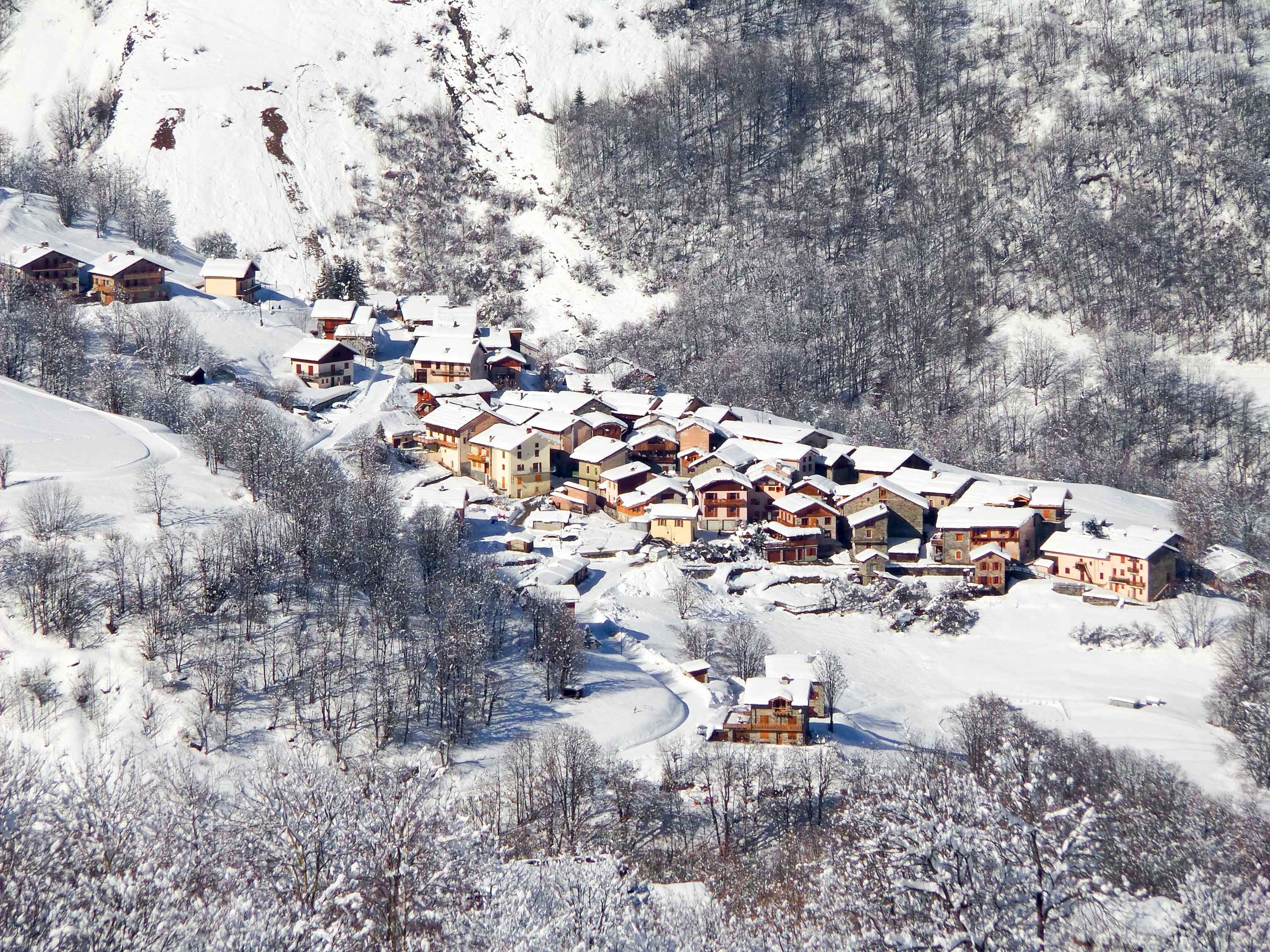
Valmorel was built from scratch in the mid-1970s as a deliberate reaction to the concrete going up elsewhere in Savoie, and it has aged better than most of what it was reacting to. Rue du Bourg is a single cobbled street of low wood-and-stone buildings, closed to traffic, with the lifts at one end and the shops along it. Accommodation is mostly apartments and chalets within walking distance of the snow front. Evenings are quiet - a few bars that fill up at four and empty by ten, Savoyard restaurants, and one late venue for anyone who wants it.
La Plagne is not one village but eleven, and choosing between them is a decision in itself. Plagne Centre is the hub with the most shops and services; Belle Plagne is pedestrianised and the prettiest of the high bases; Aime 2000 is a single vast block that is either brutal or brilliant depending on your view, and unbeatable for ski access. Lower down, Montchavin, Les Coches, Montalbert and Champagny-en-Vanoise sit in the trees and look like the Savoyard villages they mostly were. The apartment stock is enormous and spans everything from 1970s studios to new residences with pools. Après runs from terrace bars at Plagne Centre to a handful of late places, and there are well over a hundred restaurants across the villages.
Who it suits: for a village with one street and a shared atmosphere, Valmorel; for choosing your own altitude, price and pace of evening, La Plagne.
Both work, and the difference is what a first week actually feels like. Valmorel's case is that the whole resort is built around it: free beginner lifts at the village, no roads between your door and the nursery slope, a quarter of the area graded green and nearly half blue, and gentle marked zones like the Pirates' village to break up a morning. Lift queues stay short, which for a six-year-old is the difference between a good day and a tearful one.
La Plagne's case is scale and the room to grow into it. There are free beginner lifts at most of the villages, a large ski-school network, and enough gentle terrain that a child who starts on Monday has somewhere new to go by Friday. Set against that, the bases are further apart and getting between them takes lifts or a bus, so a family with a toddler will spend more of the week in transit than they would at Valmorel. The bobsleigh track, the ice rinks and the sledging fill a non-skiing afternoon better than anything Valmorel has.
Who it suits: for a first family week with young children, Valmorel; for children who already ski and will get bored of 95 km, La Plagne.
Neither resort is chosen for its blacks, and they are not equal once you leave the piste. Valmorel has a modest set of steeper runs and four marked freeride zones, plus quieter side-country under the Lauzière massif above Saint-François that stays untracked longer than anything in the main Tarentaise. It is a good place to learn to ski off-piste rather than a place to test yourself on it.
La Plagne's serious terrain is the Bellecôte north face, a long, committing descent that needs a guide, safety kit and settled conditions, and one of the better-known lines in the Alps. Below that, the blacks off Roche de Mio and the bowls above Champagny hold their own, and the freestyle setup - a main park near Plagne Centre, a boardercross and a fun slope - is considerably larger than Valmorel's.
Who it suits: for a first season venturing off the marked runs, Valmorel; for a guided big-mountain day and a real park, La Plagne.
WeSki insider tip: if you base in Valmorel and buy the Grand Domaine pass, cross the Col de la Madeleine early rather than after lunch. The Saint-François side faces the sun, so it skis best in the first two hours and turns heavy by mid-afternoon, and the crossing only needs blue-run ability in either direction. Check the last lift back before you commit - miss it and the road round is a long way.
Valmorel has the easier arrival, and by a wider margin than the map suggests. Its turning is at La Léchère, before Moûtiers, so you leave the dual carriageway ahead of the Saturday bottleneck that every Three Valleys and upper-Tarentaise transfer has to sit through, then climb about 13 km. Chambéry is roughly an hour and ten minutes, Geneva and Lyon around two hours each, and Moûtiers station about half an hour below the village with shuttle buses running up.
La Plagne is a further 25 km up the valley and then a climb of its own, which puts Chambéry at around an hour and a half and Geneva nearer two and a half. Its rail case is the stronger one, though: Aime-La Plagne has its own station directly below the resort, on the line that carries the winter services from Paris and London, with around half an hour of road above it. Once you arrive, both resorts expect you to leave the car parked - Valmorel because there is nowhere to drive, La Plagne because the inter-village lifts and buses are quicker than the roads between the bases.
Who it suits: for the shortest door-to-door by road, Valmorel; for arriving by train without a long transfer at the end, La Plagne.
There is no shared pass here, so unlike most pairings in this section the choice is exclusive. Three questions settle it.
How much will you actually ski? A strong skier doing five or six hours a day will have seen Valmorel's 95 km by Wednesday, and the Grand Domaine pass buys another two days at most. La Plagne's 225 km takes a week to work through before Paradiski is even on the table. If mileage is the point of the holiday, this question ends it.
Is anyone in the group on their first skis? Valmorel is built for that week in a way few resorts are - no roads, short queues, free lifts at the bottom and a green-heavy mountain above. La Plagne does beginners well too, but a first-timer there spends more of the day moving between places rather than skiing.
When are you going? Through January and February both hold up. For late April, La Plagne's 3,080 m and its high bowls are the safer booking, and it is usually still running when the Grand Domaine has closed for the season.
If none of those separates them, the question is what you want the week to feel like: one street where you keep bumping into the same people, or eleven villages and a mountain you cannot finish.
No - and this is the first thing to know about the pairing. Valmorel and La Plagne are separate mountains in separate parts of the Tarentaise, roughly 50 minutes apart by road, with no lift, piste or shared circuit connecting them. Whichever you book, you ski that area all week. Valmorel's links run west over the Col de la Madeleine to Saint-François-Longchamp; La Plagne's run east across the Vanoise Express to Les Arcs. The two never meet.
It does not. They belong to different ski areas with entirely separate pass systems. Valmorel sits in Le Grand Domaine, where a Valmorel pass covers 95 km and a Grand Domaine pass extends it to 165 km including Saint-François-Longchamp. La Plagne sits in Paradiski, where the La Plagne pass covers 225 km and a Paradiski pass or day extension opens the full 425 km with Les Arcs and Peisey-Vallandry. Skiing both in one holiday means buying two passes.
Valmorel, for a first week. The village is car-free, the nursery area is a few steps from most accommodation, the beginner lifts are free, and roughly a quarter of the area is graded green with almost half blue - so there is a long runway before anything gets intimidating. La Plagne has excellent ski schools and plenty of gentle terrain, but its villages are spread out, so a nervous first-timer spends more of the day working out how to get places.
La Plagne, on altitude. About 70% of its skiing sits above 2,000 m and the top station reaches 3,080 m, which holds a base at both ends of the season. Valmorel tops out at 2,550 m and relies more on snowmaking, which covers the runs back to the village well. Its real advantage is a different one: the tree-lined descents to Doucy and Celliers stay skiable in flat light, when La Plagne's open plateau gives you nothing to see by.
The honest answer is that it depends on what you book rather than which resort you pick. Valmorel is smaller and its accommodation is weighted towards apartments and mid-range chalets, so a week there tends to land lower overall. La Plagne spans a much wider range - 1970s studios at one end, new residences with spas at the other - so it can come in below Valmorel or well above it. The pass is the clearer difference: Valmorel's local pass covers a smaller area and is priced accordingly.
It comes down to the ages. Valmorel suits families with young children or first-timers: no traffic, nothing more than a short walk, short lift queues and gentle terrain everywhere. La Plagne suits families whose children already ski and want room to explore, with 225 km to spread across, and more to do away from the snow - the Olympic bobsleigh run, ice rinks and sledging among it. If you are carrying skis for a four-year-old, Valmorel makes the week easier.