
EN
EN
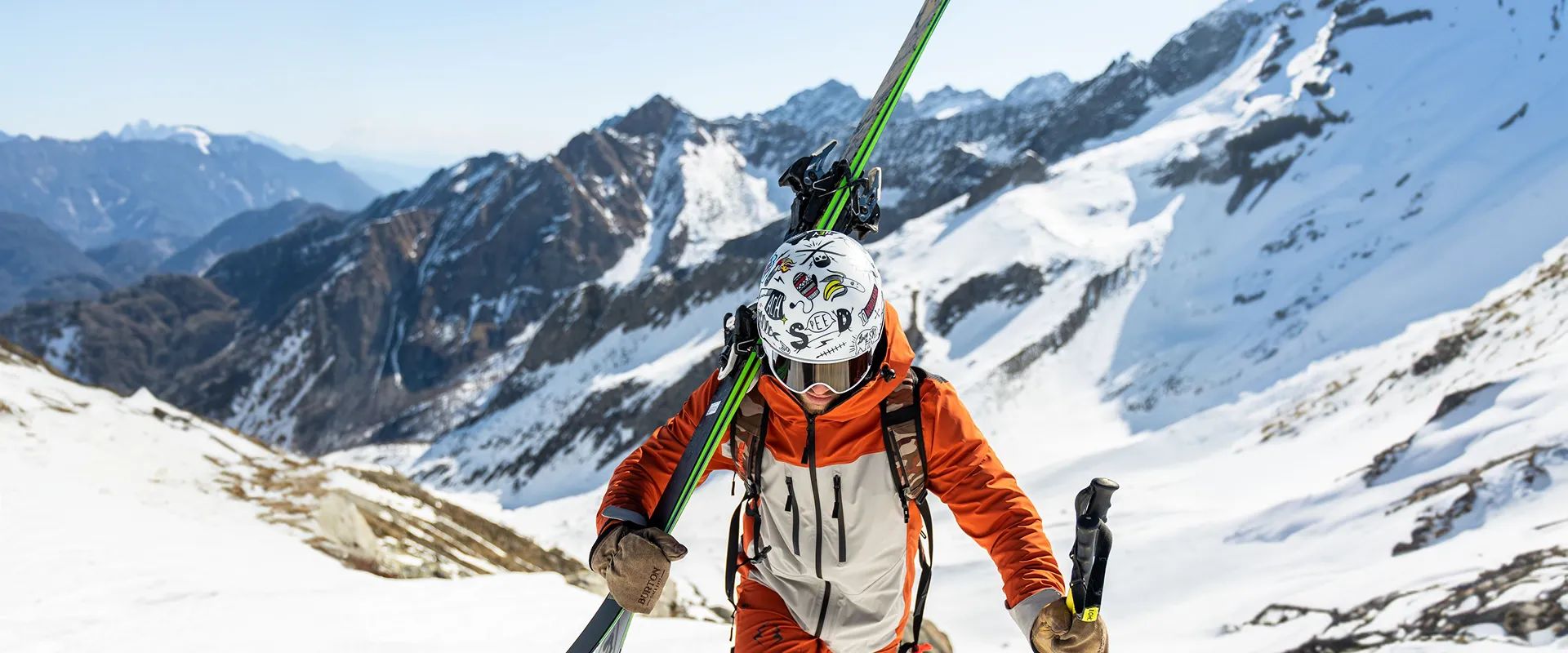
You don't need a full suit of armour to ski safely - but a few well-chosen pieces of protective gear make a meaningful difference to your confidence and comfort on the mountain. This guide covers the safety equipment worth considering, from the essentials that every skier should have to the specialist kit that's useful in specific situations. If you want to understand the rules that keep everyone safe on the slopes, our guide to the rules of the piste walks through the FIS code in plain English. And for practical preparation tips, our how to stay safe on the ski slopes guide covers everything from warming up properly to reading the terrain.
A helmet is the single most impactful piece of safety equipment you can wear on the mountain. Head injuries account for a significant proportion of serious ski accidents, and a well-fitted helmet reduces the severity of impact substantially. In Italy, helmets are mandatory for anyone under 18 - but the numbers make a strong case for wearing one regardless of age or legal requirement.
Modern ski helmets are light, well-ventilated, and designed to work with goggles and audio systems. They also keep your head noticeably warmer than a hat - an underrated benefit on cold, windy days. Most rental shops carry helmets, but if you ski regularly, owning one that fits you properly is worthwhile. Look for adjustable sizing dials, removable ear pads, and a certification mark (EN 1077 for Europe). MIPS technology - a low-friction liner that reduces rotational force in a fall - is increasingly standard and worth choosing if it's available.
✓ Reduces the severity of head injuries - the most common serious skiing injury.
✓ Keeps your head warm and comfortable in all conditions.
✓ Mandatory for children in Italy and several Austrian provinces - essential if you're skiing there.
WeSki insider tip: Try your helmet on with your goggles before you get to the mountain. The gap between helmet brim and goggle frame should be minimal - a large 'forehead gap' means cold air, fogging, and reduced protection.
Goggles do more than keep snow out of your eyes. They protect against UV radiation (which is significantly stronger at altitude), improve visibility in flat light and snowfall, and shield your face from wind chill. Sunglasses work on calm, sunny days - but the moment conditions change, goggles are vastly more functional.
Lens colour matters more than brand. A dark or mirrored lens suits bright sunshine; an orange, rose, or yellow lens enhances contrast in overcast or flat-light conditions. If you can only bring one pair, a versatile mid-tint lens (often marketed as 'all-conditions' or 'variable light') covers the widest range. Photochromic lenses that adjust to light conditions automatically are a practical choice too, though they respond slower in very cold temperatures.
✓ UV protection at altitude is essential - snow reflects up to 80% of UV rays, multiplying exposure.
✓ Flat-light lenses transform visibility on overcast days, helping you read the terrain.
✓ Wind and snow protection keeps you comfortable and skiing longer.
WeSki insider tip: Anti-fog treatment only works if you don't touch the inside of the lens. If your goggles fog up, resist the urge to wipe them - air them out instead. Wiping damages the coating and makes future fogging worse.
Back protectors are one of those pieces of kit that feel like overkill until you actually need one. They absorb and distribute impact force across your spine, reducing the risk of vertebral injury from falls, collisions, or contact with hard-packed snow and ice. For anyone skiing at intermediate level and above - where speeds are higher and terrain more varied - they're a sensible addition.
Two main types exist. Soft protectors use foam that hardens on impact (D3O or similar) and feel like wearing a thin vest - flexible and barely noticeable under a jacket. Hard-shell protectors use rigid plastic plates and provide higher-rated protection but are bulkier. For most recreational skiers, a CE-rated soft protector strikes the right balance between protection and comfort. Some ski jackets now come with integrated back protectors, which saves a separate purchase.
✓ Spinal injuries, while rare, are among the most serious skiing accidents - a protector reduces the risk.
✓ Modern soft protectors are thin, flexible, and comfortable enough to forget you're wearing one.
✓ Increasingly standard for children and young skiers across European ski schools.
WeSki insider tip: A back protector should sit flush against your spine from the base of your neck to your coccyx. If it rides up when you bend forward into a skiing stance, it's too short or needs adjusting.
Wrist fractures are the most common injury in snowboarding and a frequent one among beginner skiers too - the instinct to break a fall with outstretched hands puts enormous force through the wrist joint. Wrist guards work by splinting the joint and distributing impact across a wider area, reducing fracture risk significantly.
Snowboarders benefit most, but beginner skiers (who fall more often and haven't yet learned to fall 'correctly') also find them reassuring. Look for guards that fit inside your gloves or, better still, gloves with integrated wrist protection built in. Standalone guards that sit over gloves tend to be bulkier and can interfere with pole grip.
✓ Wrist fractures are the single most common snowboarding injury - guards reduce the risk substantially.
✓ Beginner skiers who fall frequently benefit from the added confidence and protection.
✓ Integrated glove-guard combinations are the most practical option for most skiers.
WeSki insider tip: If you're taking snowboard lessons for the first time, ask your instructor about wrist guards before the session. Many ski schools have them available to borrow, and they make the early learning phase noticeably less daunting.
Impact shorts are padded compression shorts worn underneath your ski trousers. They protect your hips, tailbone, and upper thighs from the bruising that comes with repeated falls - and on hard-packed or icy slopes, even a slow fall can leave you sore for days.
Snowboarders tend to fall backwards more often than skiers, making impact shorts especially useful during the learning phase. But anyone skiing on firm snow conditions or progressing into steeper terrain will appreciate the cushioning. They're lightweight, comfortable to wear all day, and invisible under your ski trousers - most people forget they're there within the first run.
✓ Tailbone and hip bruising is common and can limit how much you ski - padding prevents it.
✓ Particularly valuable for snowboarders and anyone learning on hard-packed snow.
✓ Thin enough to wear all day without affecting movement or comfort.
WeSki insider tip: Impact shorts are one of the few pieces of safety gear you can't easily hire at most resorts. If you think you'll want them, bring your own or buy before you travel.
Knee injuries - particularly ACL tears - are the most common serious injury in alpine skiing. The forces involved in turning, stopping, and falling all load through the knee joint, and the rigid ski boot (which is excellent for ankle support) transfers much of that force upward.
Preventive knee braces don't eliminate the risk, but they do provide additional support and proprioceptive feedback that helps your muscles respond more effectively under load. They're most useful for skiers returning from a previous knee injury, those with known ligament laxity, or anyone skiing at higher speeds on challenging terrain. For healthy knees with no history of issues, a brace is a personal choice rather than a necessity - but the weight of evidence suggests they reduce injury rates in at-risk groups.
✓ ACL injuries are the most common serious ski injury - a brace provides additional joint support.
✓ Particularly valuable for anyone returning to skiing after a knee injury.
✓ Compression and warmth from a brace can also reduce fatigue on longer ski days.
WeSki insider tip: If you have a history of knee problems, speak to a physiotherapist before your trip. A few targeted exercises in the weeks beforehand can strengthen the muscles around the joint and complement whatever brace you wear.
If you're planning to ski off-piste - beyond the marked and patrolled runs - an avalanche safety kit is non-negotiable. The kit has three components: a transceiver (a small radio device worn on your body that sends and receives a signal), a probe (a collapsible pole used to locate a buried person), and a shovel (a lightweight, packable shovel for digging them out). All three are essential; any one component without the others is of limited use.
You also need to know how to use them - and that means practice. Most ski schools and mountain guides run transceiver training sessions, often as part of an off-piste introduction course. These sessions typically last a few hours and cover search technique, efficient digging strategy, and basic avalanche awareness. They're worth doing even if you only plan to dip a toe into off-piste skiing.
Avalanche airbag backpacks are an additional option for more committed off-piste skiers. When deployed, the airbag increases your volume and helps keep you near the surface of a slide. They're effective, but they're supplementary to - not a substitute for - the core transceiver-probe-shovel combination.
✓ Transceiver, probe, and shovel are the minimum requirement for any off-piste skiing.
✓ Knowing how to use them matters as much as carrying them - take a training session.
✓ Airbag backpacks provide additional protection but are supplementary, not a replacement.
WeSki insider tip: Turn your transceiver on at the bottom of the mountain and check it at the resort's transceiver checkpoint (most resorts have one near the main lifts). A flat battery or faulty unit is worse than no transceiver at all - you won't be found where you expect to be.
Sun protection might not feel like 'safety gear' in the traditional sense, but UV exposure at altitude is a serious and underestimated risk. UV intensity increases by roughly 10-12% for every 1,000 metres of elevation gain, and snow reflects up to 80% of UV rays back at you - meaning you're effectively exposed from above and below simultaneously. Sunburn at 2,000 metres happens faster than most people expect, even on overcast days.
Use SPF 50 sunscreen on all exposed skin, reapplying every two hours and after sweating. Don't forget your lips (a dedicated SPF lip balm is essential), the underside of your nose, your ears, and any skin between your goggles and neck warmer. Goggles with UV400 protection handle the eye side of things, but if you're wearing sunglasses instead, make sure they're rated for high-altitude UV.
✓ UV intensity is significantly stronger at altitude - sunburn happens faster than at sea level, even in cloud.
✓ Snow reflects up to 80% of UV rays, doubling your exposure.
✓ Lips and under-nose are the most commonly missed areas - and the first to burn.
WeSki insider tip: Apply your first layer of sunscreen 20 minutes before you go outside - it needs time to absorb properly. Putting it on in the lift queue means your first run is unprotected.
Helmets are widely available for hire at most European ski resorts - they're typically included or available as an add-on with ski and boot hire. Back protectors and wrist guards are less commonly stocked at rental shops, though some larger operations carry them. Items like impact shorts and knee braces are best brought from home, as they need to fit well and are rarely available to hire.
Beginners tend to fall more often, but at lower speeds and on gentler terrain - so the risk of serious spinal impact is relatively low. That said, falls onto hard-packed snow can still be uncomfortable, and a lightweight soft protector adds reassurance without restricting movement. For children and teenagers, many European ski schools now recommend or require them.
If you're skiing exclusively on marked and patrolled pistes, an avalanche kit isn't necessary - these runs are controlled and managed by ski patrol. Avalanche safety equipment becomes essential when you ski off-piste, even for short sections. Our guide to the rules of the piste explains the distinction between marked runs and off-piste terrain in more detail.
SPF 50 is the standard recommendation for skiing. At altitude, UV radiation is substantially stronger than at sea level, and snow reflection amplifies exposure further. Even on overcast days, enough UV penetrates cloud cover to cause sunburn. Reapply every two hours, use a dedicated SPF lip balm, and don't rely on your moisturiser's built-in SPF - it's unlikely to provide adequate protection for a full day on the mountain.
MIPS (Multi-directional Impact Protection System) is a liner technology that allows the helmet shell to rotate slightly on impact, reducing the rotational force transmitted to the brain. Independent testing suggests it provides measurable additional protection in angled impacts - the most common type in skiing. It's worth choosing if the option is available, though a well-fitted standard helmet with CE certification is still a significant improvement over no helmet at all.
Still deciding on your next ski trip? WeSki’s AI trip planner helps you find the right resort for your priorities - tell it what matters and get a shortlist built around you.



WeSki is a trading name operated by WeTrip Ltd. All the flights and flight-inclusive holidays on this website are financially protected by the ATOL scheme. When you pay you will be supplied with an ATOL Certificate. Please ask for it and check to ensure that everything you booked (flights, hotels and other services) is listed on it. Please see our booking conditions for further information or for more information about financial protection and the ATOL Certificate go to: www.caa.co.uk.
Package holidays that do not include travel by air are financially protected via ABTOT.
For the latest travel advice from the Foreign & Commonwealth Office visit www.gov.uk/foreign-travel-advice.