EN
EN
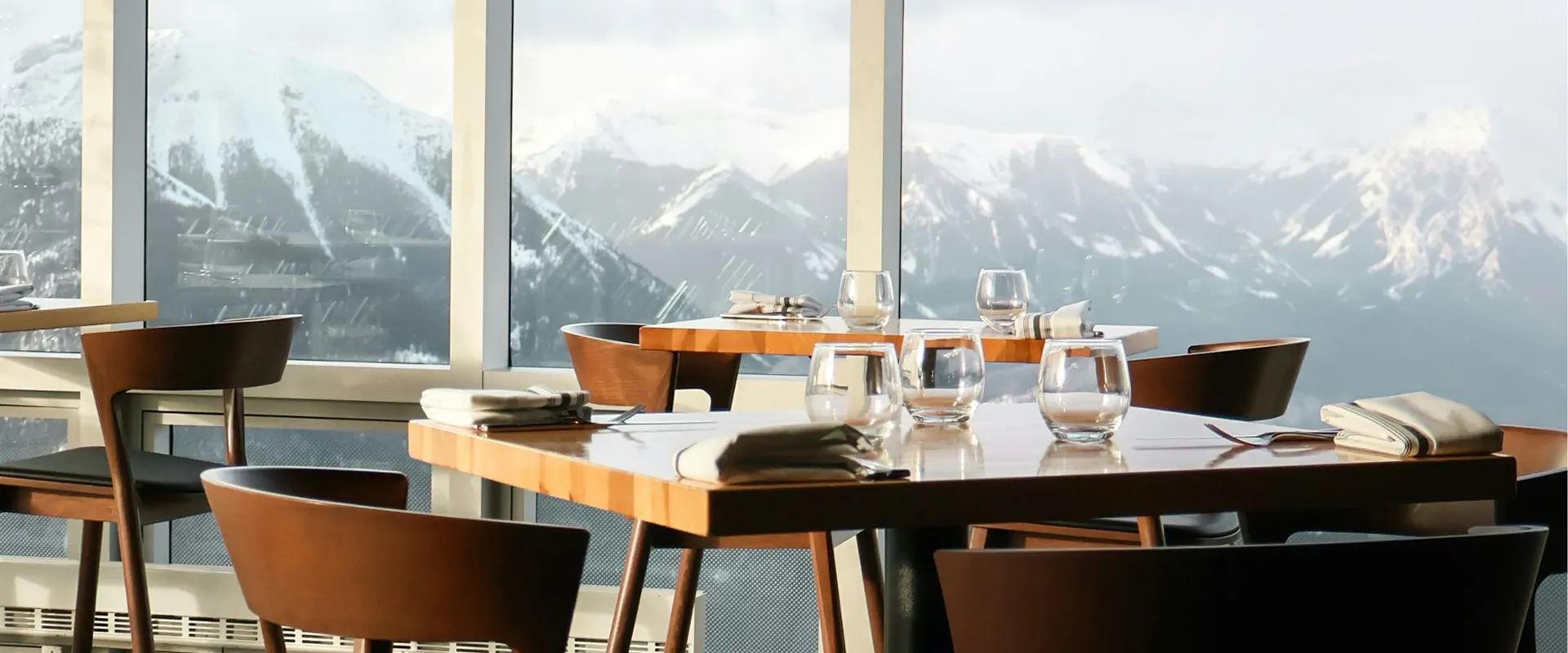
Finding a good mountain restaurant can make or break your lunch stop. Turn up at the wrong place and you'll queue for a self-service tray in a crowded canteen; find the right one and you'll sit down to homemade pasta with views that rival anything you'll ski past all day. The difference often comes down to a few practical choices - when you go, how you search, and what you look for on a piste map. This guide covers the tactics that experienced skiers use to eat well on the mountain, every day of the holiday. For background on what mountain restaurants are and how they work, our guide to what a mountain restaurant is covers the basics. And if you want specific recommendations, our list of the best mountain restaurants in the Alps is a good place to start.
Every ski resort provides a piste map, and almost all of them mark mountain restaurants with a knife-and-fork symbol. The problem is that these maps treat every restaurant the same - a Michelin-quality rifugio gets the same symbol as a basic self-service canteen. Learning to read between the lines takes a little practice.
Start by noticing location. Restaurants clustered at lift stations tend to be high-traffic, self-service operations designed for volume. Restaurants marked slightly away from the main pistes - on a side run or a linking path - are more likely to be smaller, independently run, and focused on quality. The best mountain restaurants are often a short detour from the busiest routes, which is what keeps them from becoming overcrowded.
Some resorts now produce dining guides alongside their piste maps, with photos, menus, and reservation details for each restaurant. These are usually available at the tourist office or on the resort's website, and they're worth picking up on your first morning.
Ski instructors eat on the mountain every working day for months at a time. They know which restaurants serve the best food, which have the sunniest terraces, and which ones to avoid on a Saturday. A good instructor recommendation is worth more than any guidebook, because it's based on repeat visits rather than a single review.
If you're in group lessons, ask at the end of a session rather than during skiing. Most instructors are happy to share their favourite spots. Hotel and chalet staff are another good source - particularly hosts who've worked in the resort for multiple seasons. The best recommendations tend to come from people who eat on the mountain regularly, not from marketing materials.
The single biggest factor in how much you enjoy your mountain lunch is when you sit down. The peak rush at most mountain restaurants runs from about 12:15pm to 1:15pm, and during busy weeks (Christmas, half term, Easter) the queue for food and the competition for terrace seats can be considerable.
Experienced skiers use one of two approaches: eat early (around 11:15am to 11:45am) before the rush arrives, or eat late (from 1:15pm onwards) after it passes. Both work well. The early approach has the advantage of securing the best terrace seats while the sun is still strong; the late approach means quieter restaurants and often faster service.
A mid-morning stop for coffee and cake around 10am, followed by a late lunch at 1:30pm, is a rhythm many experienced skiers swear by. It means you're skiing the best snow conditions in the morning and eating when the restaurants are calmest.
Rather than skiing first and looking for lunch when you're already hungry, decide where you want to eat and build your morning skiing around getting there. This small shift in planning changes the experience entirely. Instead of ending up at whatever restaurant is nearest when your energy drops, you arrive at a specific spot you've chosen or been recommended.
In larger ski areas like the Trois Vallees, the Espace Killy, or the Dolomiti Superski, the best restaurants might be in a different valley or sector from where you start the day. Working out the lift connections in advance - and allowing time for the journey - ensures you don't rush the approach or arrive too late for a table. A quick look at the piste map the night before, with a restaurant circled, is all it takes.
Not all mountain restaurants serve the same purpose. Self-service restaurants at lift stations are designed for speed and volume - useful for a quick refuel, less so for a relaxing lunch. Table-service restaurants are where you'll find cooked-to-order food, proper wine lists, and a calmer atmosphere. Mountain huts (rifugios, refuges, Hutten) are often the most characterful option - smaller, family-run, and tucked away from the main runs.
Understanding what you want before you sit down saves time and disappointment. If you're looking for a quick bite to keep skiing, a self-service stop near a lift station is the right call. If you want an hour-long lunch with a view, a table-service restaurant or a mountain hut will serve you much better. The piste map symbols don't usually distinguish between these types, which is why local recommendations and dining guides are so useful.
Most mountain restaurants work on a walk-in basis, but the best ones - especially at popular resorts during peak weeks - can fill up entirely by noon. This is particularly true for table-service restaurants in resorts like Zermatt, Alta Badia, and Val d'Isere, where a handful of well-known spots draw visitors from across the ski area.
Making a reservation is straightforward: many mountain restaurants have phone numbers listed on the resort's dining guide or website, and an increasing number now appear on booking apps. A call the evening before is usually enough. If you can't book, arriving before the rush (see section 3) is the best backup plan.
It's also worth knowing that some restaurants take bookings for terrace tables separately from indoor seating. On a sunny day, a terrace reservation is worth its weight in gold - and on a cloudy day, the indoor tables that nobody wanted suddenly become the most comfortable spot on the mountain.
Most ski resorts now have official apps that include restaurant locations, opening hours, and sometimes menus and photos. These are useful for getting your bearings, though the quality of the information varies. Some apps include user reviews; others just list names and locations without any context about quality or style.
Interactive piste maps - available on resort websites and apps - are more useful than printed maps for locating restaurants, because you can zoom in to see exactly where a restaurant sits relative to the runs and lifts around it. This is especially helpful in larger ski areas where a restaurant might be marked on the map but hard to find on the ground.
Social media can be a useful tool for mountain restaurant research. Searching for a resort name plus 'mountain restaurant' or 'mountain lunch' on platforms like Instagram often surfaces photos and recent reviews that give you a much better sense of what to expect than an official listing.
Look for the knife-and-fork symbol, which is used almost universally across European ski resorts. Pay attention to where the symbol sits relative to the runs and lifts - restaurants away from major lift stations are generally quieter and more interesting. Many resorts also produce separate dining guides with photos, menus, and phone numbers for each restaurant.
In Austrian and German-speaking resorts, sharing tables is completely normal and expected when a restaurant is busy. A polite 'Ist hier noch frei?' (Is this seat free?) is all you need. In French and Italian resorts, it's less common at table-service restaurants, but still standard at self-service spots and on shared sun terraces.
Larger mountain restaurants, especially in France and Switzerland, are increasingly accommodating dietary requirements - vegetarian, gluten-free, and dairy-free options are becoming more common. Smaller mountain huts may have a more limited menu. If you have specific requirements, checking a restaurant's menu online in advance or calling ahead is the most reliable approach.
At most mountain restaurants, having just a drink is completely fine - especially at umbrella bars, terrace stops, and self-service counters. Some table-service restaurants may prefer that you order food if you're taking up a table during peak lunch hours, but this is rarely enforced. A coffee or a glass of wine on a sunny terrace is one of the best mid-morning breaks a ski day has to give.
The most reliable source is a personal recommendation from someone who eats on that mountain regularly - an instructor, a chalet host, or a regular visitor. Resort dining guides, app reviews, and social media posts can help too, though they vary in reliability. As a general rule, restaurants that are slightly away from the busiest pistes, independently run, and consistently busy with locals rather than tourists are worth seeking out.
Got a clearer picture of what you're looking for? WeSki’s AI trip planner can match you to resorts where mountain dining is a standout feature - tell it your priorities and get a shortlist in seconds.



WeSki is a trading name operated by WeTrip Ltd. All the flights and flight-inclusive holidays on this website are financially protected by the ATOL scheme. When you pay you will be supplied with an ATOL Certificate. Please ask for it and check to ensure that everything you booked (flights, hotels and other services) is listed on it. Please see our booking conditions for further information or for more information about financial protection and the ATOL Certificate go to: www.caa.co.uk.
Package holidays that do not include travel by air are financially protected via ABTOT.
For the latest travel advice from the Foreign & Commonwealth Office visit www.gov.uk/foreign-travel-advice.