EN
EN
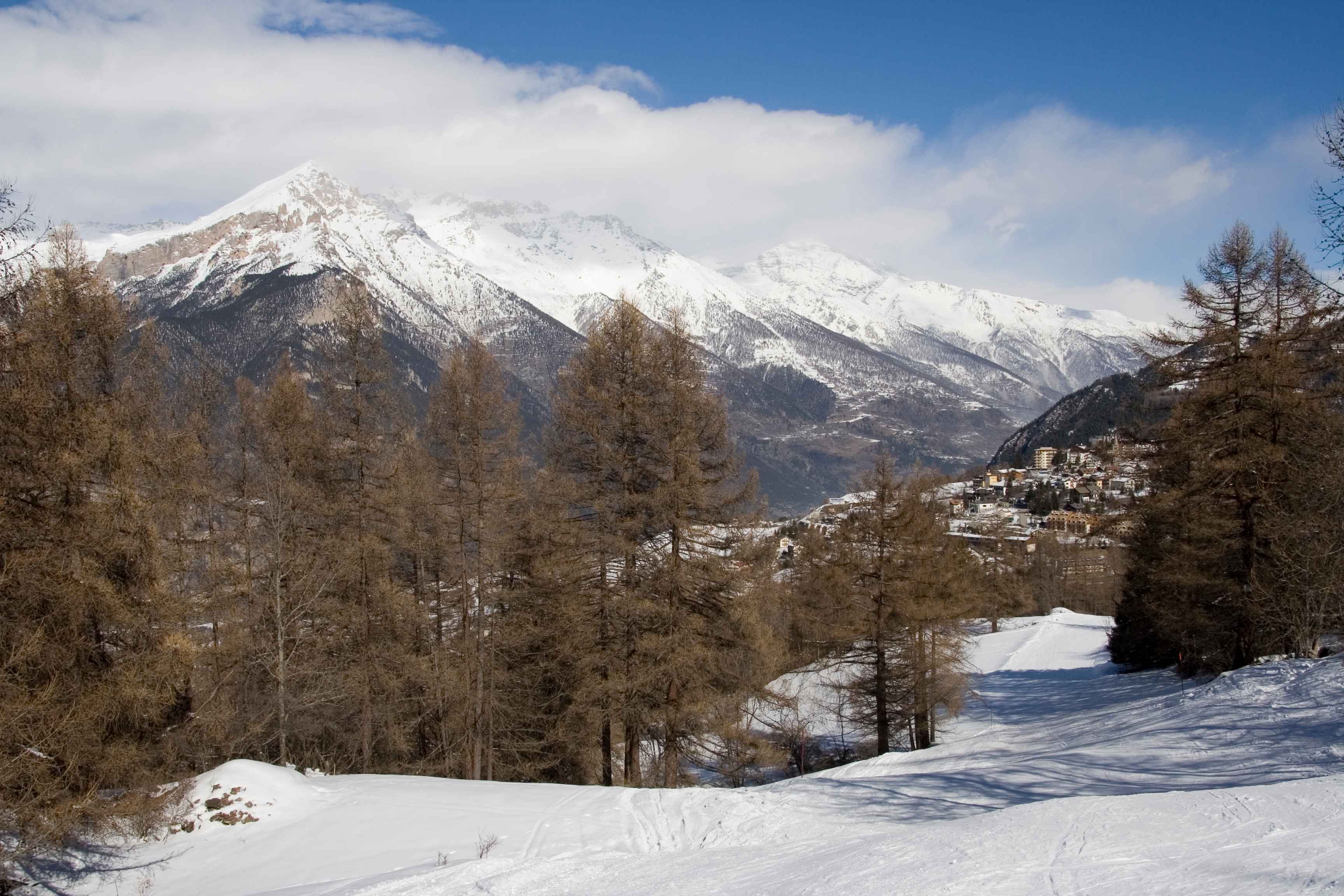
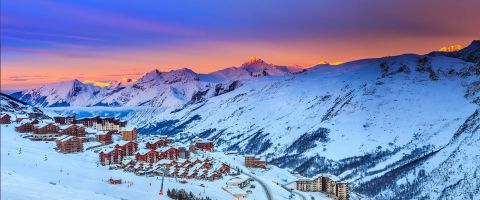
Montgenèvre and Sauze d'Oulx sit at opposite ends of the Milky Way, the cross-border area the Italians call the Via Lattea. Montgenèvre is the French village at the western end, on a col at 1,860 m. Sauze d'Oulx is the Italian one at the eastern end, on a shelf above the Susa valley at 1,509 m. Both are sold on the same 400 km headline, and that number is where most comparisons stop being useful - because the standard pass you buy in one of them does not cover the other. This guide compares them on terrain, snow, villages, après, families, experts and transfers, and it starts with the pass, because that is the part a week in the wrong village turns into a problem.
Choose Montgenèvre for: the highest village base in the area by 350 m, nursery ground at village level rather than up a lift, skiing on two aspects either side of the col so there is usually a sheltered side and a sunny one, and a pedestrianised centre that makes life simpler for first-timers and families.
Choose Sauze d'Oulx for: long red runs through larch forest that come back to the village door, direct access over Monte Fraiteve to the whole Italian side on the standard pass, the shortest transfer from Turin in the area, and the liveliest and least expensive evenings in the Via Lattea - which is why it suits groups.


| Feature | Montgenèvre | Sauze d'Oulx |
|---|---|---|
| Country | France | Italy |
| Shared ski area | Milky Way (Via Lattea) - around 400 km across eight linked villages | Milky Way (Via Lattea) - around 400 km across eight linked villages |
| Local pistes | Around 90 km on the resort's own lifts | Around 110 km on the resort's own lifts |
| Village altitude | 1,860 m | 1,509 m |
| Highest lift | Around 2,630 m (Le Chalvet) | 2,701 m (Monte Fraiteve) |
| Slope aspect | Both sides of the col - north-facing Gondrans, sunny Chalvet | Mainly sunny, much of it in larch forest |
| Lift pass | Montgenèvre-only, Monts de la Lune (adds Claviere and Cesana), or Via Lattea International for the full area | Standard Via Lattea covers the Italian side; six days or more adds one Montgenèvre day |
| Season | Roughly early December to mid-April | Roughly early December to mid-April |
| Best for | Beginners, families, snow at village level | Intermediate mileage, tree skiing, evenings |
| Village character | High border village with a pedestrian centre | Cobbled old town above a modern bar quarter |
| Nearest airport | Turin (~1 hr 30 min); Grenoble (~2 hr 15 min) | Turin (~1 hr 15 min); Milan Malpensa (~2 hr 30 min) |
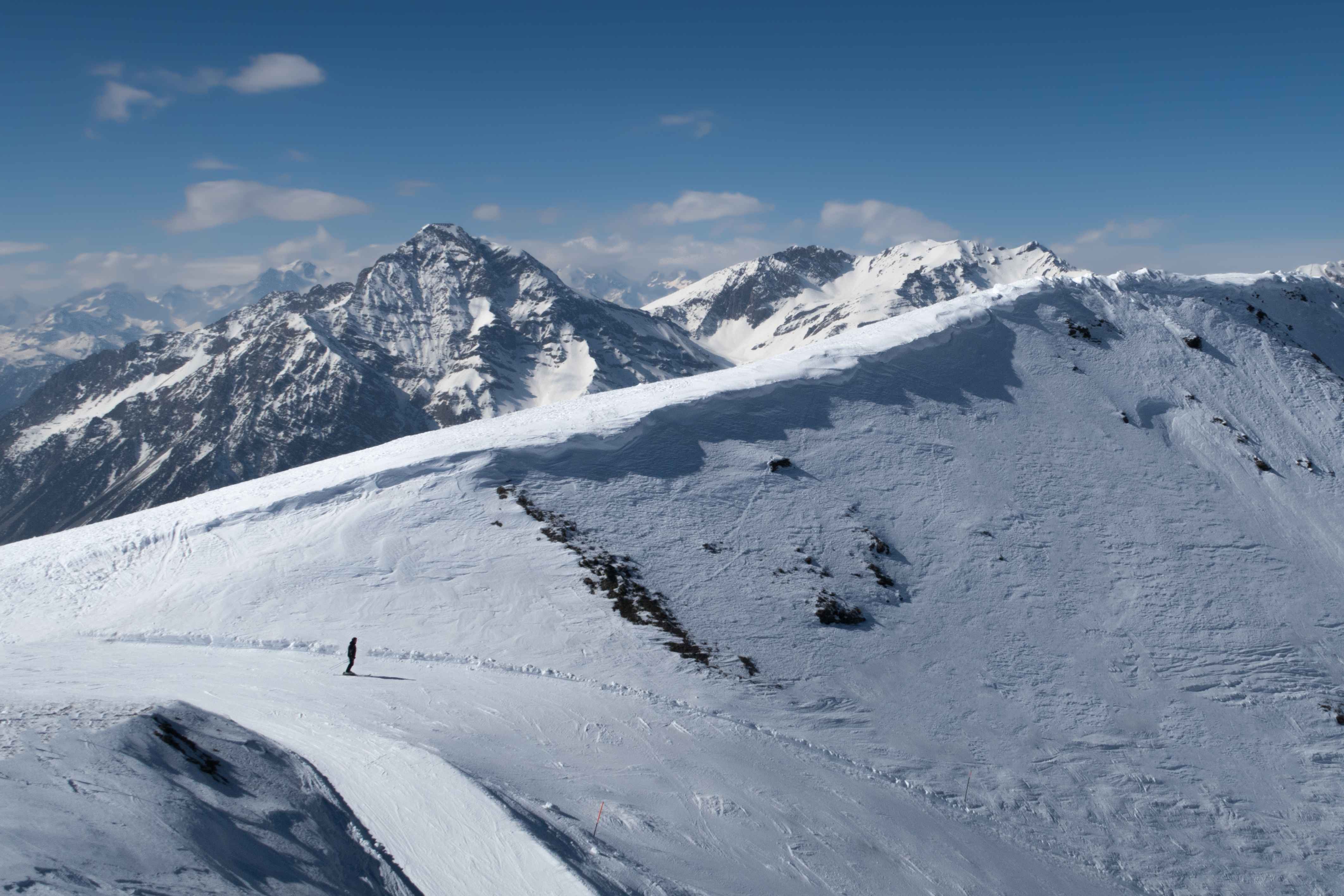
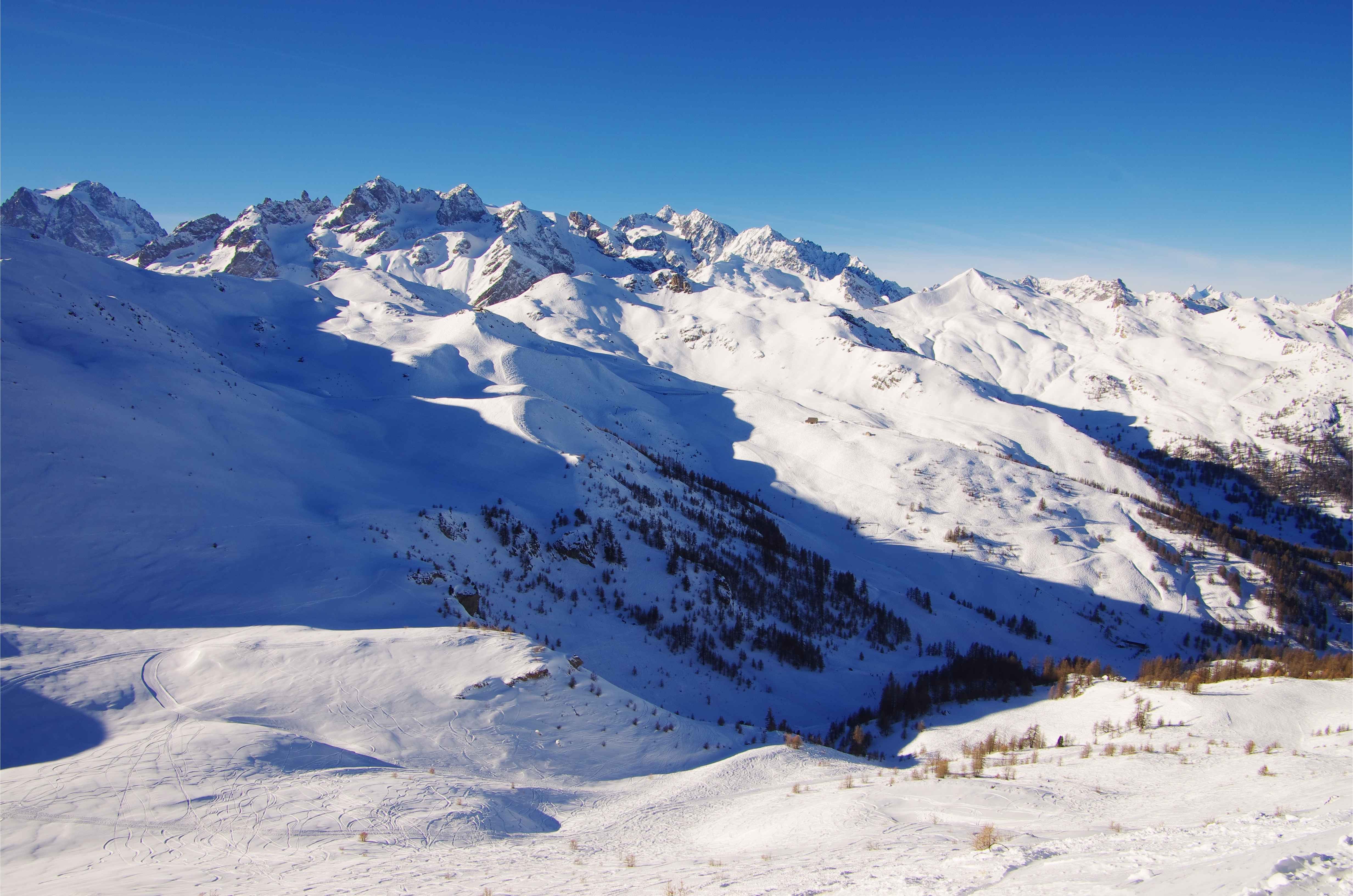
Montgenèvre skis both sides of its col, which is unusual for a village this size and is what makes it work in changeable weather. North of the road, Les Gondrans holds the nursery ground, the terrain park and a run of greens that come down from the top of the sector all the way to the village. South of it, Le Chalvet catches the afternoon sun, with the long Phare blue and a set of blacks that most confident intermediates handle without much drama. Everything returns to the same place. Sauze d'Oulx is laid out differently: the working hub is Sportinia, a wooded plateau at 2,137 m, and the resort's character is in the reds that drop from it through larch forest to the village, the Gran Pista down to Jouvenceaux being the one people remember. Above Sportinia, Monte Fraiteve at 2,701 m is the junction where the rest of the Italian side opens up towards Sansicario and Sestriere. Grading runs soft on both sides of the border, and softest in Sauze, where a black often skis like a red elsewhere.
Who it suits: for a compact area where every run comes home, Montgenèvre; for tree-lined mileage and a gateway to the rest of the Italian sector, Sauze d'Oulx.
Both resorts are marketed on the same 400 km, and neither standard pass gives you all of it. From Sauze d'Oulx, the pass almost every package includes is the plain Via Lattea, and it covers the Italian side: Sauze, Sestriere, Sansicario, Cesana, Claviere, Oulx and Pragelato. France is not on it. What is on it, if you buy six consecutive days or more, is a single day in Montgenèvre and a single day in Bardonecchia, both loaded onto the chip with nothing to claim. Buy five days and you lose both. From Montgenèvre the tickets run the other way: a Montgenèvre-only pass for the local sectors, the Monts de la Lune pass reaching across to Claviere and Cesana, and Via Lattea International for everything. That last one is the only ticket either village sells that covers the whole area every day. Work out which half you actually intend to ski before you book, because it is easier to change your village than your pass.
Who it suits: for a week of Italian mileage on one ordinary ticket, Sauze d'Oulx; for France with Italy as an occasional extra, Montgenèvre.
Altitude settles more of this than usual, because the gap is wide. Montgenèvre's village sits at 1,860 m on an open col that takes weather from several directions, and roughly half its pistes carry snowmaking, so the runs to the door hold up well into spring. Having terrain on two aspects helps as much as the height does: when the Chalvet side has gone heavy in the sun there is still a firmer surface over on Gondrans. Sauze d'Oulx starts 350 m lower and has the lowest base in the area, which shows at both ends of the season - the bowl above the village goes through a freeze-and-thaw cycle that leaves it hard first thing, and the final stretch home is the first thing to go thin in a warm spell. Its defence is the forest. The larch woods above the village shelter the snow and give you something to look at when the cloud comes down, which is worth more in a storm week than 300 m of altitude.
Who it suits: for late season, or a lean winter, Montgenèvre is the safer booking; for visibility while it is snowing, Sauze d'Oulx's trees are the better place to be.
Montgenèvre is a border village that predates the skiing, strung along the road at the top of the col, with a pedestrianised core and a good deal of rebuilding behind it over the last twenty years. Most of what you can book sits on or beside the snow, so ski-in access is normal rather than a premium, and the stock runs to apartment residences and hotels with a spa attached. Evenings are quiet and it does not pretend otherwise. Sauze d'Oulx has two halves that barely resemble each other. Up the hill is a cobbled old town of narrow lanes and stone houses; below it, nearer the lifts, is the modern quarter where the bars and much of the accommodation sit. Apartments are plentiful and a week there costs less than almost anywhere comparable in the Alps, though reaching the lifts from a good deal of the village means a short walk or the shuttle bus rather than stepping onto a piste.
Who it suits: for a quiet week with the snow at the door, Montgenèvre; for streets worth wandering and somewhere open when you get back, Sauze d'Oulx.
Sauze d'Oulx has the louder half of this pairing by a distance, and the cheaper half too. The reputation it earned in the 1980s has softened a great deal, but the bar quarter still runs live music most nights of the week, and Paddy McGinty's, the Cotton Club, the Derby and Moncrons will each be busy from the moment the lifts stop. Mountain eating is Italian and unhurried, with the cluster at Sportinia doing the bulk of it. Montgenèvre keeps a handful of bars around the front de neige and closes early by comparison. What it has instead is a kitchen that sits on a border: French cooking in the village, Italian influence running through it, and mountain restaurants on the Gondrans side worth planning a lunch around rather than eating at whichever one you reach at one o'clock.
Who it suits: for evenings that run late without costing much, Sauze d'Oulx; for a long lunch and an early night, Montgenèvre.
This is the clearest split on the page, and it comes down to where the easy ground sits. Montgenèvre keeps its learning area at village level, a wide front de neige served by magic carpets and a free lift, with green runs from the top of Gondrans that return to the same spot, so a first-timer skis from the door on day one and finishes where everyone else does. The hybrid lift out of Les Chalmettes means novices can reach the higher sectors without facing a drag. Away from the snow there is an ice rink, a sledging area and a cinema in a centre you can cross without meeting a road. Sauze d'Oulx has a good learning area, but it is at Sportinia, more than 600 m above the village, which means a lift or the bus up with children and kit every morning. The slope at village level is steeper than it looks and takes the traffic of everyone skiing home, so it tends to carry the thinnest snow in the resort.
Who it suits: for a first week or young children, Montgenèvre; Sauze d'Oulx suits families whose children already ski blues without thinking about it.
Neither village is built around steep pistes, so the question is what each gives you off them. Montgenèvre's case rests on open ground close to the lifts and very little competition for it - the Gondrans bowl, the terrain under Rocher de l'Aigle and the approaches to the Col de l'Alpet hold their lines longer than the altitude suggests, and all of it wants a guide and a look at the bulletin first. Its marked blacks are mild. Sauze d'Oulx answers with trees. Powder stays untracked in the larch woods for days after a storm because the traffic thins out fast away from the main runs, and the Rio Nero itinerary is the one locals point at. For steep pistes, both rely on the same answer: the Sestriere sector over Fraiteve, where Motta, Sises and Banchetta carry the pitch that neither home mountain has.
Who it suits: for quiet lift-served off-piste above the treeline, Montgenèvre; for tree skiing after fresh snow, Sauze d'Oulx.
Turin is the gateway for both, and it is close by Alpine standards: around an hour and a quarter to Sauze d'Oulx, around an hour and a half to Montgenèvre. Milan Malpensa adds roughly an hour to either. Being in France, Montgenèvre also opens up Grenoble at about two and a quarter hours and Lyon at around three, neither of which does anything for a trip to Sauze. The option worth knowing applies to both: Oulx has a mainline station on the Paris to Turin route, about fifteen minutes below Sauze d'Oulx and around thirty-five from Montgenèvre, which makes this one of the easier corners of the Alps to reach without flying at all.
Who it suits: Turin and the train work for both; Grenoble and Lyon only open up if you are heading for Montgenèvre.
WeSki insider tip: if you are staying in Sauze d'Oulx and want to use your free Montgenèvre day, take the road rather than the pistes. Skiing across is around two and a half hours each way over Fraiteve, Cesana and Claviere, on a chain of lifts that includes sections running downhill, so a ski crossing spends most of the day travelling. It is about half an hour by road. One thing to watch either way: your French day activates the moment you ride the first lift above Claviere, so it is easy to spend it by accident on an afternoon that was only meant to be a look around.
These two share a ski area but not a ticket, so unlike most pairings the pass is part of the decision rather than a detail underneath it. Three questions tend to settle it.
Is anyone in the group learning? Montgenèvre, without much argument. Its nursery ground is at village level with easy runs that come back to it, so a first week involves no lift before the lesson and none after it. Sauze d'Oulx teaches just as well at Sportinia, but the journey up and down is a piece of admin on every day of the holiday.
Which pass are you actually going to buy? If the appeal is a week of mileage on one ordinary ticket, that points to Sauze d'Oulx and the Italian side, with France as a day out. If you would rather ski France and treat Italy as an occasional extra, Montgenèvre on the Monts de la Lune pass is the cheaper shape of the same week.
How late do you want the evening to run? Sauze d'Oulx has the bars, the live music and the smaller bill at the end of it. Montgenèvre has a quiet village and an early start. Once the first two questions come out level, this is the one that decides it.
Yes, the lifts connect the whole way, but treat it as a day out rather than a morning's outing. The route runs over Monte Fraiteve, down through Cesana and Claviere and up into France, and it takes around two and a half hours each way, partly on lifts that carry you downhill rather than up. You need to be comfortable on reds and you need to start early, because missing the last connection home leaves you on the wrong side of a border with a taxi fare to settle. Most people who make the trip go by road instead.
Only partly, and this catches a lot of people out. The standard Via Lattea pass sold in Sauze covers the Italian side of the area - Sauze, Sestriere, Sansicario, Cesana, Claviere, Oulx and Pragelato - and not France. If you buy six consecutive days or more, one day in Montgenèvre is added to the chip, along with a day in Bardonecchia. For more than that you need the Via Lattea International pass, which covers Montgenèvre every day for a supplement. It is worth checking which pass your package includes before you travel.
Montgenèvre, fairly clearly, and it is about geography rather than teaching. Its learning area is at village level on wide, gentle ground, served by magic carpets and a free lift, with green runs from higher up that finish in the same place. Sauze d'Oulx has a good beginner plateau at Sportinia, but it sits more than 600 m above the village, so a first week means riding up and down each day. Both have English-speaking ski schools, so the difference is in how the mountain is laid out.
Montgenèvre holds snow better at village level, and the reason is straightforward: its base sits at 1,860 m against 1,509 m, roughly half its pistes are covered by snowmaking, and it has terrain on two aspects, so there is usually a shaded side worth skiing. Sauze d'Oulx has the lowest base in the area and its home runs feel it first in a warm spell. What Sauze has instead is forest, which shelters the snow it does get and gives you visibility when the cloud is down.
Broadly, yes. Sauze d'Oulx is one of the better-value villages in the Alps for eating and drinking, and its apartment stock keeps the cost of a week down for groups. Montgenèvre skews towards hotels and apartment residences with more facilities attached, and French village prices sit above Italian ones for much the same meal. The lift pass works the other way round depending on what you want: a Montgenèvre-only ticket is a smaller purchase than a full Via Lattea pass, while the International pass that covers everything is the largest of the lot.
Sauze d'Oulx, and it is not close. The bar quarter near the lifts runs live music most nights through the season, and places like Paddy McGinty's and the Cotton Club have been doing it for decades. The wilder reputation it picked up in the 1980s has faded and the crowd is now a mix of Turin second-home owners and British visitors, so it is busy rather than rowdy. Montgenèvre has a few bars near the slopes and a quiet village behind them, which suits a group who would rather ski early than drink late.


WeSki is a trading name operated by WeTrip Ltd. All the flights and flight-inclusive holidays on this website are financially protected by the ATOL scheme. When you pay you will be supplied with an ATOL Certificate. Please ask for it and check to ensure that everything you booked (flights, hotels and other services) is listed on it. Please see our booking conditions for further information or for more information about financial protection and the ATOL Certificate go to: www.caa.co.uk.
Package holidays that do not include travel by air are financially protected via ABTOT.
For the latest travel advice from the Foreign & Commonwealth Office visit www.gov.uk/foreign-travel-advice.