
EN
EN
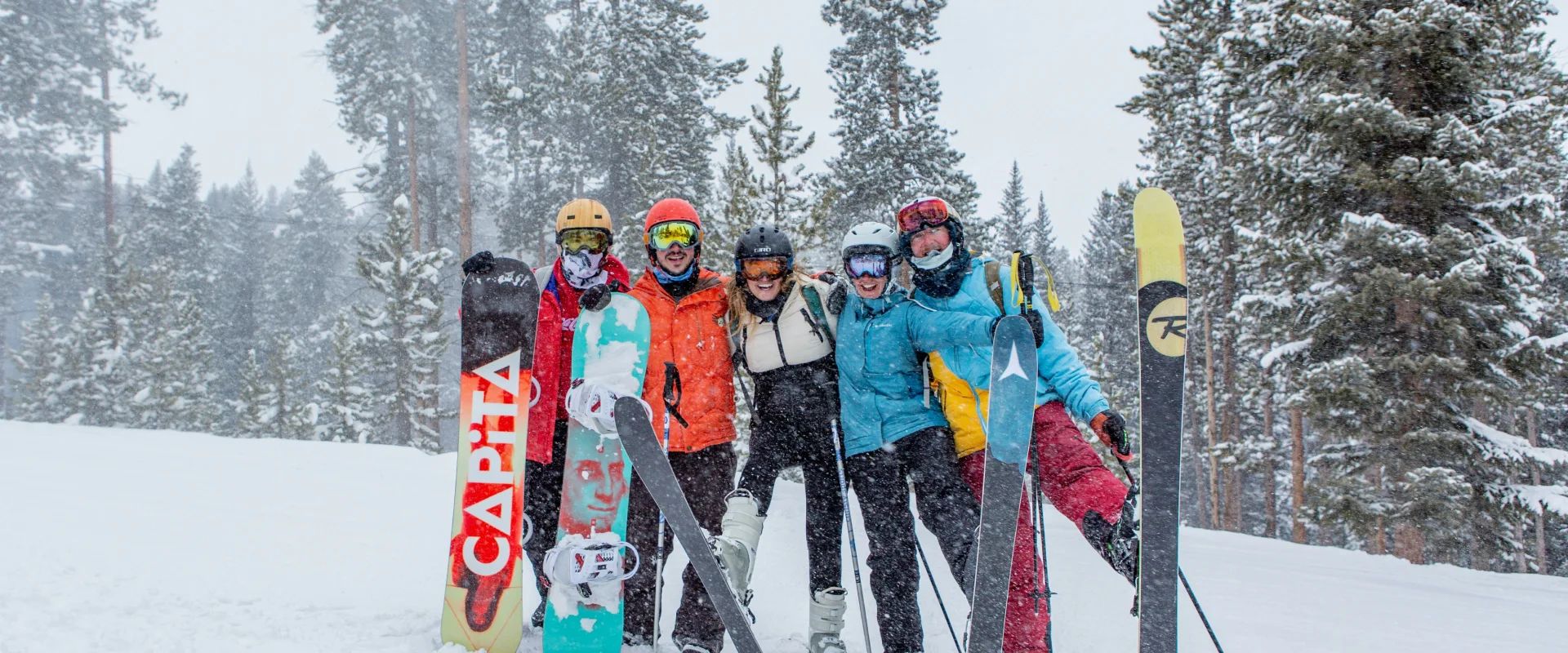
A group ski holiday is, at its simplest, a ski trip with more people than a couple or a family - friends, colleagues, extended family, a stag or hen party, or any combination of people who've decided to spend a week on the mountain together. The appeal is straightforward: shared experiences, split costs, and the kind of memories that get retold for years. But the reality of organising one involves a few more moving parts than a trip for two. This guide covers how group ski holidays actually work, what sizes suit different types of trip, how mixed abilities are handled, and what the experience is like day to day. If you're already committed and want the practical planning steps, our how to organise a group ski holiday guide covers the logistics. And if you're comparing resorts, our best ski resorts for groups list is a useful starting point - or browse our group ski holidays to see what's bookable for your party.
A group ski holiday follows the same basic structure as any ski trip - flights, transfers, accommodation, lift passes, equipment hire, and time on the mountain - but with one key difference: everything is coordinated for a larger number of people. In practice, this means one booking for the group (rather than each person arranging things independently), shared accommodation under one roof or in adjacent properties, and a loose daily structure that gives everyone time together without forcing the whole party to ski in a convoy from nine to four.
Most group ski holidays are booked as packages, which bundle accommodation, lift passes, transfers, and often equipment hire into a single reservation. This matters more for groups than it does for couples or solo travellers, because the logistics multiply with every person you add. Different flight times, incompatible transfer schedules, and mismatched lift passes are common headaches when a group tries to book individually - a package sidesteps all of it.
The typical group ski week runs Saturday to Saturday. Arrival day is for settling in, collecting equipment if it's not already at the accommodation, and getting oriented. Skiing starts on Sunday morning. Most groups fall into a natural rhythm within a day or two: the experienced skiers head off early, the beginners go to ski school, and everyone reconvenes at a mountain restaurant for lunch or back at the chalet for dinner.
Group ski holidays range from half a dozen friends to corporate trips of thirty or more, and the experience changes significantly with the numbers. A group of six to eight is the sweet spot for many people - small enough that everyone can ski together for at least part of the day, large enough to create a proper group atmosphere in the evenings, and manageable in terms of finding accommodation and coordinating logistics.
Groups of ten to sixteen tend to work well in a large catered chalet. This is the classic format for stag and hen parties, birthday celebrations, and close friend groups. The chalet becomes the social hub - shared meals, a communal living space, and the feeling of having your own mountain base for the week. At this size, the group is big enough to split into smaller clusters during the day (beginners go to lessons, advanced skiers explore further afield) while still feeling like a cohesive unit in the evenings.
Larger groups - twenty or more - need more deliberate coordination. Accommodation is usually split across two or more properties, and the group will naturally fragment during the day. The key is building in reliable touchpoints: a set lunch spot, a group dinner on two or three evenings, and one or two planned activities. Trying to keep a group of twenty-five together all day every day is exhausting for everyone, including the organiser.
Mixed ability is the norm for group ski trips, not the exception. In most groups of eight or more, you'll find a spread from complete beginners to confident intermediates, and sometimes an advanced skier or two who've been going for years. The question isn't whether mixed abilities are a problem - they aren't - but how the trip is structured so that everyone has a good time at their own level.
The most common approach is to split during the morning and regroup at lunchtime. Beginners go to ski school, where they'll be with others at the same level and will progress at a steady pace. Intermediate skiers might take a group lesson to sharpen their technique or explore the mountain together. Advanced skiers head off to find the challenging terrain. Everyone meets at a pre-agreed mountain restaurant around midday.
By mid-week, something interesting tends to happen. The beginners, buoyed by three or four days of instruction, are often ready to try an easy blue run with the wider group. This is one of the highlights of a group ski trip - the moment when someone who'd never been on snow five days earlier skis down a real run with their friends cheering them on. It doesn't happen every time, and the pace varies, but when it does it's the kind of moment people talk about long after the holiday.
The accommodation choice shapes the feel of a group ski holiday more than almost any other decision. A ski chalet - particularly a catered one - is the most popular option for groups, and for good reason. You eat together, spend evenings in a shared living space, and have a home base that becomes the centre of the trip. Most catered chalets include breakfast and a multi-course dinner with wine, which means the social side of the trip happens naturally rather than needing to be arranged.
For groups that prefer more independence, self-catered apartments or apart-hotels in the same building can work well. Each sub-group has their own space, but you're close enough to knock on doors and gather in minutes. This suits groups where some people want early nights and others want to stay up, or where dietary needs vary significantly.
Hotels work for groups too, particularly when the party includes people with different standards of comfort. Everyone gets their own room and bathroom, which avoids the sometimes-delicate politics of room allocation in a shared chalet. The trade-off is that you lose the communal living space and the built-in social rhythm of shared meals. For corporate groups and milestone celebrations, a hotel with a private dining room or event space can bridge the gap.
Ask anyone who's been on a group ski trip what they remember most, and the answer is rarely a specific run or a particular day's skiing. It's the evenings. It's the apres ski beers in the sunshine outside a mountain bar. It's the group dinner where someone told a story so funny the table went quiet. It's the last-night toast in the chalet. The skiing is the reason you go, but the social side is often the reason you remember it.
Most group ski holidays settle into a rhythm. Late afternoon, as the lifts close, the group drifts towards a bar - sometimes on the mountain, sometimes in the village. In Austria, this might be an outdoor terrace with live music. In France, it might be a quiet vin chaud stop. Dinner follows, either at the chalet or at a restaurant the organiser has booked for the group. Evenings might involve board games, a trip to a local bar, or simply sitting around the fire in the chalet - and in a group setting, all of these feel different from how they would on a trip for two.
For groups with non-skiers, the daytime options vary by resort. Spas, winter walking trails, snowshoeing, sledging, and village exploring are all common. A good resort for groups is one where non-skiers can fill their days without feeling stranded, and where the whole party can come together comfortably in the evenings.
Group ski holidays suit a wider range of people than you might expect. Friend groups in their twenties and thirties are the classic audience, but extended families, work teams, sports clubs, and milestone celebration parties all make up a significant share of group ski bookings. The common thread isn't a particular demographic - it's a willingness to share the experience rather than have it privately.
That said, group ski holidays aren't for everyone. If you prefer complete flexibility in your schedule, dislike the social dynamics of large gatherings, or want to ski at your own pace without anyone else's timetable to consider, a smaller trip might suit you better. The best group ski holidays have a shared framework and enough flexibility for individuals to do their own thing when they need to. If the organiser understands this balance, most people - including self-described introverts - find the experience more enjoyable than they anticipated.
For first-time skiers, a group trip can be a reassuring way to try the sport. You're surrounded by people you know, the logistics are handled for you, and there's no pressure to progress at a particular pace. Several people in the group will likely be in the same position, which takes the edge off the uncertainty of trying something completely new.
Group trips can be very cost-effective because accommodation costs are shared across more people. A large chalet that sleeps twelve, for example, typically works out to less per person per night than a hotel room for two. Transfers, group lessons, and equipment hire can also be more economical at group rates. The savings depend on the resort and the accommodation, but groups generally get more space and better communal facilities for the same or lower per-person cost.
Injuries on ski holidays are uncommon but not unheard of. Travel insurance with winter sports cover is essential for every member of the group. If someone is injured, ski patrol will provide first aid and transport from the mountain. The rest of the group can continue skiing - the injured person has medical support and the accommodation to recover in. On a group trip, having others around is actually a comfort, since there are people to help with practicalities.
Not at all - most group ski trips include a range of abilities, and that's part of what makes them work. Beginners take lessons while experienced skiers explore the mountain, and the group comes together for lunch and evenings. By mid-week, the improvers are often ready to join the wider group for a few gentle runs. Our how to organise a group ski holiday guide has more detail on managing mixed abilities.
Non-skiers are a natural part of many group ski holidays, and most resorts have plenty to keep them busy during the day. Spas, winter hiking, snowshoeing, sledging, and village exploring are all common options. Choose a resort with a lively village centre so non-skiers have things to do without needing to rely on the rest of the group. In the evenings, everyone comes together regardless of whether they spent the day on the slopes or not.
For peak weeks like Christmas, New Year, and half term, booking six to nine months ahead is advisable - large properties and group-sized chalets sell out early. For quieter weeks in January or March, three to four months is usually enough. The earlier you book, the more choice you'll have on accommodation, and for groups the accommodation is typically the hardest piece to get right.
Thinking about getting a group together? WeSki’s AI trip planner can match your group's size and ability mix to the right resort in seconds


WeSki is a trading name operated by Wetrip Weski Ltd (BR021500). All the flights and flight-inclusive holidays on this website are financially protected by the ATOL scheme. When you pay you will be supplied with an ATOL Certificate. Please ask for it and check to ensure that everything you booked (flights, hotels and other services) is listed on it. Please see our booking conditions for further information or for more information about financial protection and the ATOL Certificate go to: www.caa.co.uk.
Package holidays that do not include travel by air are financially protected via ABTOT.
For the latest travel advice from the Foreign & Commonwealth Office visit www.gov.uk/foreign-travel-advice.