
EN
EN
 Hidden gem
 Top facilities
 Off-slope activitiesHidden gemTop facilitiesOff-slope activitiesHidden gemTop facilitiesOff-slope activitiesHidden gemTop facilitiesOff-slope activities
Winter Park is Colorado's longest-running ski resort, and its roots show. Opened in 1940 as a community ski area served by a train from Denver, it has grown into one of the state's largest ski destinations while keeping a laid-back, locals-first atmosphere that sets it apart from the glitzier resorts along the I-70 corridor. Sitting on the western side of the Continental Divide in the Rocky Mountains, the resort town of Winter Park is refreshingly low-key - more fleece and craft beer than fur coats and champagne. For UK skiers looking for an authentic American mountain experience without the price tag or pretension of Vail or Aspen, Winter Park is a proper find.
The mountain is big. Over 3,000 acres of skiable terrain spread across seven distinct territories, with a summit at 3,676m and a vertical drop of 933m. Winter Park picks up an average of around 8.5 metres of snow each season, keeping conditions reliably good from mid-November well into April. The terrain skews toward experienced skiers - roughly 74% of runs are rated advanced or expert - but the resort's beginner and intermediate areas are well designed and far from an afterthought. Twenty-five lifts, including a gondola and two high-speed six-packs, keep things moving efficiently across the mountain.
The base village has developed steadily over recent years, with a growing collection of restaurants, bars, and shops that make evenings off the mountain enjoyable without being overwhelming. Winter Park's proximity to Denver - just 110km by road, or a scenic Amtrak train ride through the Rockies - makes it one of the easiest major Colorado resorts to reach. It is also one of the few resorts in the US with a dedicated programme for adaptive skiing, a legacy of its community origins that still shapes the resort's welcoming character today. Check out Winter Park ski deals to start planning your trip.
Winter Park is Colorado's longest-running ski resort, and its roots show. Opened in 1940 as a community ski area served by a train from Denver, it has grown into one of the state's largest ski destinations while keeping a laid-back, locals-first atmosphere that sets it apart from the glitzier resorts along the I-70 corridor. Sitting on the western side of the Continental Divide in the Rocky Mountains, the resort town of Winter Park is refreshingly low-key - more fleece and craft beer than fur coats and champagne. For UK skiers looking for an authentic American mountain experience without the price tag or pretension of Vail or Aspen, Winter Park is a proper find.
The mountain is big. Over 3,000 acres of skiable terrain spread across seven distinct territories, with a summit at 3,676m and a vertical drop of 933m. Winter Park picks up an average of around 8.5 metres of snow each season, keeping conditions reliably good from mid-November well into April. The terrain skews toward experienced skiers - roughly 74% of runs are rated advanced or expert - but the resort's beginner and intermediate areas are well designed and far from an afterthought. Twenty-five lifts, including a gondola and two high-speed six-packs, keep things moving efficiently across the mountain.
The base village has developed steadily over recent years, with a growing collection of restaurants, bars, and shops that make evenings off the mountain enjoyable without being overwhelming. Winter Park's proximity to Denver - just 110km by road, or a scenic Amtrak train ride through the Rockies - makes it one of the easiest major Colorado resorts to reach. It is also one of the few resorts in the US with a dedicated programme for adaptive skiing, a legacy of its community origins that still shapes the resort's welcoming character today. Check out Winter Park ski deals to start planning your trip.
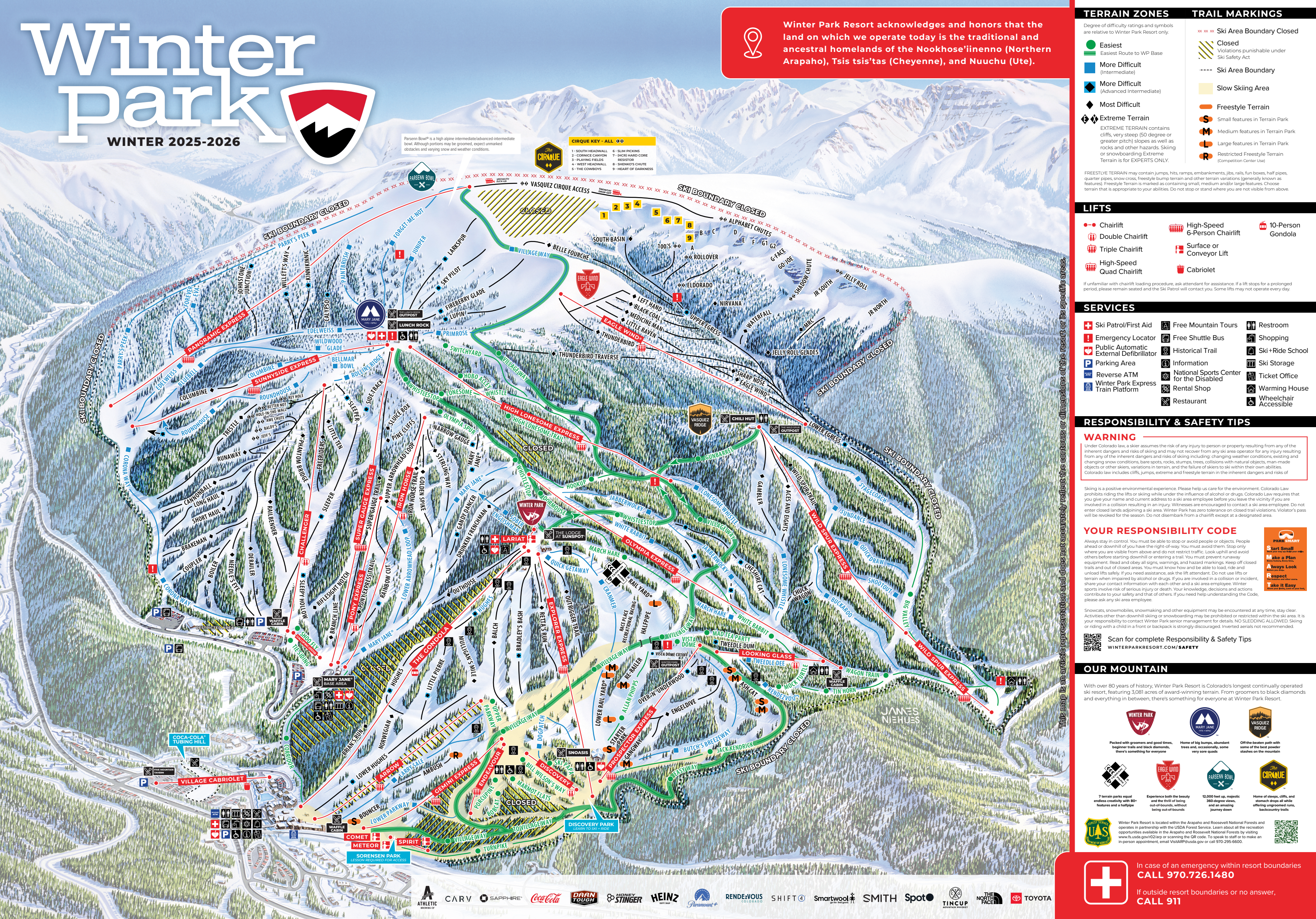
Skiing at Winter Park feels expansive and honest. The mountain sprawls across seven interconnected territories - Winter Park, Mary Jane, Vasquez Ridge, Vasquez Cirque, The Railyard terrain park, Parsenn Bowl, and Eagle Wind - each with its own distinct character, from groomed cruisers to steep mogul fields and above-treeline bowls.
A quick note for UK visitors: North American resorts use a different trail grading system. Green circles are beginner runs (similar to European greens and easy blues). Blue squares cover intermediates but span a wider range than European blues - some can be quite challenging. Black diamonds are advanced terrain, while double black diamonds are expert-only, often featuring steep chutes, moguls, or cliffs. There is no direct equivalent of a European red run, so confident intermediates should be prepared for blue squares that vary significantly in difficulty.
Winter Park's beginner terrain is concentrated around the Discovery Park area at the base, with gentle green-circle runs served by their own lifts away from faster traffic. The progression is well thought out - once you are comfortable on the nursery slopes, a network of mellow green and easy blue runs extends across the lower mountain, giving new skiers room to build confidence without feeling boxed in.
The resort's ski school has a strong reputation, with purpose-built teaching areas and a structured progression programme. Lessons are available for adults and children, and the Discovery Park zone means beginners can spend their first days in a dedicated space before venturing further up the mountain.
WeSki insider tip: Start on the Galloping Goose trail from the top of the Eskimo Express lift - it is one of the longest, smoothest green runs on the mountain and a brilliant way to get your first taste of skiing at altitude.*
Intermediates have a satisfying amount of ground to cover. The Winter Park territory is where most of the groomed blue-square cruisers live - long, rolling runs like Cranmer and Jabberwocky that let you open up and work on technique. Vasquez Ridge, accessed from the main base area, tends to be quieter and is a good spot for intermediates looking to ski at their own pace without crowds.
When you are ready to push yourself, head to Mary Jane. Several of its blue runs have a steeper pitch and more natural terrain features than the main Winter Park side, and the transition from comfortable blues to easier black diamonds here feels natural rather than jarring. Parsenn Bowl, above the treeline, is also within reach for confident intermediates on calmer days - the wide-open terrain and views of the Continental Divide are worth the trip.
WeSki insider tip: The Panoramic Express lift on the Winter Park side serves some of the best intermediate terrain on the mountain, with consistently groomed runs and far fewer people than the base area lifts.*
Mary Jane is the main event for advanced and expert skiers, and it deserves its reputation. The front face is a relentless wall of mogul runs - Drunken Frenchman, Brakeman, and Derailer are classics that demand strong legs and precise line selection. These are not token steep sections; they are sustained, top-to-bottom bump fields that will test anyone.
Beyond Mary Jane, Vasquez Cirque and Eagle Wind open up genuine backcountry-style terrain within the resort boundary - steep chutes, rock features, and ungroomed powder shots that require good conditions and solid ability. Parsenn Bowl provides wide-open above-treeline skiing that holds powder beautifully after storms. With nearly three-quarters of the mountain rated advanced or expert, Winter Park rewards strong skiers in a way that few comparably accessible resorts can match.
WeSki insider tip: After a fresh snowfall, head straight to the Parsenn Bowl or Vasquez Cirque before they get tracked out. The Panoramic Express to Super Gauge Express combination gets you there fastest while everyone else queues at Mary Jane.*
Winter Park is a strong resort for snowboarding, with varied terrain that suits all levels. The natural features across Mary Jane and Vasquez Cirque make for excellent freeride riding, while the wide groomed runs on the Winter Park side are ideal for carving. The Railyard terrain park is one of Colorado's best, with progression-based features from small boxes and rollers up to competition-level jumps and rails.
Winter Park has substantial in-bounds off-piste terrain, particularly through Vasquez Cirque, Eagle Wind, and the trees flanking Mary Jane. Vasquez Cirque delivers proper alpine terrain with chutes and rock bands, while the gladed runs through the trees on Mary Jane hold powder for days after a storm. For those looking beyond the resort boundary, Berthoud Pass - just a short drive south - is one of Colorado's most popular backcountry skiing destinations.
Winter Park's ski and ride school covers all ages and abilities, from first-timers through to expert-level clinics. Group and private lessons are available, and the resort's National Sports Center for the Disabled runs one of the most respected adaptive skiing programmes in the world. English is the primary language, so UK visitors will have no issues with communication.
The Railyard is Winter Park's flagship terrain park and one of the most complete park set-ups in Colorado. It is divided into progression zones: Starter Park for beginners, Railyard Park for intermediate and advanced riders, and a superpipe. Features are well maintained and regularly updated throughout the season, attracting a dedicated park community.
Winter Park has been a family destination since its earliest days, and the infrastructure reflects that. Young children can start in the ski school's dedicated learning area at Discovery Park, where lessons are designed to build confidence through play. There are also childcare facilities at the base for non-skiing little ones, giving parents the freedom to hit the mountain knowing their children are well looked after.
Older children and teenagers have plenty to keep them challenged. The progression from green to blue to black runs across the mountain is gradual enough that improving skiers always have a next step, and The Railyard terrain park gives freestyle-minded teens a serious playground. Off the slopes, tubing at Fraser Tubing Hill is a family favourite, and the resort runs regular events and activities aimed at families throughout the season.
For parents, the base village layout keeps things manageable - restaurants, rental shops, and lift access are all within easy reach, so there is less time spent shuttling between locations and more time actually enjoying the holiday. The resort's relaxed atmosphere means family dining is straightforward, with a good mix of casual eateries and sit-down restaurants that welcome children without feeling exclusively like a kids' destination.
Winter Park and the surrounding Fraser Valley provide a solid range of activities beyond skiing and snowboarding. Whether you are taking a rest day, travelling with non-skiers, or simply want to experience more of the Colorado mountains, there is enough here to fill your time without needing to leave the area.
The surrounding mountains and forests open up plenty of ways to enjoy the snow without strapping on skis:
Rest days and non-skiers are well catered for, with a mix of relaxation, culture, and day-trip options:
Winter Park's dining scene reflects the resort's character - unpretentious, generous, and better than you might expect. From mountain-top lodges to lively downtown spots, there is enough variety to keep a full week interesting. Here are some highlights:
WeSki insider tip: Try the green chilli - it is a Colorado staple you will not find back home. Most breakfast spots serve it smothered over eggs and burritos, and it is the perfect fuel for a cold morning on the mountain.*
Winter Park's après scene is relaxed and social rather than raucous. This is not Ischgl - the vibe is more about a well-earned beer with friends than table-dancing in ski boots. The base village has a cluster of bars that fill up as the lifts close, with a mix of locals and visitors creating a friendly, approachable atmosphere. Live music features regularly, and several spots have outdoor terraces that catch the late-afternoon sun.
As evening rolls in, the action shifts downtown, where a handful of bars and restaurants keep things going at a comfortable pace. It is the kind of resort where you will end up chatting to a local at the bar and getting next-day trail recommendations - that is part of the appeal.
Accommodation in Winter Park is spread between three main areas: the base village at the resort, the town of Winter Park along US Highway 40, and the quieter community of Fraser a few kilometres further west. The base village puts you closest to the lifts, with ski-in/ski-out condos and hotels right at the gondola - convenient but typically at a premium. Downtown Winter Park has a wider range of hotels, lodges, and vacation rentals at varied price points, most within a short shuttle ride of the slopes. Fraser is the most affordable area and still well connected by the free shuttle bus. Condos and self-catering apartments are popular choices for families, while couples may prefer one of the boutique hotels or lodges in the village or downtown area.
Winter Park is part of the Ikon Pass network, which provides access to a collection of ski resorts across North America and beyond. Multi-day lift tickets are also available for those visiting Winter Park specifically. The pass covers all seven territories and all lifts across the resort. Check for family and multi-day pass options when booking your Winter Park ski holiday through WeSki to find the best fit for your trip.
Several rental shops operate in the base village and along the main road in downtown Winter Park. The resort's own rental facility at the base offers a wide range of skis, boots, snowboards, and helmets, with the option to swap equipment during your stay. Booking in advance, especially during peak weeks, is recommended to guarantee your preferred gear and save time on arrival. Independent shops in town often have competitive rates and more personalised fitting.
Getting around Winter Park is straightforward thanks to The Lift, the town's free shuttle bus service. It runs regular routes connecting the resort base, downtown Winter Park, and Fraser throughout the day and into the evening, making it easy to get between accommodation and the slopes without a car. During peak times, buses run frequently. The base village itself is compact and walkable, with the gondola, restaurants, and shops all within easy reach. If you are staying downtown or in Fraser, the shuttle is reliable enough that a car is not essential, though having one gives you flexibility to explore further afield. Taxis and rideshares are available but limited - do not count on them during busy periods.
Winter Park is one of the most accessible major ski resorts in Colorado. Denver International Airport (DEN) is the nearest major airport, approximately 110km to the east. The drive takes around 90 minutes via I-70 and US-40, though the journey over Berthoud Pass can be slow in heavy snowfall. Winter Park is also the only major US ski resort served directly by Amtrak's Winter Park Express train from Denver's Union Station - a scenic, stress-free alternative to driving.
WeSki offers car rentals from the airport as well as private transfers to Winter Park. Add them to your Winter Park ski holiday package for seamless door-to-door travel.
Yes, though it is worth knowing that the majority of terrain is rated advanced or expert. That said, the beginner areas at Discovery Park are purpose-built and well separated from faster traffic, and the ski school has an excellent reputation. Once you have found your feet, there are enough green and easy blue runs to keep you progressing throughout a week-long trip. Beginners will not run out of things to do, but this is a resort where you will be sharing the mountain with some very experienced skiers.
Winter Park tends to be more affordable and less crowded than the I-70 corridor resorts like Vail, Beaver Creek, and Breckenridge. The terrain, especially on Mary Jane, is among the most challenging in Colorado, and the snow record is strong. What you trade is a smaller village scene and less luxury accommodation - but for many UK visitors, the authentic mountain-town atmosphere and excellent skiing more than compensate.
Winter Park averages around 8.5 metres of snowfall per season, which is among the highest in Colorado. Its position on the western side of the Continental Divide means it catches storms that other Front Range resorts miss. The season typically runs from mid-November through late April, with the best and most consistent conditions usually between January and March.
North American resorts use a different grading system from Europe. Green circles are beginner runs, blue squares are intermediate, black diamonds are advanced, and double black diamonds are expert-only. The key thing for UK visitors to know is that there is no equivalent of a European red run - American blue squares cover a wider range, so some will feel closer to a European red. Start on the easier blues and work your way up.
Yes - Winter Park is the only major US ski resort with a direct train service. The Winter Park Express runs from Denver's Union Station on weekends and some holidays during the ski season, arriving right at the resort base. The journey takes around two hours through some spectacular Rocky Mountain scenery. It is a genuinely enjoyable way to travel, especially if you want to avoid driving over Berthoud Pass in winter conditions.
Absolutely. With roughly 74% of terrain rated advanced or expert, Winter Park is one of Colorado's strongest resorts for experienced skiers. Mary Jane's mogul runs are legendary, Vasquez Cirque provides steep alpine terrain, and the gladed runs through the trees hold powder for days after a storm. If you are a strong skier looking for challenging terrain without the crowds of more famous resorts, Winter Park should be high on your list.
The base sits at 2,743m and the summit reaches 3,676m, which is high even by Colorado standards. UK visitors flying in from sea level should take altitude seriously - drink plenty of water, ease into your first day, and consider spending a night in Denver to acclimatise before heading up to the resort. Most people adjust within a day or two, but the effects can include headaches, fatigue, and shortness of breath.
 4.9/5
4.9/5I usually book flights, transfers, hotel, ski rental and lift passes myself but this year used WeSki for a trip to Morzine. It was so much easier. Everything worked perfectly - transfers arrived on time and there was plenty of feedback throughout the whole process giving you confidence the holiday would go smoothly.

A really useful service that is so much easier to use than other 'all-inclusive' sites. It nicely bridges the gap between a travel agent and booking the trip yourself online. I will use WeSki every time I go skiing from now on.
We booked a late minute skiing trip to Morzine through we ski. We looked at booking the trip ourselves but could get anywhere near the price quoted by we ski. The company was excellent and we had no problems at all from start to finish. I would definitely use them to book another weekend skiing trip.
Seamless experience from start to finish. I was spending ages trying to sort out a weekend break and managed to do it with we ski in minutes and for the same price as booking it all up yourself. Flight, transfer and accommodation was all as expected and faultless.

WeSki is a trading name operated by Wetrip Weski Ltd (BR021500). All the flights and flight-inclusive holidays on this website are financially protected by the ATOL scheme. When you pay you will be supplied with an ATOL Certificate. Please ask for it and check to ensure that everything you booked (flights, hotels and other services) is listed on it. Please see our booking conditions for further information or for more information about financial protection and the ATOL Certificate go to: www.caa.co.uk.
Package holidays that do not include travel by air are financially protected via ABTOT.
For the latest travel advice from the Foreign & Commonwealth Office visit www.gov.uk/foreign-travel-advice.