
EN
EN
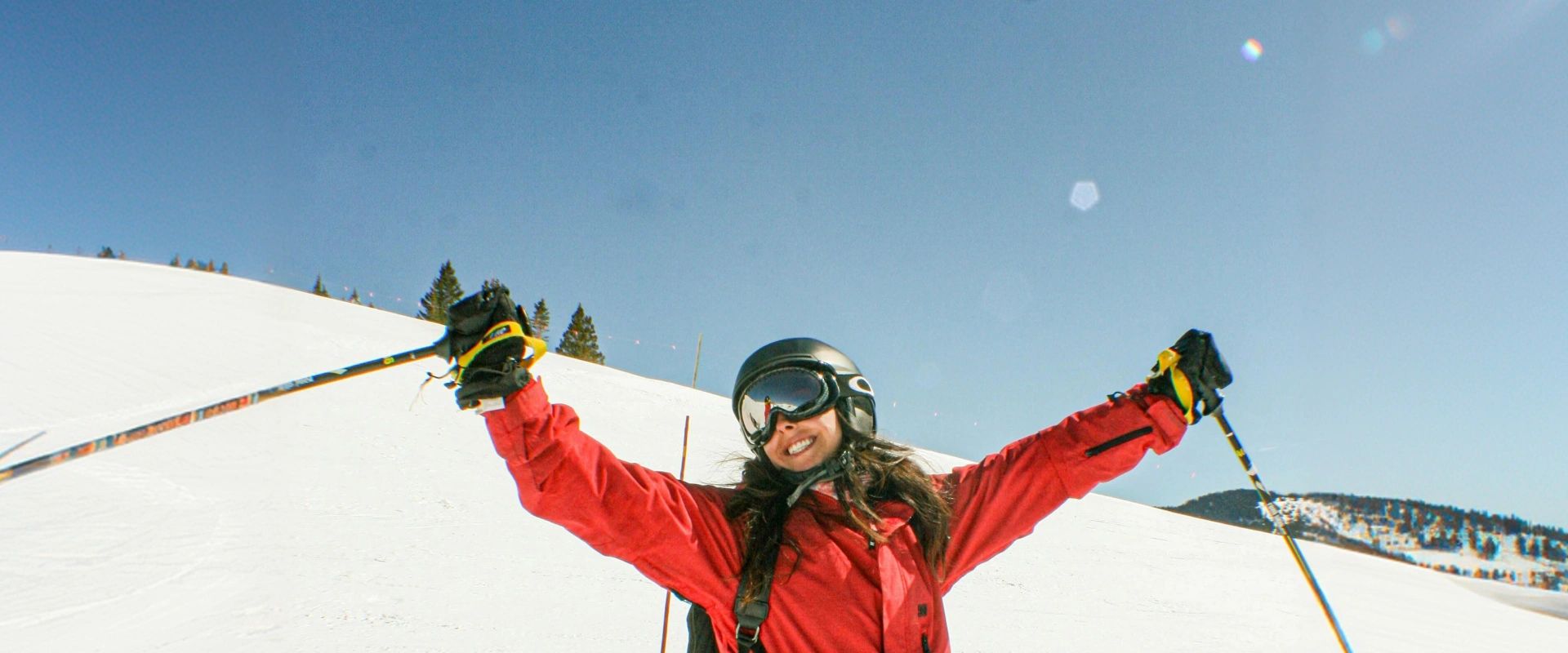
You don’t need to spend a fortune on gear before your first ski trip - but the items you do bring make a real difference to how comfortable and confident you feel on the mountain. This list covers the ten gear categories that matter most for beginners, with a focus on what to look for and what to avoid. Technical equipment like skis and boots gets hired in resort (our complete ski equipment guide explains the full kit list), so this guide concentrates on the clothing and accessories you’ll want to sort before you travel. If you want step-by-step help choosing between hire tiers and working out what to bring versus what to rent, our guide to choosing the right ski equipment covers the practical decisions.
Your ski jacket is the piece of gear you’ll wear every day, and it’s worth getting right from the start. Unlike skis or boots, a jacket doesn’t need to change as your ability improves - a good one works from your first snowplough to your hundredth red run. The main job is keeping wind, rain, and snow out while letting moisture from sweat escape, and the difference between a proper ski jacket and a regular waterproof coat is noticeable from the first chairlift ride.
Look for a waterproof rating of at least 10,000 mm and taped seams. Ski-specific features make a practical difference: a powder skirt stops snow riding up if you fall, wrist gaiters seal the gap between glove and sleeve, and a helmet-compatible hood sits over your helmet without restricting vision. A lift pass pocket on the sleeve lets you tap through the gates without opening your jacket.
✓ Waterproofing and breathability keep you dry from outside and inside.
✓ Ski-specific features (powder skirt, wrist gaiters, pass pocket) are practically useful from day one.
✓ Lasts for years regardless of ability level - a buy-once item.
| Key spec | Waterproof rating 10,000 mm+, taped seams |
|---|---|
| Look for | Powder skirt, wrist gaiters, helmet-compatible hood, lift pass pocket |
| Avoid | Standard waterproof jackets without taped seams or ski-specific features |
| Hire or buy | Buy if budget allows - one of the best long-term investments |
WeSki insider tip: Try the jacket on with a mid-layer underneath and your arms raised above your head. If the hem rides up past your hips, it’s too short - you want coverage that stays in place when you’re moving and reaching.
Ski trousers take more punishment than the jacket. You’ll sit in snow, kneel in slush, and brush against ice - they need to handle all of it without letting moisture through. As with the jacket, waterproofing is the priority: at least 10,000 mm rating and taped seams.
The fit should allow full range of movement - deep knee bends, lunges, and crouching. Salopettes (trousers with a built-in bib) keep snow out more effectively than waist-level trousers, particularly if you’re falling regularly as a beginner. Internal boot gaiters with a hook that clips to the top of your ski boot are essential - they stop snow working its way up from below.
✓ Waterproof and hardwearing enough for regular contact with snow and ice.
✓ Boot gaiters prevent snow entering from below - critical for beginners who fall more often.
✓ Salopette style keeps the waist covered and eliminates the gap between jacket and trousers.
| Key spec | Waterproof rating 10,000 mm+, taped seams, reinforced hems |
|---|---|
| Look for | Boot gaiters with hook, articulated knees, belt loops or adjustable waist |
| Style options | Salopettes (bib) or standard waist - salopettes give better snow protection |
| Hire or buy | Buy if budget allows - another long-lasting item |
WeSki insider tip: Check the inner leg seam reinforcement before you buy. Ski trousers take a beating from boot buckles and ski edges. Reinforced hems and inner leg panels last much longer than single-layer fabric in those areas.
Base layers sit against your skin and their job is managing moisture. When you’re skiing, you generate heat and sweat. A good base layer moves that moisture away from your skin so it can evaporate through the layers above. A bad one (cotton) absorbs the sweat, holds it against your body, and leaves you cold and clammy the moment you stop moving.
Merino wool and synthetic technical fabrics are the two main options. Merino is naturally odour-resistant, soft against the skin, and regulates temperature well across a range of conditions. Synthetic fabrics dry faster and tend to cost less. Both work well for skiing. You’ll want a long-sleeve top and full-length leggings as a minimum - pack two sets for the week so one can dry while you wear the other.
✓ Moisture-wicking fabric keeps you dry and warm all day.
✓ Merino wool is naturally odour-resistant - practical across a week of skiing.
✓ The single most impactful clothing choice for comfort on the mountain.
| Key spec | Moisture-wicking, quick-drying fabric - merino wool or synthetic |
|---|---|
| Weight | Midweight (200-250 g/m²) works for most conditions |
| Avoid | Cotton in any form - t-shirts, vests, leggings |
| Hire or buy | Buy - inexpensive and essential from trip one |
WeSki insider tip: Pack a lightweight merino t-shirt as well as the long-sleeve version. On warmer spring days, swapping the long-sleeve for a short-sleeve base layer under your jacket is enough to avoid overheating without losing the moisture management.
The mid-layer sits between your base layer and your jacket, and its job is trapping warm air close to your body. A fleece, a thin down jacket, or a lightweight synthetic puffer all work. Which one you choose depends partly on conditions and partly on personal preference.
Fleeces are breathable, dry quickly, and keep working even when damp. They’re the most versatile mid-layer option for skiing because they handle the constant cycle of effort and rest - skiing hard, then standing on a chairlift - without leaving you either overheated or cold. A thin synthetic or down puffer provides more warmth for its weight but breathes less, making it better suited to very cold days or for wearing off the slopes.
✓ Provides adjustable warmth between your base layer and jacket.
✓ Fleece is the most versatile option - breathable, quick-drying, and effective when damp.
✓ Having two mid-layer weights gives you flexibility across the week.
| Key spec | Lightweight, breathable, quick-drying insulation |
|---|---|
| Best for skiing | Fleece or grid-fleece - breathable during exertion |
| Best for cold days | Thin synthetic puffer - more warmth per gram |
| Hire or buy | Buy - you likely own something suitable already |
WeSki insider tip: If you only bring one mid-layer, make it a fleece. On colder days you can always add a thin gilet over the fleece for extra core warmth without restricting arm movement - a useful trick that avoids overheating on the way down.
Goggles protect your eyes from UV radiation, wind, snow, and glare - all of which are significantly more intense at altitude than at sea level. Even on overcast days, the reflection off snow amplifies UV exposure, and wind chill on a chairlift can make your eyes stream. Sunglasses work on calm, sunny days off the slopes, but goggles are the right tool for actually skiing.
For a first pair, a single lens in a medium tint (amber, rose, or vermillion) handles the widest range of conditions. These tints enhance contrast in flat light while still being comfortable in sunshine. If you wear prescription glasses, look for OTG (over-the-glasses) goggles that fit comfortably over your frames. Anti-fog coating is standard on most goggles - double-lens construction is the feature that makes the biggest difference to fog resistance.
✓ UV400 protection is essential at altitude - not optional.
✓ A medium-tint lens works across most weather conditions for beginners.
✓ Goggles seal to your face, blocking wind, snow, and peripheral glare that sunglasses miss.
| Key spec | UV400 protection, double-lens construction, anti-fog coating |
|---|---|
| Lens tint | Amber, rose, or vermillion for best all-round visibility |
| Fit check | Should sit flush against your helmet with no gap at the forehead |
| Hire or buy | Buy - relatively inexpensive and personal to your face shape |
WeSki insider tip: Try your goggles on with your helmet before you travel. The goggles should sit flush against the helmet with no gap at the forehead - that gap is where cold air sneaks in and causes fogging. Different helmet and goggle brands fit together differently, so checking the combination in advance avoids a frustrating discovery on the mountain.
Cold hands end a ski day faster than tired legs. Your gloves or mittens are one of the highest-impact purchases for comfort, and getting them right is worth the attention. The two non-negotiable features are insulation and waterproofing - a waterproof membrane (like a Gore-Tex insert) keeps melted snow out, and proper insulation keeps your hands warm in the wind.
The gloves-versus-mittens choice comes down to warmth against dexterity. Mittens keep your fingers together, which means they share body heat and stay warmer in cold conditions. Gloves give you more finger control for zips, buckles, and pole grips. For beginners, mittens are often the better choice - you’re not performing fine motor tasks on the slopes, and warm hands matter more than nimble fingers.
✓ Waterproof membrane keeps melted snow and moisture out all day.
✓ Good insulation is the difference between a full day on the slopes and cutting it short.
✓ Long cuffs that overlap your jacket sleeves seal out wind and snow at the wrist.
| Key spec | Waterproof membrane, insulated, long cuff |
|---|---|
| Warmest option | Mittens - fingers share body heat |
| Most dexterous | Gloves - better for zips and buckles |
| Hire or buy | Buy - fit is personal and you’ll use them every trip |
WeSki insider tip: Bring two pairs. Gloves get wet - from snow, from sweat, from adjusting equipment. A second pair drying on a radiator overnight while you wear the first pair the next morning is a simple backup that makes a significant difference on a cold day.
Ski socks are one of the most underestimated pieces of gear. The instinct is to wear thick, cushioned socks for warmth - but inside a ski boot, thick socks create problems. They bunch up, create pressure points, reduce circulation, and actually make your feet colder rather than warmer. The boot provides the insulation; the sock’s job is moisture management and a smooth interface between your foot and the boot liner.
One pair of thin, moisture-wicking ski socks per day is all you need. Merino wool or a merino-synthetic blend is the standard. The sock should reach just below the knee - no higher, no lower. Higher socks bunch behind the knee; lower socks leave a gap where the boot cuff presses directly on your shin.
✓ Thin socks give a better boot fit and more control than thick alternatives.
✓ Merino wool wicks moisture and resists odour across a full day of skiing.
✓ Knee-height socks prevent the boot cuff rubbing against bare skin.
| Key spec | Thin, moisture-wicking, knee-height |
|---|---|
| Best fabric | Merino wool or merino-synthetic blend |
| Avoid | Thick hiking socks, cotton socks, double-layering |
| Hire or buy | Buy - pack three to four pairs for the week |
WeSki insider tip: Never double up on socks. Two pairs inside a ski boot creates more bulk, more pressure, and less circulation. If your feet are cold, the issue is almost always boot fit, not sock thickness. Go back to the hire shop and ask them to check.
A neck gaiter (sometimes called a buff) is a tube of fabric that sits around your neck and can be pulled up to cover your chin, mouth, and nose in cold or windy conditions. It’s lightweight, packs small, and makes a noticeable difference to comfort on the chairlift and during morning runs when temperatures are lowest.
Merino wool versions are the most comfortable against the skin and regulate temperature well. Synthetic options dry faster if they get damp from breath moisture. A balaclava serves the same purpose but covers the whole head - useful in very cold weather, though a gaiter combined with a helmet is sufficient for most resort skiing.
✓ Blocks wind and cold across your neck, chin, and lower face.
✓ Lightweight and packable - easy to stash in a pocket when conditions warm up.
✓ Merino versions are soft, breathable, and odour-resistant.
| Key spec | Breathable, moisture-wicking, thin enough to sit under a helmet |
|---|---|
| Best fabric | Merino wool for comfort; synthetic for fast drying |
| Versatility | Pull up for cold, push down as a neck warmer, remove entirely on warm days |
| Hire or buy | Buy - inexpensive and useful beyond skiing |
WeSki insider tip: Breathing through a damp gaiter fogs your goggles fast. On very cold days, pull the gaiter up to cover your nose but make sure your exhaled breath vents downwards rather than up into your goggles. Positioning it just below your nostrils rather than over them helps.
UV at altitude is considerably stronger than at sea level, and snow reflects up to 80% of UV radiation back at you - so you’re effectively being hit from above and below. Sunburn on a ski holiday is common, fast, and catches people off guard because the cold air masks the sensation of burning. Factor 30 or higher is the minimum, applied before you leave your accommodation every morning.
Lip balm with SPF protection is equally important. Lips burn easily at altitude and the wind strips moisture from them throughout the day. A small stick of SPF lip balm in your jacket pocket, reapplied every couple of hours, prevents the cracked, painful lips that are almost a rite of passage for first-timers who forget.
✓ SPF 30+ applied every morning is essential at altitude, even on cloudy days.
✓ SPF lip balm prevents painful cracking and sunburn on exposed lips.
✓ Snow reflects up to 80% of UV - protection is needed from above and below.
| Key spec | SPF 30+ broad-spectrum sun cream; SPF lip balm |
|---|---|
| Application | Apply before leaving accommodation - reapply at lunch |
| Common mistake | Skipping sun cream on cloudy days - UV penetrates cloud at altitude |
| Hire or buy | Buy - essential from your first morning on snow |
WeSki insider tip: Apply sun cream to the underside of your nose and chin as well as the obvious areas. Snow reflection means UV hits upward-facing skin that you wouldn’t normally think to protect. The raccoon-eye sunburn pattern (white around the eyes from goggles, red everywhere else) is the classic first-timer look - easy to avoid with thorough application.
A compact backpack (15-25 litres) isn’t essential on your first trip, but it earns its place quickly. Somewhere to carry a water bottle, spare mid-layer, sun cream, snacks, and your phone keeps you self-sufficient on the mountain without relying on jacket pockets for everything.
Ski-specific backpacks have useful features: a padded back panel that sits comfortably with a jacket, a chest strap and waist strap that stop the bag bouncing when you ski, and external straps for carrying a helmet or attaching equipment. For a first trip, any small, comfortable rucksack works - the ski-specific version is worth it once you know you’ll be using it regularly.
✓ Keeps essentials accessible without stuffing every jacket pocket.
✓ Chest and waist straps stop the bag bouncing while you ski.
✓ Any small comfortable rucksack works for a first trip - no need to buy ski-specific.
| Key spec | 15-25 litres, comfortable with a ski jacket |
|---|---|
| Look for | Chest strap, waist strap, hydration-compatible |
| Avoid | Anything over 30 litres - too bulky for resort skiing |
| Hire or buy | Use what you have - a day pack or running backpack is fine for trip one |
WeSki insider tip: If you carry a phone in your backpack, keep it in an inside pocket against your back. Cold temperatures drain phone batteries fast, and your body heat keeps it warmer than an outer pocket would. A portable battery pack is worth stashing in there too if you use your phone for resort maps or tracking apps.
It depends on what you already own. If you have a waterproof jacket and thermal base layers, you may only need goggles, ski socks, and gloves - a modest outlay. If you’re starting from scratch, a ski jacket and trousers represent the biggest investment but they last for years. Prioritise the items closest to your skin (base layers, socks, gloves) and work outward. Skis, boots, poles, and helmet are all hired in resort, so the upfront spend is only on clothing and accessories.
A regular waterproof jacket can work for a first trip, provided it’s properly waterproof (not just shower-resistant) and breathable. You’ll miss the ski-specific features - powder skirt, wrist gaiters, lift pass pocket, helmet-compatible hood - but none of these are safety-critical. If you’re testing whether you enjoy skiing before investing in dedicated gear, a good waterproof is a reasonable starting point.
Any moisture-wicking base layer works - it doesn’t need to be marketed as ski-specific. Running thermals, cycling base layers, or generic merino wool tops all do the job. The critical thing is the fabric: merino or synthetic. Cotton is the one material to avoid entirely, because it absorbs moisture and holds it against your skin, which leaves you cold as soon as you stop moving.
Boots. Everything else can be imperfect and you’ll still have a decent day. Poorly fitting boots affect your control, your comfort, and your learning speed in a way no other piece of equipment does. Since you’ll be hiring boots in resort, the most important thing you can do is take the fitting seriously, wear thin ski socks, and go back to the shop immediately if something doesn’t feel right. Our guide to choosing the right ski equipment covers the fitting process in detail.
Base layers, ski socks, and gloves are worth buying before any trip - they’re relatively inexpensive and make an immediate difference to comfort. A ski jacket and trousers are worth buying if you plan to ski again, since they’ll last for years. Skis and boots should always be hired for your first few trips - your ability and preferences change rapidly, and what suits a beginner won’t suit you once you’re skiing confidently.
Ready to put this into action? Use WeSki’s AI trip planner to find the right resort for you


WeSki is a trading name operated by WeTrip Ltd. All the flights and flight-inclusive holidays on this website are financially protected by the ATOL scheme. When you pay you will be supplied with an ATOL Certificate. Please ask for it and check to ensure that everything you booked (flights, hotels and other services) is listed on it. Please see our booking conditions for further information or for more information about financial protection and the ATOL Certificate go to: www.caa.co.uk.
Package holidays that do not include travel by air are financially protected via ABTOT.
For the latest travel advice from the Foreign & Commonwealth Office visit www.gov.uk/foreign-travel-advice.