
EN
EN
Snow conditions can make or break a ski holiday, particularly if you're travelling early or late in the season. Some resorts hold their cover from November through to April with barely a thin patch in sight, while others depend heavily on the weather cooperating. This guide explains the factors that separate a snow-sure resort from a hopeful one - altitude, aspect, snowmaking infrastructure and glacier access - so you can make a more informed choice when you book. If you're already comparing options, our best snow-sure ski resorts in Europe list narrows the field. And if you want practical steps for building snow reliability into your trip, our guide on how to guarantee good snow on your ski holiday covers the planning side.
In ski industry terms, a resort is considered snow-sure when it can reliably maintain skiable cover throughout the published season - typically December to April in the Alps. That doesn't mean it never has a bad week or that every run is pristine every day. It means the combination of natural snowfall, altitude, aspect and snowmaking gives the resort enough resilience to stay open and enjoyable even in below-average snow years.
There's no official certification or threshold. Tour operators and resort marketing teams use the term loosely, which is why it helps to understand the underlying factors yourself. A resort at 600m with a single snowmaking cannon and a confident marketing department is not the same proposition as one sitting above 2,000m with north-facing slopes and 500 snow guns. The rest of this guide breaks down exactly what to look for.
Worth noting: snow-sure doesn't automatically mean the best skiing. Some lower-altitude resorts with charming villages and excellent ski schools have a brilliant product in a good snow year. The question is how much weather risk you're comfortable with, and whether you're booking during a period when conditions are less predictable.
Altitude matters because temperature drops roughly 6.5 degrees Celsius for every 1,000m of elevation gain. Snow that falls at 2,000m as dry powder might arrive as rain at 800m. For the Alps, the general rule is that resorts with most of their skiing above 1,800m tend to hold snow well throughout the season, while those below 1,200m are increasingly weather-dependent.
Two altitude numbers matter when you're comparing resorts. The first is the village altitude - how high the resort town sits. A high village means you can ski back to your door on natural snow rather than relying on an artificially maintained home run. The second is the top-station altitude, which tells you how high the ski area reaches. A resort with a low village but high upper slopes - like Chamonix, which reaches over 3,800m - can still be very snow-sure at the top, even when the valley is green.
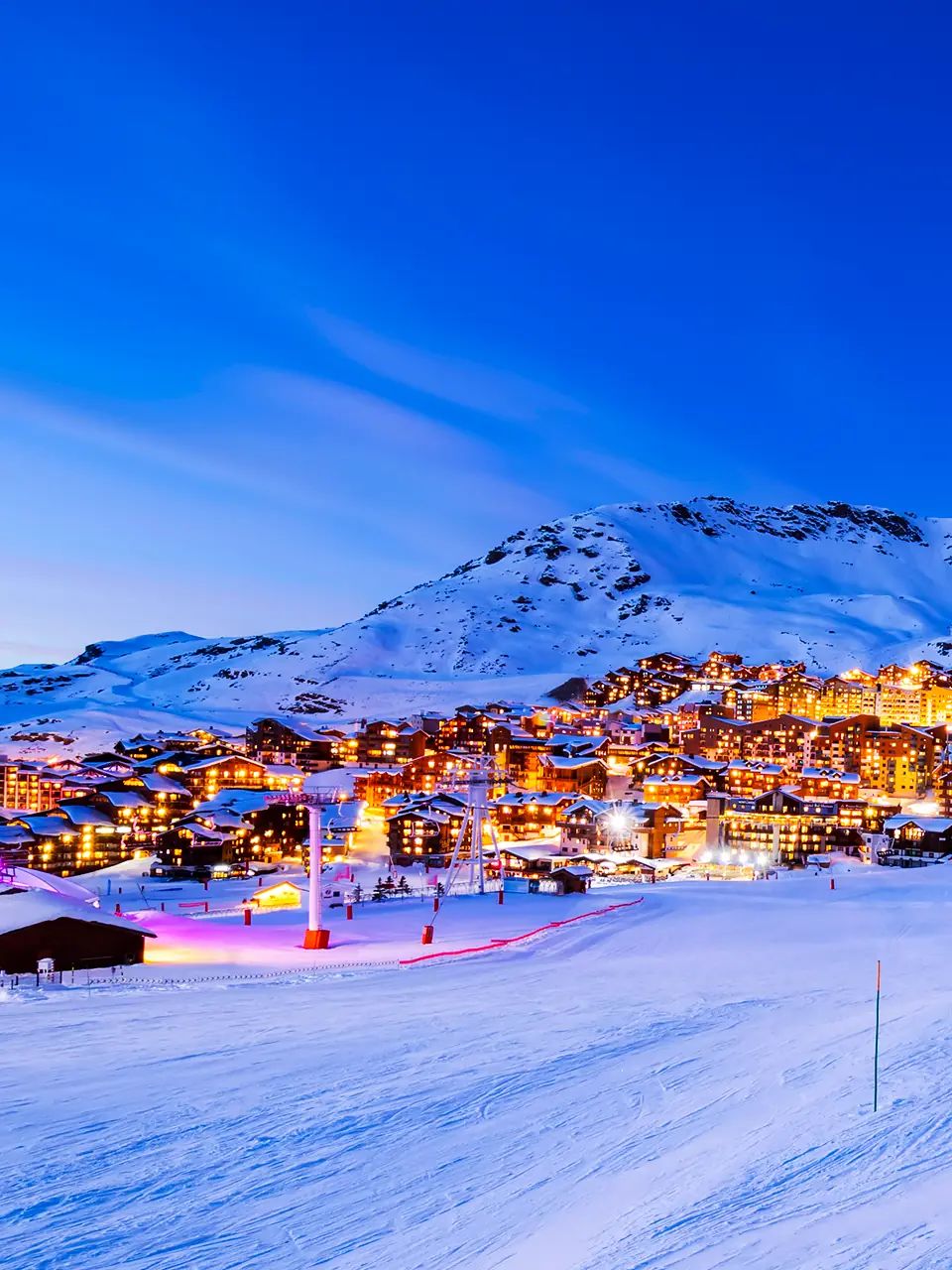
The sweet spot for most skiers is a resort where the village sits above 1,500m and the majority of the ski area is above 2,000m. Resorts like Val Thorens (village at 2,300m), Obergurgl (1,930m) and Cervinia (2,050m) rarely have snow problems during the core season. But altitude alone isn't the full picture - a south-facing slope at 2,500m can thin out faster than a sheltered north-facing one at 1,800m.
Aspect refers to which direction a slope faces, and it has a major impact on how long snow lasts once it's fallen. North-facing slopes receive less direct sunlight, so they hold their cover longer and resist the freeze-thaw cycles that turn good snow into ice. South-facing slopes get more sun, which can be pleasant on a cold morning but tends to soften and thin the snowpack faster, especially later in the season.
This is why you'll sometimes find two resorts at similar altitudes performing quite differently. A resort with predominantly north-facing terrain - like La Rosiere in France or Ischgl in Austria - can maintain excellent conditions well into April. Meanwhile a similar-altitude resort with mostly south-facing slopes may start losing lower runs by March.
Terrain shape plays a supporting role. Resorts set in deep, narrow valleys or surrounded by high ridges tend to be more sheltered from warm winds. Bowls and cirques collect and hold snow efficiently. Open, exposed ridgelines lose snow to wind. None of this is something you'd easily notice from a resort's marketing photos, but a quick look at the piste map orientation gives you a useful steer.
Modern snowmaking has transformed the reliability equation for many resorts. A well-equipped resort can lay down a base layer of machine-made snow before the season even starts, then top it up as needed throughout the winter. The technology has improved dramatically - newer snow guns produce a finer, more natural-feeling snow that skis well and lasts longer than the icy output of older systems.
Coverage is the number to look for. A resort that can make snow on 30% of its pistes has a decent safety net for the main routes back to the village and the busiest intermediate runs. A resort covering 70% or more - which is increasingly common in Austria and the Italian Dolomites - can keep the majority of its ski area in good shape even during a prolonged dry spell. Austrian resorts like Saalbach and the SkiWelt have invested heavily, as have Italian resorts across the Dolomiti Superski network.
There's a practical caveat: snowmaking requires temperatures below around minus two degrees Celsius to work efficiently. A warm, wet spell at lower altitudes can stop the guns just when they're needed most. This is why the combination of altitude plus snowmaking is more reliable than either factor alone. A high-altitude resort with extensive snowmaking is about as close to a guarantee as skiing gets.
Glacier skiing is the ultimate snow insurance. Glaciers hold permanent ice and snow year-round, which means resorts connected to them can keep runs open even when the rest of the Alps is struggling. Glacier-linked resorts are particularly valuable for early-season and late-season skiing, when lower slopes may not yet have - or may have already lost - reliable cover.
A handful of well-known resorts have glacier access built into their ski area. Zermatt's Klein Matterhorn glacier reaches 3,883m and allows skiing almost year-round. Hintertux in Austria keeps its glacier sector open 365 days a year. Tignes connects to the Grande Motte glacier, giving it some of the most reliable early-season conditions in France. Saas-Fee and Stubai are other notable examples.
That said, glacier terrain tends to be at very high altitude, which means it's often above the treeline and can feel exposed in bad weather. The runs are typically wide, gentle to intermediate - not the most varied terrain. For most holidaymakers, glacier access is best thought of as a valuable backup rather than the centrepiece of the trip. It means that even on a poor snow week, you'll have somewhere good to ski - which is exactly the kind of insurance that makes a holiday feel less weather-dependent.
When you travel matters as much as where. The Alps follow a fairly predictable seasonal pattern: natural snowfall tends to build from late November, with the most consistent coverage between January and mid-March. December can be excellent at high-altitude resorts but is a bigger gamble below 1,500m. April skiing is increasingly a high-altitude or glacier proposition.
The Pyrenees and Scottish Highlands follow different patterns, with shorter, less predictable windows. Scandinavian resorts have long seasons thanks to latitude rather than altitude, though they tend to trade dramatic vertical for reliable cold and dry snow. If you're flexible on timing, the January to mid-March window gives you the best odds across most European destinations.
Climate change is influencing these patterns. Average snow lines have been creeping higher over the past two decades, which has pushed investment toward snowmaking and high-altitude infrastructure. The practical takeaway: resorts that were considered reliable at 1,000m twenty years ago may be less dependable today, while those above 2,000m with modern snowmaking remain excellent bets. Checking a resort's recent-season track record - how many lifts were open, how late in the season it operated - gives a more honest picture than marketing claims.
The peace of mind alone makes a strong case, particularly if you're booking months in advance and can't easily change dates. A snow-sure resort reduces the risk of arriving to find limited runs open or slushy conditions on lower slopes. For a first ski holiday or a special trip, the extra reliability is usually worth prioritising. If you're flexible on dates and can book closer to the time, you have more room to chase the conditions.
It goes a long way, but it's not a complete substitute. Snowmaking needs cold temperatures to work, and lower-altitude resorts are more likely to hit warm spells that shut the guns down. Resorts below 1,200m with strong snowmaking can still have excellent seasons, but they're more vulnerable to prolonged mild weather than a higher resort with the same equipment.
As a useful benchmark, look for resorts where the village sits above 1,500m and the ski area reaches above 2,000m. This puts most of the skiing comfortably above the typical rain-snow line in average conditions. Resorts at 2,000m and above - like Val Thorens, Obergurgl or Cervinia - very rarely have snow problems during the core December-to-April window.
Glacier terrain tends to be wide and gentle, which suits beginners well from a slope perspective. The main consideration is altitude - at 3,000m-plus, the air is thinner and the sun is stronger, which can be tiring on your first days. Most glacier-linked resorts also have excellent lower-altitude nursery areas, so beginners can learn in the main ski area and treat the glacier as a bonus for later in the week. Our best snow-sure ski resorts in Europe guide flags which resorts are strongest for different levels.
The trend over the past two decades is that average snow lines have moved higher, making lower-altitude resorts less dependable than they once were. The Alps still receive significant snowfall each winter, but the window of reliable natural cover has narrowed at lower elevations. Resorts have responded with heavy investment in snowmaking and high-altitude infrastructure. The practical advice hasn't changed much: book higher, prioritise snowmaking coverage, and travel during the core January-to-March window for the strongest odds.
Thinking about giving it a go? Try WeSki’s AI trip planner - tell it what matters to you and get a personalised shortlist of resorts in seconds



WeSki is a trading name operated by WeTrip Ltd. All the flights and flight-inclusive holidays on this website are financially protected by the ATOL scheme. When you pay you will be supplied with an ATOL Certificate. Please ask for it and check to ensure that everything you booked (flights, hotels and other services) is listed on it. Please see our booking conditions for further information or for more information about financial protection and the ATOL Certificate go to: www.caa.co.uk.
Package holidays that do not include travel by air are financially protected via ABTOT.
For the latest travel advice from the Foreign & Commonwealth Office visit www.gov.uk/foreign-travel-advice.